Intro/Drugs & Behavior
What is a drug?
• Chemical Substance
• Taken into the Body (administered)
• Alters Physiological Function
• Excluding Necessary Nutrients (not a nutrient)
• Intended to be Taken
Instrumental vs. Recreational Use
• Instrumental Use
– The user has a specific behavior goal in mind (sleep, wake, lower blood pressure)
• Recreational Use
– The user wants to achieve a pleasurable or psychological state (Tobacco and Alcohol) or wants to achieve a different state of mind
Drugs & Behavior
Drugs
• Drug use in society today is a SERIOUS problem
Driven by money
• Why is drug use viewed as a serious problem?
– Toxicity of the drug (damage or adverse effect of the drug)
– Potential for behavioral dependence
– Connection between drug use and crime/violence
Drug Toxicity
• The physical and psychological harm that a drug might present to the user in the short period after ingestion (Acute Toxicity) - a few hours or a couple of days = a short period
• Dose-Response Curve: the more an individual takes the greater the response
It is common to see an overlap between the ED and LD curve
Y-axis - the percentage of people that will have the set response (at 6 dose/pills 100% response)
ED = effective dose
LD = lethal dose
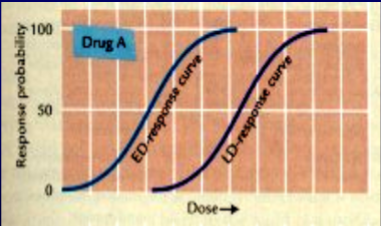
Dose-Response Curve
• Effective Dose 50 (ED50)
– Drug dosage for effective response in 50% of the sample
• Effective Dose 99 (ED99)
– Drug dosage for effective response in 99% of the sample
• Lethal Dose 50 (LD50)
– Drug dosage for lethal response in 50% of the sample
• Lethal Dose 99 (LD99)
– Drug dosage for lethal response in 99% of the sample
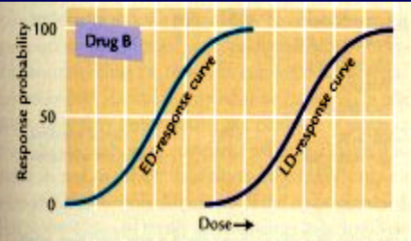
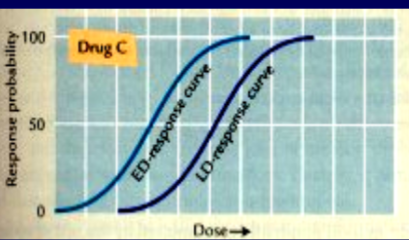
Drug B is most common for OTC medications
Drug C is the most lethal because the curves overlap too much
Therapeutic Index
• Determine the ratio of lethal dose to effective dose. It suggests drug’s toxicity
• Therapeutic Index = LD50/ED50
The dose needed to reach ED50 should be lower than the dose for LD50
The numerator (LD) should be greater than the denominator
The lower the index or margin of safety the more toxic it is
A therapeutic index of 1.7 vs 102 vs 53 - 102 is the safest medication
• The amount found to incur a 50% chance of dying relative to the amount effective for half of the population.(assumes half of the population dies)
• THIS IS TOO HIGH OF A CHANCE FOR DEATH!!!
Margin of Safety
• Margin of Safety = LD1/ED99
• The amount that would be effective for 99% of the population to incur a 1% chance of dying.
Drug B would be 5 / 6 (LD1 = 5 & ED99 = 6)
• These ratios are easier to calculate for prescription drugs than street drugs.
Can be lower than 1 and still be safe
The ED99 is usually the dosage prescribed
Drug Tolerance
• Ability of the drug dose to gradually diminish its effect on the user as the drug is taken repeatedly (caffeine, nicotine, etc.).
• Problem? - Increased dose vs. Lethal dose
• Also - what one person takes compared to a nonuser can have very different effects.
• Therefore, the number of times a person regularly takes the drug impacts tolerance.
• Behavioral Tolerance: The environment the user is in can impact tolerance.
At a party vs. study environment
• Metabolic Tolerance: over time the liver can increase the breakdown of a drug if taken regularly.
The body adapts to caffeine or drug breakdown and does it quicker
• Cellular Tolerance: Receptors will up-regulate (increase receptor #) or down-regulate (decrease receptor #) if too little or too much drug is taken over time.
Drug Dependence
• Physical Dependence: Person develops physical symptoms during withdrawal from drug.
• Drug has become normal part of physiological environment.
• These withdrawal symptoms are typically opposite of drug’s effects.
Taking blood pressure medication that decreases BP, and when taken off, blood pressure may increase (rebound hypertension)
• Psychological Dependence - Person attempts to avoid the withdrawal difficulties and feed the craving, or desire, for the drug.
• Substance Dependence: Person with significant signs of a dependent relationship
upon a drug.
• Substance Abuse: Person who continues to take a drug even when the drug (or drug- taking behavior) is creating specific problems for the user. Creating a physical and/or psychological problem.