Chapter 8: The Media
The media
The media is made up of different communication formats that provide information to the public
There is media that uses the public airwaves such as television channels and radio stations
There is printed media such as newspapers
Recently, social media has been playing a more important role in getting information out to young(er) people
Because of the internet, the number of choices available to find information has increased greatly
The media is a business
Telecommunications Act of 1996 allowed for consolation of media companies
Few companies own majority the majority of newspaper with a daily circulation
Some argue it was necessary, others argue it is a threat to free speech
In 1996, there was reform that made it possible for fewer companies to own several media companies. {Some see this as a threat to free speech.}
Media and partisanship
Media landscape is increasingly focused on reaching certain types of people
Example: Fox News-Republicans, MSNBC-Democrats
Media viewed as being biased
In particular, many conservatives feel that the media is biased against them
What does the media do?
Public Watchdog
Watergate scandal role of Bernstein and Woodward (journalist) and Mark Felt (informant)
Agenda setting: The media’s ability to choose which issues or topics get attention
Priming: ”when media coverage predisposes the viewer or reader to a particular perspective on a subject or issue. If a newspaper article focuses on unemployment, struggling industries, and jobs moving overseas, the reader will have a negative opinion about the economy”
Framing: “choosing the way information is presented. Framing can affect the way an event or story is perceived. Candidates described with negative adjectives, for instance, may do poorly on Election Day”
The media needs to provide us with accurate information
Help us distinguish what is true and what is not
Government and politicians often have a complicated relationship with the press
{The media can act as the fourth branch of government }
Media around the world
Most nations began with government-operated broadcast media
Most democratic countries introduced public stations owned by the government, funded through taxes
BBC
Berlusconi family controls Italian television, Silvio Berlusconi four term prime minister
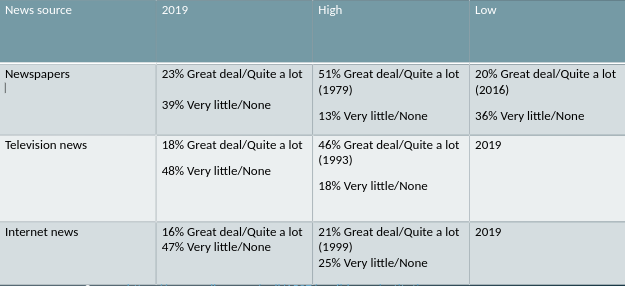
Confidence in News
Depiction by the media