Government intervention in markets
Indirect taxes are taxes on expenditure. Used to discourage the production or consumption of a demerit good or service
Indirect taxation graphs : Ad valorem
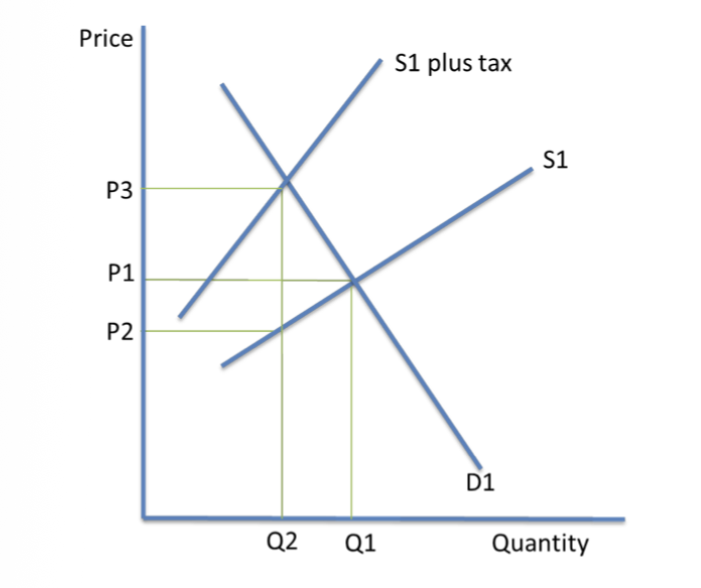
Incidence of the tax depends on the price elasticity of demand of the good.
Consumers could pay the whole tax (P3-P2) or producers could pay part of it if they feel this would lower sales so may pay (P1-P2) and consumers might pay (P3-P1)
This should discourage consumption of the demerit good and reduce negative externalities.
Government revenue from ad valorem taxes is larger if demand is price inelastic. Since demand falls only slightly with the tax
Indirect taxation graphs: Specific taxes- a set tax per unit, such as the 58p per litre fuel duty on unleaded petrol
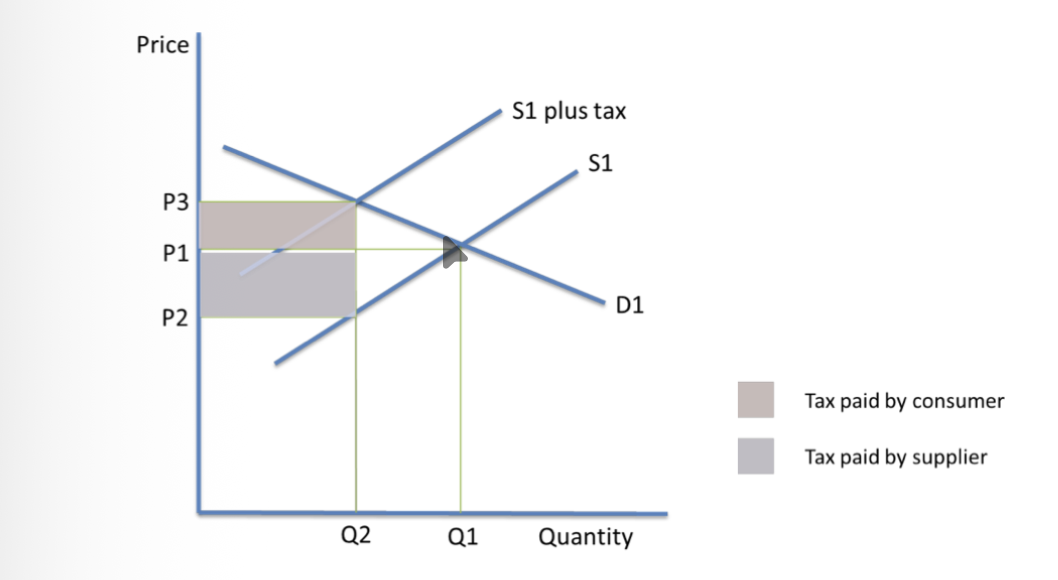
The more inelastic the demand, the higher the tax burden for the consumer, and the lower the burden of tax for the producer.
Indirect taxes internalises the externality
If tax is equal to the external cost of each unit, then the supply curve becomes MSC rather than MPC so the free market equilibrium becomes the socially optimum equilibrium
Subsidies
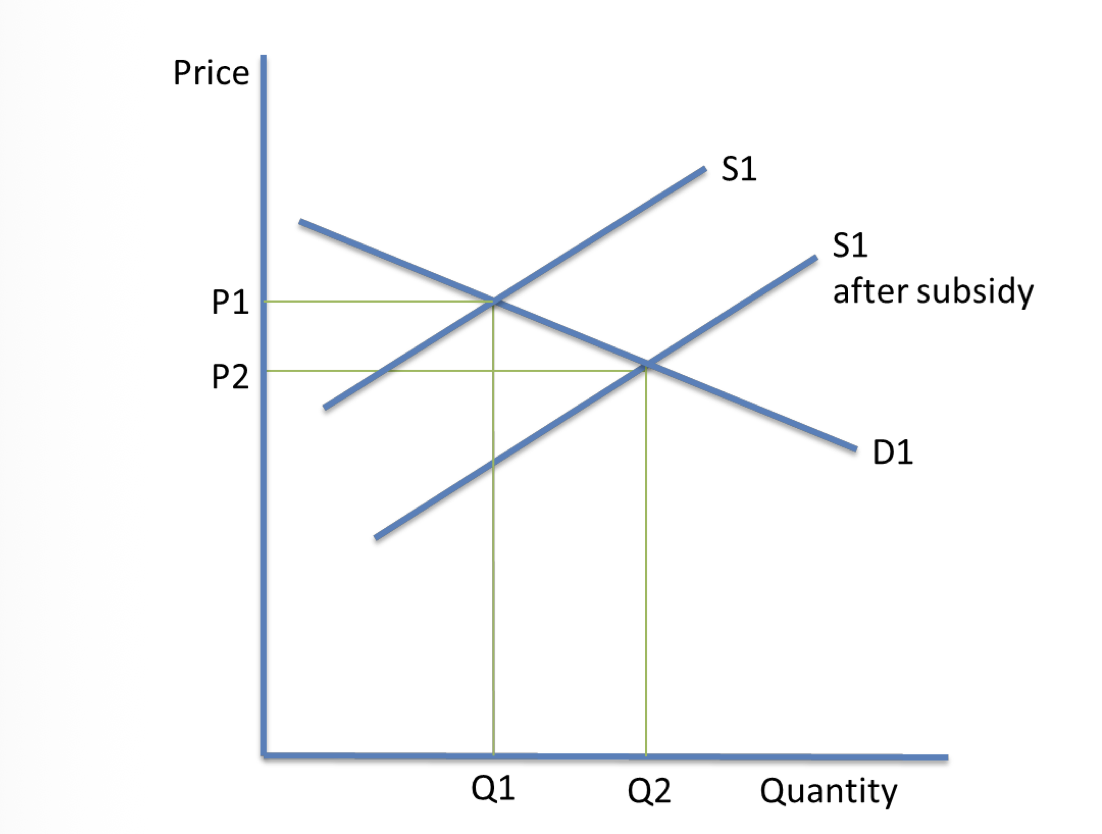
Subsidies encourage the consumption of merit goods. Full social benefit in the market price of the good. The external benefit is internalised.
The government might subsidise recycling schemes so its cheaper for consumers to recycle waste
Supply curve shifts to the left. More of the merit good is produced and the price falls from P1 to P2.
Vertical distance between the supply curves shows the value of the subsidy per unit
Producers supply more when demand is price elastic
Maximum and minimum prices
Maximum price
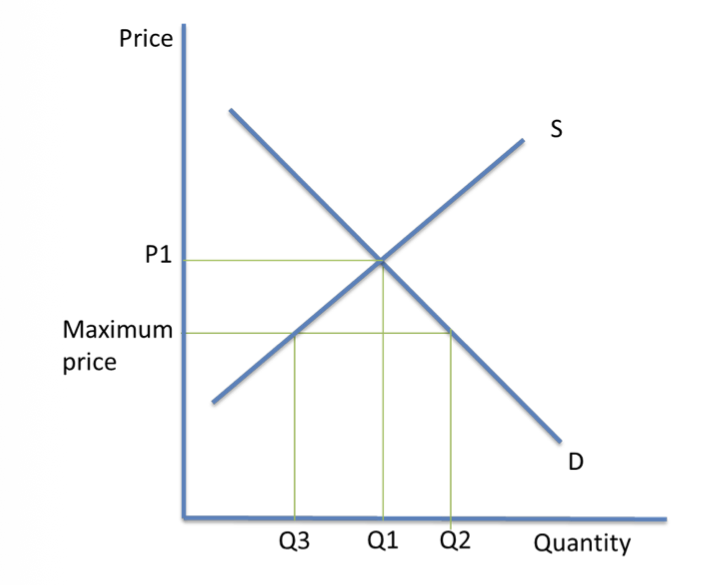
Maximum prices have to be set below the free market price, otherwise they would be ineffective.
The free market equilibrium is at P1, Q1
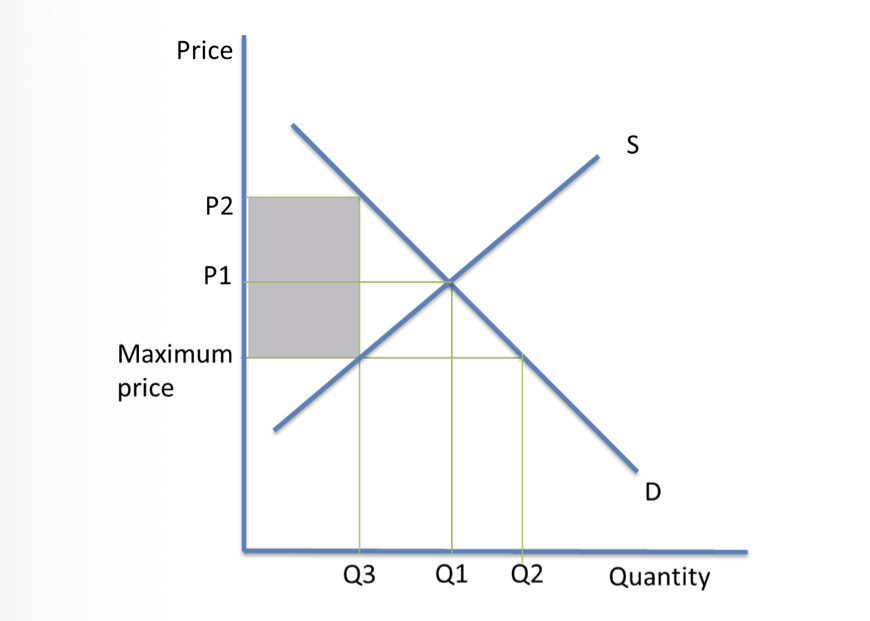
Shaded area shows the consumer surplus producers can take with the higher price. A quantity of Q3 would require rationing or auctioning since qd is Q2.
Maximum prices could
control the market price, this could lead to government failure
lead to welfare gains for consumers by keeping prices low and increase efficiency in firms
could reduce a firm’s profits. Moreover, firms might raise the prices of other goods.
Minimum price
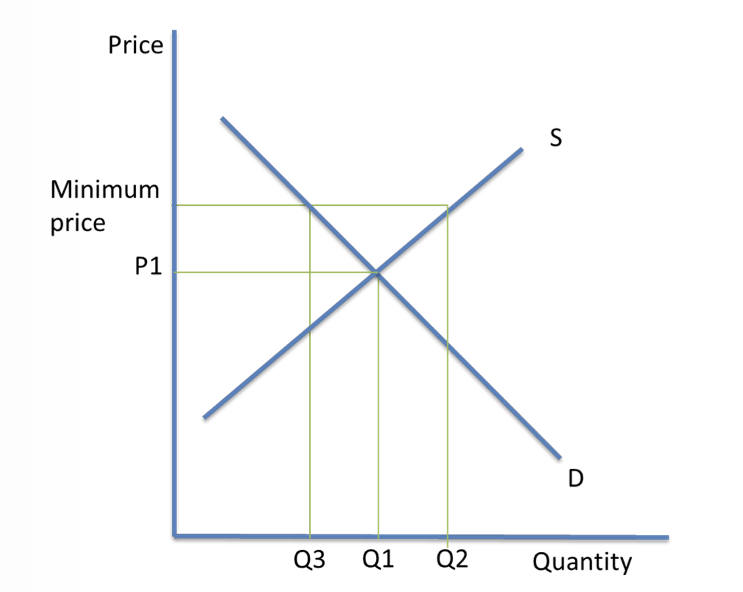
Diagram suggests that a minimum wage leads to a fall in the employment rate (Q1-Q3). -depends on what level the wage is set
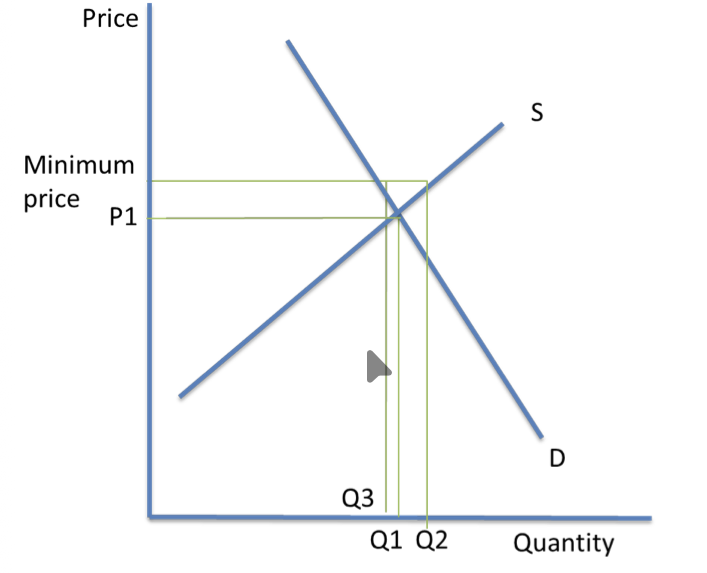
Minimum price will yield the positive externalities of a decent wage, which will increase the standard of living of the poorest and provide an incentive for people to work.
Other methods of government intervention
Tradeable pollution permits
—Could limit the amount of negative externalities, in the form of pollution, created in industries. Firms will be allowed to pollute up to a certain amount and any surplus on their permit can be traded
-Firms can buy and sell allowances between themselves
Advantages
-This should benefit the environment in the long run, by encouraging firms to use green production methods
-Government could raise revenue from their permits because they can sell them to firms, Revenue could be reinvested in green technology
Disadvantages
-Could lead to firms relocating to where they can pollute without limits, will reduce their production costs
-Firms might pass the higher costs of production onto the consumer.
State provision of public goods
-The government could provide public goods which are underprovided in the free market, such as education and healthcare. These have external benefits.
-This makes merit goods more accessible, which might increase their consumption and yield positive externalities.
Provision of information
-By providing information, governments can ensure there is no information failure, so consumers and firms can make informed economic decisions.
Regulation
-Government could use laws to ban consumers from consuming a good. They could also make it illegal not to do something. (e.g. Minimum school leaving age means full time education until 16 years of age)
-Positive externalities in the form of a higher skilled
-Compulsory recycling scheme would make it difficult to police and there could be high administrative costs.
-Firms which fail to follow regulations could face heavy fines which acts as a disincentive to break the rule
-It could raise costs of firms , who might pass the higher costs to consumers