AP World History Final (600 CE- 1750 CE)
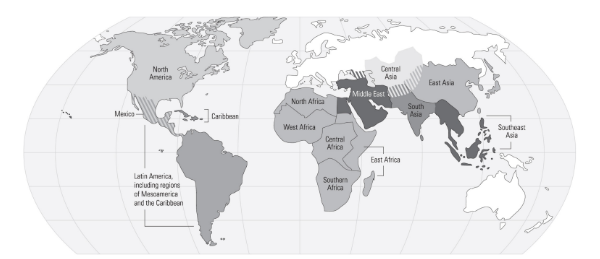
[[Civilizations/regions:[[
- Southwest Asia (Middle East)
- Persia (Middle East, Northeast of Africa)
- Sahara (North Africa)
- Mesoamerica (Southern Mexico)
- Andes (Western South America)
- Indian Ocean (East of India)
- Pacific Ocean (Western Americas, Eastern Asia)
- Atlantic Ocean (Eastern America, Western Africa)
- Mediterranean Sea (Northern Africa and Southwest Europe)
- Iberian Peninsula (Southwest Europe, modern-day divided between Spain and Portugal)
- Italian Peninsula (Southern Europe, small little “shoe-sized” land near Africa)
- Balkans (Southeast Europe, east of Italy)
- Malacca (Southeast Asian Islands, South of Thailand and East of India)
- Baghdad (capital of Iraq, Middle Eastern)
- Tenochtitlan (Capital of Mesoamerica, Southeast Mexico)
- Timbuktu (Northwest African city, capital of Mali)
- Mecca (Between Africa and Southwest Asia)
- Hangzhou (Eastern Chinese state)
- Chang’an (Northeastern China)
- Venice (Capital of Italy)
- Swahili City-States (East African)
- Cordoba (Islamic capital of Spain)
- Cuzco (Northwest South America)
{{600 CE- 1450 CE (The Post Classical Period){{
}}China}}
- Hangzhou
- capital of the Song dynasty
- 13th century
- center of trade
- access to oceanic and maritime trade routes
- Large port city (silk road) where people could exchange goods, culture, and ideas
- Chang’an
- Significant stop in the middle of Silk Road trade route
- crossroad between China, Central Asia, and Middle East
- Sui Dynasty
- 581-618 CE
- unified North and Southern China after period of disunity
- Emperors Wen, Yang, Gong
- Capital was Chang’an
- Created Great Canal
- Continue building Great Wall using labor force from prisoners of war and peasants
- Fell after wars, destruction, heavy taxes, and revolts
- Created the civil service exam system with Confucian ideals
- Filial piety continued to play a huge role
- Buddhism firmly established: Buddhist monasteries and temples promoted religion to commoners (mostly still Confucian)
- Tang Dynasty
- 618-907 CE
- Golden Age for China (dark age for Europe)
- Largest cities: Chang’an and Xi’an
- Emperor Gaozu, Taizong, empress Wu, and emperor Xuanzong
- Civil service exam to elect officials
- mostly landowners, exception to some commoners whose family was able to afford education
- Mostly middle class men/boys
- meritocracy (based on talent and intelligence rather than aristocracy)
- invention of block printing (because of demand for textbooks)
- Rejected Buddhism (made monks and monastery owners pay taxes)
- Expanded empire with military, trade, and diplomacy (international relations)
- Song Dynasty
- 960-1279 CE
- Stable transition because of Mandate of Heaven, transportation, communication, exports, urban center
- Also part of the Golden Age (notable inventions: Ceramics, printing, gunpowder, medicine, ships (junks), navigation technology (compass), paper money)
- %%Champa rice (LOOK THIS UPP!!!!!!)%%
- NEO-CONFUCIANISM (syncretic religion combining Buddhist and Confucian principles)
- Significant population growth, most urbanized region at the time, used paper $, had letters of credit/ promissory notes (check)
- Tribute system
- China’s mentality of “middle kingdom” (saw selves as superior compared to foreigners)
- didn’t borrow much from others (especially culture and religious ideas)
- Made others pay tribute to China in order to gain access to goods
- allowed some foreigners to also gain prestige
- Imperial bureaucracy
- Civil service examination to select loyal and trustworthy candidates based on knowledge
- Foot binding
- Practice continued until 20th century
- Women forced to wear tight shoes to deform feet (beauty standard of the patriarchal system)
}}Japan}}
- Influence from China
- voluntary and selective borrowing from China
- Sent merchants to China to bring back goods, cultures, and ideas
- Still had a unique culture
- Shintoism (religion)
- ancient belief that there’s purity and spiritual powers
- good vs. evil concept (purpose is to keep away evil spirits)
- Heian (Golden Age)
- 794- 1185
- Emperor moved capital to Heian-kyo
- Heian means peace
- period when art, poetry, and literature flourished
- Shotoku Taishi
- Imported Chinese scores, art, texts, and other stuff
- Brought Confucian and Buddhist ideals into Japanese government
- Encouraged the building of Buddhist temples
- Sent travelers to China to bring back items and ideas from them
- Gender roles
- Women wrote books during time period
- Restricted with little freedom during feudalism
- Japanese emperor
- belief that emperor cannot be overthrown because descendant from the Sun God
- Japanese Feudalism (1100s)
- Lords raised private armies for more power
- imperial government weakened
- emperor’s power decreased, lord’s power increased
- Shogunate Shogun
- kingdom to king
- The Social Hierarchy (Daimyo, Samurai & Code of Bushido, peasant class)
- Shogun: most powerful lord
- Daimyo: noble landowners/lords
- Samurai: Skilled warriors (fought for shogun)
- Followed Code of Bushido (way of the warrior)
- Peasant class: worked on land owned by lord or Buddhist monastery
- payed taxes
- unable to pay: became genin (homeless laborers) who were essentially slaves (could be bought and sold)
}}Korea}}
- Chinese invasions (Goguryeo- Sui War)
- 598- 614 CE
- Sui dynasty expanding their territory
- Result → Sui dynasty lost the Mandate of Heaven
- Tang and Goguryeo's relation
- Tang took over the dynasty
- split land in half w/ southern Korean dynasty (Silla)
- Maintained relative autonomy (with distinct culture and language)
- Held Korea’s golden age
- Koryo Dynasty
- 10th century CE
- gained power in Northern Korea (used to be under Tang control)
- Modeled government after Chinese ideas
- Collapse after Mongol takeover (13th century)
}}South Asia}}
- Heavy influence by/on trade (Indian ocean and Silk Road)
- Diffusion of Confucianism, Hinduism, Buddhism, and Islam
- Indian alphabet used to create other languages in Southeast Asia
- Caste system (varnas)
- religious authority
- Belief that people are in the caste that they deserve because of karma in the past life
- Indianization
- (Similar to Americanization) spread of Indian culture while changing others cultures into an “Indian version”
- Rajput Kingdom
- Mostly Hindu Warriors
- Contained many fighting clans
- fought against Muslim invaders
- Delhi Sultanate
- Taken over by Islamic leaders
- controlled/main people of Indian Ocean trade
- Afghan Turks (Afghanistan)
- took gold and jewels while destroying Hindu temples
- Vijayanagar Empire
- Hindu dominated
- grew as a result of the Muslim empire up North
- Rajput kingdoms and other smaller states also here
- Bhakti movement
- shift in devotion to personal god (similar to what Sufi Muslims preach)
- believed to have grown as a result of growing Islamic Empire
- spoke against the Indian caste system
}}Southeast Asia}}
- Indian culture’s impact
- Cultural borrowing was voluntary
- Still had differences in some practices (e.g. women in Southeast Asia less restricted than in South Asia)
- Khmer Kingdom of Angkor
- Contains the most significant Hindu temple, Angkor Wat
- exported forest products in return for Chinese and Indian handicrafts
- Srivajaya Empire
- Major center of Buddhist teachings
- Many Hindu temples and Buddhist monuments (e.g. Borobudur)
- connection between trade and state building
- Contained lost of gold and spices → attracted many traders
- Combined Indian political ideas and Buddhist religious concepts
- had many Bodhisattvas- Buddhists who help others reach nirvana
- Majahapit Kingdom
- Located in Eastern Java
- Indianized kingdom
}}Islamic World}}
- About Islam (religion)
- Founded in 600s (7th century)
- Monotheistic (god is Allah)
- Impacted by monotheistic religions Christianity and Judaism
- Abrahamic religion (followers of Islam are children on Abraham)
- Muhammad is the seal of prophets
- was a religious and political leader
- founder of Islam
- Had a spiritual awakening
- Troubled by the corruption of Mecca, his hometown
- Quran is their sacred text
- Belief that it has the words of Allah
- translated and written by Muhammad’s followers
- Challenged Arab clans and practices of Mecca (inequality especially towards women and orphans)
- Hadiths
- sayings of Muhammad that were translated and written by his followers
- very patriarchal (blamed women for everything)
- 5 pillars of Islam
- actions required by all Muslims (followers of Islam)
1. Allah is the only god 2. Pray 5x a day 3. almsgiving- give to the poor and needy 4. Ramadan- self-purification by fasting and pure intentions 5. Hajj- reenact events in Islamic history (event) * sometimes 6. jjad/jihad (struggle) by fighting against greed and selfishness
- Mecca
- Quraysh families took control
- Arabs lived with Christians, Zoroastrians
- Place where Muslims visit at least once in a lifetime, part of five pillars of Islam (Jjad)
- Idolatry practices forbidden (practice of worshipping an idol)
- Kicked Muhammad out after his disloyalty
- Medina
- Where Muhammad and his followers settled after being kicked out
- Hijra: 622 CE- Beginning of the Islamic calendar, also the day Muhammad came to Medina
- Muhammad was in charge (tax-free environment, payment for the poor)
- Islam declared as independent from Judaism → Some Jews allied with enemies and others remained loyal
- Expansion of Islam
- Started in Arabia (Byzantine Empire/Rome and Sassanid/Persia)
- Many Arabs joined in 632 CE
- Muhammad turned many gods into one god in Mecca (630 CE)
- Expanded everywhere in Afro-Eurasia for empire building (cultural and political)
- Dhimmis (people of the book)
- people who practice any Abrahamic religion (Christianity, Judaism, Islam)
- had more freedom but still had to pay Jizya (special tax for non-muslims)
- Conversions
- most converted for convenience (Familiarity, helped with trade, avoid jizya, higher up social hierarchy)
- Spain (1000) 1st wave
- al-andalus (place with Islamic encounter)
- Cordoba- capital of Muslim Spain
- used to have harmony, religious tolerance, freedom of worship
- Later turned into violence and intolerance
- Back to peace when people did stuff (Muslims and Jews driven out)
- Anatolia (1000)
- Turkic speakers invaded Anatolia (Christian and Greek dominated by Byzantine Empire)
- Destroyed monasteries, forced taxes and clothes, discrimination against Christians
- 1500 had powerful Ottoman empire
- Had many conversions
- Distinct Turkish religion still remained
- West Africa (1000)
- brought peacefully through traders and merchants
- many converted for the sake of commerce
- Created an African version of Islam
- Many mosques, Quranic schools, and libraries created
- Many Africans turned called themselves Arab Muslims
- African religions still continued
- India (1000)
- Turkic-speakers brought Islam faith
- destroyed temples and took treasures
- many conversions but majority of India remained Hindu
- Sikhism formed with concepts from Islam and Hinduism
- Sunni Vs. Shia
- debate on who should be the next successor of Muhammad
- Sunni- next leader should be chosen by the Islamic community
- Shia/Shiites- next leader should be a relative of Muhammad
- Many revolts and fighting as a result
- Sufis and Sharia
- Sharia- Scholars who talked about every aspect of life
- Sufis- focused more on teachings of law and behavior
- coexisted peacefully
- Sufis were majority
- Dar al-Islam
- abode of Islam (territory led by Islam/Islamic world)
- Umma
- community of Muslims
- Ummayad Dynasty
- 1st dynasty in Islamic World
- Capital from Medina → City of Damascus
- resisted by Shia and non-Arab Muslims
- Abbasids
- Overthrown Ummayad dynasty (750)
- new capital in Baghdad where non-Arabs had a prominent role
- Got divided into separate sultanates in 1258 (Persian and Turkic Dynasties)
- House of Wisdom- used during the Golden Age
- Commerce
- Many areas became Muslim and Arab
- Main people of Afro-Eurasian trade (silk road and Sahara)
- long-distance relationship with China
- Golden Age (13th century)
- House of Wisdom- research and translation of texts
- Technology- paper making, mills
- Added onto Indian and Greek teachings (Algebra, astronomy, disease treatment, 1st hospital)
- Arab medical scholarships
}}Pastoral/Nomadic People}}
- Characteristics
- smaller populations
- more egalitarian (still has hierarchal relationships)
- higher mobility
- Seen as barbarians by sedentary societies
- needed/wanted items from other societies → traded with agricultural neighbors
- exceptional horseback riding and hunting skills
- survived in environments unsuitable for agriculture
- Created technology related to horseback riding (e.g. harness, saddle, compound bow, armor, types of swords)
- great ability to extract wealth from agricultural civilizations
- Xiongnu
- from Mongolian Steppes north of China
- centralized and hierarchal political system
- took tribute from other nomads and China
- Forced Chinese emperor to see them as equals
- influenced other pastoral empires (Arabs and Turks)
- Arabs
- first and most dramatic pastoral invasions
- Effective fighters with developments of camel saddles
- Controlled trade routes along Arabia
- Aided Islam expansion with followers and military force
- Turks
- Located in Central Asian Steppes (Mongolia and Southern Siberia)
- Invaded Abbasid territory and took over Baghdad (1055 CE)
- Converted to Islam (10th to 14th century)
- 3rd major carrier of Islam
- Created Seljuk Turk Empire (11th to 12th century)
- created Ottoman Empire (1500)
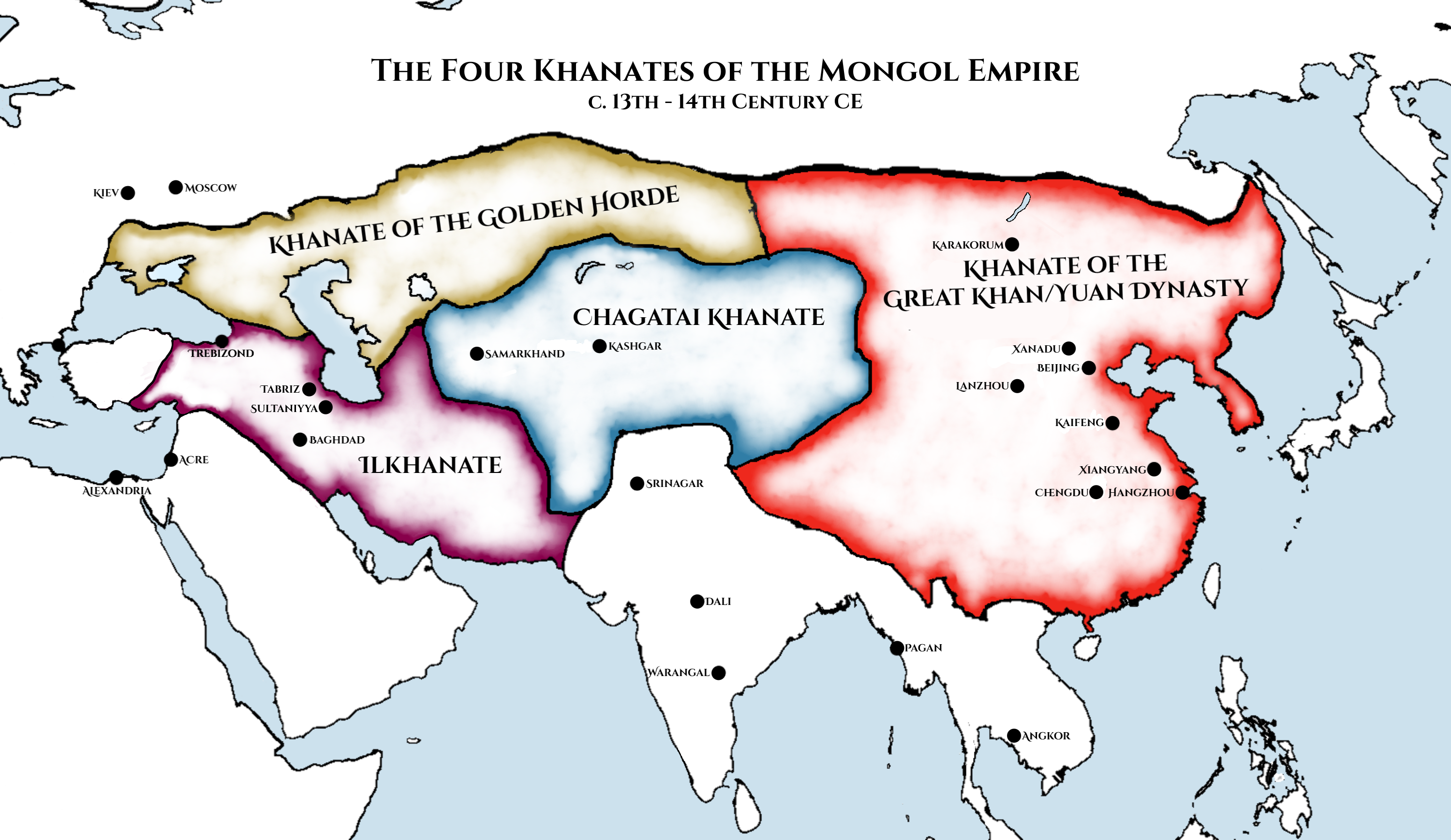
- Mongols (13th to 14th century)
- Leader: Temujin/Genghis Khan
- Gained military victory within tribe → became a chief
- given the name Genghis Khan (Supreme leader)
- Wanted to maintain unity without chaos → Expanded towards China to grow wealth
- Setbacks
- Withdraw from Europe after death of their leader (1242)
- Defeat in Palestine (1260)
- Failed to conquer Japan after Typhoon (1281)
- How they became successful
- Disciplined and loyal army (often created by threats)
- Received outside help
- Human and material resources
- prestigious imperial guard
- Chinese invasions
- North had more destruction, South had more accommodation
- unified a divided China
- Some believed Mongols had the Mandate of Heaven
- Wanted to extract wealth
- had harsh rules (bribes, executions, violation of women)
- Retained many traditional ways of life (e.g. Role of women was different)
- Ended mid 14th century because of increasing prices, factionalism (splitting society into different groups), plague, and peasant rebellions
- Yuan Dynasty
- Last Mongol invasion in China
- leader- Khublai Khan
- Inspired by Chinese culture → changed to Chinese dynastic title
- transferred capital in Beijing
- Supported Daoism and Confucianism → got military support
- Persian invasion
- Taken over by Genghis Khan and later his grandson
- abrupt and destructive takeover
- Sacked Baghdad (1258) → ended Abbasid
- Damaged agriculture (herds and fail to maintain underground water)
- heavy taxes → lost land
- wine and silk brought for economy benefit
- Many Mongols converted to Islam
- Some took up agriculture and married locals
- “Collapsed” in 1330 by assimilating into the society (blended in)
- Quick return to patriarchal ways
- Russian invasion
- 13th century
- had many princes and disunity before Mongol takeover
- Violent invasion
- no settlements
- had little to offer → not worth occupying
- heavy tribute (tax system)
- Church flourished
- Moscow became leading role in trade
- Didn’t adapt to Russian way of life
- Russia adopted to Mongol practices (e.g. weapons, court practices, courier service, military)
- Internal divisions and plague → devastating impact
- Economy impact
- encouraged international commerce
- created a safe environment for journey (pax-Mongolica)
- benefited merchants
- monopolized Silk Road
- Europe became more aware of the wider world
- Chinese technology and artistic conventions went westward
- Muslims adopted Chinese medicine techniques and astronomy
- many plants and crops got exchanged
- Bubonic plague (14th century)
- Began in Northeast China, flowed westward to Europe (1347)
- 50-90% of the population got wiped out in Eurasia
- Decline of trade
- Growth of Western Europe
- Labor shortage → lower-class revolts
- technological innovations
- more job opportunities for women
}}Africa}}
- Overall had less restrictions on women (also matrilineal)
- Saharan Desert
- Separated North Africa from Sub-Saharan Africa
- place of Trans-Saharan Trade
- Trans-Saharan trade brought new ideas with items to West African region
- West African Kingdoms
- great demand of salt because it’s an important spice and preservative
- Ghana (Awkar)
- Heavily involved with trade in 500 CE
- Contained tons of gold and salt → kings taxed and controlled gold trade
- Traded with berbers (North African nomads who used camel caravans) and Arab merchants in North Africa for Mediterranean items
- 900s CE elites converted to Islam to have a better relationship with Muslim traders
- Northern berbers and other tribal groups took down Ghana empire
- got absorbed into other West African kingdoms (especially Mali)
- Mali
- Most people engaged in agriculture
- participated in trans-saharan trade for gold and salt
- controlled and taxed trade within the territory
- honored Islam (encouraged conversions but didn’t force)
- Provided protection for traveling merchants
- Mansa Musa (1312-1337 CE)
- went on a pilgrimage to Mecca (hajj)
- created inflation because of distributing so much gold during his journey
- built libraries, Islamic schools, and mosques in his kingdom
- Timbuktu became the political capital and cultural center of Islamic scholarship and art
- Songhai Kingdom
- Captured Timbuktu in 1464
- Last and largest Western African Kingdom
- Also grew rich from trading
- Muslim kingdom
- only lasted 100 years (fell in 1597)
- Invaded by Moroccan warriors (gun as weaponry changed history) and never united again
- Northeastern African Kingdoms
- Arab travelers spread Islam → many converted
- Christianity endured (especially in Egypt and Ethiopia)
- Egypt had coptic Christianity even while Islam has been introduced
- East African City-States
- Many spoke Bantu languages
- did not politically unite to form a kingdom
- many city-states emerged because of participation in Indian Ocean trade with Muslim merchants
- Swahili City-States
- Swahili language developed (mixture of Arabic and Bantu)
- kings governed and converted for legitimacy (but not completely separate from their own religion and culture)
- built mosques and buildings
- major city/connection in Indian ocean trade
- Southeastern African Kingdoms
- Zimbabwe
- Participated in trade with Eastern city-states
- became city with stone towers, palaces, and public buildings (great Zimbabwe)
- Prospered between 1300-1450 CE
- NOT a Muslim state (practiced Christianity)
}}Worlds of Christendom}}
- The Great Schism
- Led to the division of Eastern and Western Europe
- Development of Eastern Orthodox Church and Western Roman Catholic Church
- Pope and Patriarch excommunicated each other
- Byzantine Empire (Eastern Europe)
- Stronger, eastern half of Roman Empire turned into Byzantine Empire
- Emperor Justinian failed to conquer Western Europe but came up with a successful law code (foundation of Byzantine’s political system)
- Latin got replaced with Greek as the official language
- Eastern Orthodox Church (fought with Western Europe)
- strong central government and bureaucracy
- emperor appointed the church’s patriarch and had authority over the church (caesaropapism)
- free peasants received land in return for military service
- Position along Mediterranean Sea and between Asian and European crossroads → provided tons for trade
- Developed a silk industry and artisans produced lots of products
- Constantinople was the capital and intellectual center
- Contained the Hagia Sophia (most significant Byzantine art and architecture)
- little social mobility (but still able to change through army, trade, or church work)
- Theocracy (emperors controlled politics and church)
- Eastern Orthodox trade impacted Slavic people and Russia
- Kievan Rus (Russian prince) chose Orthodox Christianity as official Russian faith
- Wanted to preserve past Greek texts and transmitted them to Islamic World
- Western Europe
- Politically decentralized
- small feudal kingdoms
- Religiously centralized (Roman catholic church)
- Latin was the main language
- Fought with Eastern Europe (Orthodox Christianity)
- Belief that pope gave authority and was the leader
- Little access to Greek thought before 1000
- many texts in the 12th and 13 century were translated to Latin by Muslims in Spain
- Feudalism
- Vassals and lords compete for power
- constant instability, European social, economic, and political system of the Middle Ages
- Strict hierarchy and fixed class from birth (king, nobles, knights and vassals, Peasants/serfs
- Lord given land = provided military service
- Peasants protected = have to work for lord
- manors (lord’s house where peasants live near) were self-sufficient (produced what was needed to survive)
- Lord’s power was greater than ruler’s power
- Code of Chivalry developed (Similar to Bushido in Japan but more of an ideal that conduct)
- Three-field crop system (where crops rotate based on the season) was invented to help manors succeed
- Plague impact
- Labor-shortage → workers demand higher wages
- Peasant rebellions → weakened feudal system
- Antisemitism increased → Jewish communities were massacred
- Christians question faith
- Self-flagellation (whipping oneself) grew so people could atone for their own sins
- Church lost much of their clergy
- proper education and literacy decreased
- Crusades
- Effort to take back the holy land that was taken over by Muslims
- initiated by the pope
- military campaign that temporarily united catholic and orthodox
- many crusades failed
- Ended up further splitting Western and Eastern Europe
- Growing Anti-semitism
- most of the regions remained in Muslim hands
- More trade and exchange
- Western Europe got “rediscovered”
- After first Crusade, they captured Edessa, Antioch, and Jerusalem, and divided it further
- Reorganized Muslim forces took back Jerusalem in 1187 CE
- Ottoman Empire captured and conquered the capital of Constantinople which weakened the Byzantine Empire
- Vikings
- Nomadic group who settled in present-day Scandinavia to supplement their farm production
- raided many Western European countries by using small boats
- traded throughout the North Sea and Baltic Sea
- Colonized Iceland and Greenland in 800s CE
- Established a colony in Newfoundland/ modern-day Canada (North America) but was short-lived
- Norman lord from France invaded England and defeated the Saxons in 1066 CE (modern-day Britain)
- Normans and Vikings later Christianized and assimilated into Europe
- Germanic tribes
- tried to reunite what was once a centralized Roman empire (but failed)
- Balkan peninsula (East)
- crossroad of culture between Latin and Greek
- European provinces of the Ottoman Empire
- Iberian peninsula (West)
- recaptured territory from Muslims (Reconquista)
- crossroad of Christian, Arab, and Jewish cultures
- Italian peninsula (Between Balkan and Iberian)
- Major trade center in the Mediterranean sea
- Emergence of the Renaissance and Roman Empire occurred here
}}The Americas}}
- Overall facts
- hereditary society
- Rigid social class (Chief/king, priest, nobles, merchants, artisans, slaves)
- matrilineal society but still patriarchal
- animistic/polytheistic
- religious sacrifices
- women could be priests
- Agricultural practices were distinct/unique to climate
- environmental variations and geography limited trade connections (mountains, forests)
- Dugout canoes for travel and trade
- used terrace farming and slash and burn agriculture
- Trade in the Americas
- Local and regional commerce flourished (Cahokia, Mesoamerican trade, Andean trade)
- More active within region than between regions (compared to Afro-Eurasia)
- no horses, camels, wheeled vehicles, large ships
- geographical obstacles (e.g. Panama strait)
- Loosely interactive web of Great Lakes (Mississippi → Andes)
- Most traded luxury goods (similar to Silk Road) like feathers and jewels
- Privilege of royal determined status
- Utilized human caravans to carry goods
- Controlling access to goods → motive for war
- Mesoamerica
- strong trade route
- Formation of New World cultures
- Taken over by Mayans and Aztecs
- **Teotihuacan
- one of the largest cities in the world
- major center of trade
- contained large monuments
- Andes
- Located in Western South America
- located near high peaks
- domesticated plants
- most important crop: maize
- Maya
- In Mesoamerica
- Decentralized city-states each with their own king
- created a writing system
- concept of zero
- advanced astronomy
- more accurate calendar than Europe
- Aztecs
- In Mesoamerica
- Capital- Tenochtitlan
- had an expansionist policy
- Chinampas used for effective agriculture (floating gardens)
- had Pochteca (professional merchants)
- engaged in large-scale trading missions
- Inca
- In Andean Region
- state-run economic exchange (no specific group of merchants like Pochteca emerged)
- used Quipus for record keeping
- had a 20,000 mile Incan Road system
- used for the transfer of goods and information without using wheels
- Cahokia
- Mississippian culture (about 400 to 1250 CE)
- near Illinois and Missouri
- 1st large-scale civilization in North America
- Pueblo People (other societies): Choco, Mesa Verde (Southwest)
}}Trade- Diffusion, and Syncretism}}
- Silk Road Trade
- mostly traded luxuries (and determined status for elites)
- Relay trade
- connected agricultural societies to pastoral societies
- China, central Asia, Indian, Middle East, Mediterranean had many goods
- high transportation cost
- Trade interactions were greater than ever before in the 3rd wave
- uneven good distribution → exchange
- Chinese first had silk, then others had it
- worked best when connected by a large empire (Byzantine, Rome, Han, Mongols)
- merchants supported Buddhist monasteries
- use of camel caravans and caravanserais (also yokes, saddles, stirrups, horses, and oxens)
- less self-sufficiency (started to produce goods for the purpose to sell them)
- women were the main labor force in textile production
- Vast spread of Buddhism and Syncretic religions
- Mahayana Buddhism
- syncretic religion in Samarkand
- Black death significantly spread through travelers and decreased trade
- altered productions (peasants farm → produce silk and paper)
- Indian Ocean Trade
- massive growth in this period (500-1500)
- monsoon winds helped with directions
- largest sea-based network
- able to exchange luxury AND common goods
- because transportation costs were less and ships could carry more
- center kingdoms
- Swahili states
- Sultanate of Malacca
- Delhi Sultanate
- Srivijaya
- Southeast Asian spices (spice islands)
- Arabian incense, gold, and silver
- economic and political revival of China
- Mostly peaceful trade (not controlled by political entities, mostly merchants)
- emergence of Islam = increased trade and connections
- African slaves more important
- many people converted because of the benefits
- Malay peninsula port cities competed for control
- Growth of East African city-states (Swahili city-states)
- Islam dominated the region
- astrolabe, compass, Chinese junks (large ships)
- Trans-Saharan Trade
- North Africa and Mediterranean within interior of Africa
- West Africa export gold for salt
- North Africa had salt and copper
- Sub-Sahara had crops
- Middle East gave horses and doth
- major route of exchange for the FIRST TIME
- more hierarchy divisions = increased wealth
- introduction of camels (main source of transportation)
- Different climate = different products = increased trade
- West African civilization transformed
- construction of new states (Ghana, Mali, Songhay, City-states)
- Mediterranean Trade
- Linked to larger Indian-ocean trade
- Italian city-state controlled expensive goods from Asia
- (1000 CE) Venice became the center of exchange
- Byzantine was dominant force but Italy had most success
- Important people
- Marco Polo
- met Kublai Khan
- stories abroad China
- awakened desire to trade with China
- travelled through Silk trade
- Ibn Battuta
- wanted to travel through Dar al-Islam
- contributed to view of outsiders for Muslims
- travelled mostly through Africa
{{1450-1750 CE{{
}}China}}
- Eunuchs
- Prisoners who are forced to stay loyal to the emperor
- Recovery from Plague (Ming Dynasty)
- resisted foreigners from spreading culture and beliefs into Chinese territory
- eliminated foreign rule
- resisted Christianity /Jesuits (but borrowed other practices from Europe such as mathematics)
- brought back Confucianism (stronger than before)
- moved capital to Beijing
- wrote encyclopedia for different subjects
- built Forbidden City (palace in Beijing)
- Temple of Heaven for Confucian rituals
- re-establishment of civil-service exam
- rebuilt canals, reservoirs, irrigation, billions of trees → increased trade and population
- silver used as currency (foreign countries such as Spain gave them silver in trade)
- Maritime Expeditions
- Sailors travel to the Southern China sea and Southeast Asian ports
- aided by Chinese Junk
- did not seek to conquer, spread culture, or establish Chinese settlements
- Zheng He
- Muslim eunuch who led some maritime expeditions
- tried to gain the favor of Chinese authorities
- originally wanted to bring prestige and control over Indian Ocean trade and foreign trade
- ended abruptly
- death of Emperor
- officials thought it was a waste of time (“middle kingdom” mindset)
- merchants and craftsmen continued to trade without the help of the government
- Manchu (Qing) Dynasty (1644-1912)
- final Chinese Dynasty
- invaded from the north with violence
- Manchus remained the minority group
- adopted Chinese language, Confucian philosophy, bureaucracy, and Mandate of Heaven
- rewarded Chinese and outsiders who supported their rule
- Chinese rulers allowed to keep status as long as they obey Qing rules
- tolerant of faith and local customs
- Diarchy- Major positions held by Chinese and Manchu
}}Japan}}
- social classes
- shogun → shogunate (Tokugawa) = king → kingdom
- Shogun, daimyo (samurai warriors)
- merchants travel without government support
- Tokugawa (1650-1850)
- Japan closed off the country to foreign traders
- connected only to China, Korea, and Southeast Asia
- only the Dutch were allowed (Hirado and Deshima)
}}South Asia}}
- Mughal Empire
- Babur
- founder of Mughal empire
- Muslim and Turkic invaders
- brutal conquest → rare period of unity
- many Hindu/Muslim kingdoms (e.g. Vijayanagar)
- defeated the Delhi Sultanate
- Akbar
- king of toleration (we stan)
- Hinduism and Islam allowed to be practiced openly
- eliminated Jizya (non-Muslim taxes)
- Hindus in elite class
- restricted ulama
- Hindu structures allowed
- house of worship (Muslim and Hindu temple)
- Golden Age of art, architecture, and thought
- Shah Jahan
- notable for the building of Taj Mahal (example of combination of culture)
- combined Indian, Persian, and Islamic culture
- Aurangzeb
- ended period of toleration
- destroyed Hindu temples
- pro-Muslim policies
- wars of expansion
- there was an effort to remove Jizya and remove Muslims (opposition movements)
- Zamindar- tax imposed of Hindu peasants
- Europeans
- British East Indian Company and Dutch West Indian Company
- power still in India’s hands more than Europe
- Sikhism
- 16th century
- founded by Guru Nanak
- opposed distinctions of caste and religious rivalries
- has qualities from Islam and Hinduism (monotheism and concept of karma)
- Golden temple of Amritsar
}}Southeast Asia}}
- Trade City of Malacca (Sultanate of Malacca)
- center of Islam
- spread of Islam throughout Southeast Asia
- Portuguese takeover in 1511
}}Islamic World}}
- Ottoman Empire (end of 13th century)
- 14th to 20th century
- Modern-day Turkey (Anatolia)
- founded by Osman Bey
- Istanbul- Capital of Ottoman Empire, renamed after takeover of Constantinople in 1453
- goal was to bring unity to Islamic world and protect their faith
- continued to expand westward to Eastern Europe
- encompassed Christianity, Judaism, and Islam (because of large geographical range)
- Turks now dominated people of Islamic world
- many diverse cultures evident in Bazaars
- ruled by absolute monarchs (sultans)
- Mehmed II
- majority of population become Muslim
- increased seclusion of women
- Balkans: large Christian population and more religious tolerance
- devshirme and janissary corps
- gathering/collection of Christian boys
- transformed boys (as slaves) to be loyal to sultan and military
- soldiers and officials were needed
- made sense economically and religiously (religious justification)
- threat to West declined in 17th century
- too big
- Portuguese rivals
- silver lead to inflation
- Safavid empire
- early 1500s
- leader titled Shah
- centralized state based on military conquest
- absolute monarch
- gunpowder weaponry
- peasants provide food and labor
- Shia Islam
- fell in early 1700s
- unique identity of Persian culture
- less diversity and tolerance
- fought against Ottoman empire (Sunni vs. Shia)
- Wahhabism
- mid 18th century
- Arabia
- Al-Wahhab
- Argued that Islam was becoming weak because of deviation
- Syncretism = offensive
- religious renewal and reform emerged
- School of Sunni
- Political backing from Ibn Saud
}}Pastoral/Nomadic People}}
- Timurid Empire
- Turk and warlord from central Asia (Mongol wannabe)
- huge destruction to create a huge empire
- synthesis of Islamic, Persian, Mongol, and Turkic societies
- influenced Safavids and descendants who found the Mughal Empire
- city of Samarkand was a wealthy trading center and a crossroad of cultures
- Last great military success of nomadic people from Central Asia
- homeland swallowed by Russian and Chinese empires
}}Russia}}
- after Mongols
- more distinct Russian culture
- improved Russian military and government
- Moscow is a large center for trade (important capital)
- Connection with Europe
- capital always in Europe
- influence from Byzantine Empire and Vikings
- later looked westward for technology and enlightenment
- Trade
- traded with east and west
- fur trade most significant
- lead to expansion into Siberia and North America
- gave exports (fur) that Europe and China wanted
- Yasak
- forced labor system
- used for tax/fur trade
- Social hierarchy
- little social mobility
- Tsars, boyars (large landowning class/aristocracy), merchants, cossacks (free peasant warriors, live in distant areas), peasants (later turn into serfs)
- serfdom
- decrease in western Europe but increase in Russia
- territory expansion = more peasant turn into serfs
- many cossack and serf uprisings
- Muslims faced discrimination and forced to convert
- missionary activity NOT important
- Ivan III
- end of 15th century
- refused to pay tribute
- prince of Muscovy
- named Tsar (Caesar) to link with Roman Empire
- tripled size of Russia
- Kremlin- large-scale building project that grew status of ruler
- Ivan the Terrible
- 16th century
- expands border eastward
- building of St. Basil’s Cathedral
- LOTS of death and execution (literally threw cats and dogs out the window)
- added lots of territory and expanded trade opportunities
- Romanovs
- 17th to 20th century
- autocratic control
- expanded border up to Mongolia
- Peter the Great
- end of 17th century
- capital moved to St. Petersburg
- looked west for technology
- main groups were competing for power
- instituted reforms
- abolishes patriarch → he is more powerful
- Catherine the Great
- 18th century
- huge increase in territory
- appearance of enlightened role
- increased serfdom
- maintained aristocracy loyalty
- more social class tolerance
}}Africa}}
- Songhai
- 1400s
- last West African empire before colonization
- took power after Mali Empire collapsed
- Leader was Sunni Ali
- oversaw provinces, built a large army, and created a powerful navy to go to the Niger River
- Trans-Saharan went through city of Gao → lots of products like salt and textiles in exchange for gold and slaves (slavery intensified, exported to Americas because of Europeans and to the Mediterranean/Indian Ocean because of Muslim Arabs, reason? need for labor)
- Muslims (many mosques, school, and Islamic university at Timbuktu)
- Traditional African religions still present
- Started losing control when Europeans came
- Collapsed when Moroccans defeated them (1591) using gunpowder (Songhai Empire lacked gunpowder so Moroccans had advantage)
- Kongo
- \
}}Europe}}
- Status/context of Western Europe 15th century:
- Reasons for exploration
- Role of Muslim merchants & Italian city-states (Venice) in trade
- New maritime technology (caravel, sternpost rudder, triangular lateen sails, magnetic compass)
- Explorers: Prince Henry the Navigator, Bartolomeu Dias, Vasco da Gama, Ferdinand Magellan, Columbus
- Portuguese development of maritime technology and navigational skills
- Spanish colonization (of the Americas and the Philippines)
- Consequences of exploration
- Silver (where from, effect on different regions, China’s relationship with)
- Role & impact of sugar & plantation system
- European role in Atlantic Trade/Triangular trade
- European role in African slave trade
- Mulattoes
- Mestizos
- Spanish economic elite in the Americas (Creoles, peninsulares)
- End of Feudalism
- Increasingly powerful monarchs and leaders & notions of Divine Right
- Palaces such as Versailles
- Protestant Reformation
- Mercantilism
- Joint-Stock Companies
- Trading-Post Empires
- Bullion
- British East India & Dutch East India
- Printing Press
- Renaissance
- Medici & Catholic patronage of art
- Antiquity
- Developments in art, literature, music
- Humanism
- Christian missionaries across globe
- Protestant Reformation (Martin Luther, 95-Theses)
- Holy Roman Empire
- Catholic Counter- Reformation
- Calvinism
- Henry VIII & the Church of England and Anglicanism
- Scientific Revolution (key discoveries, timeframe, notable people like Copernicus & Galileo, why Europe and not elsewhere)
- Enlightenment (not too specific on people yet, just concepts)
- Religious revivals & enlightened religions (Quakers)
}}The Americas}}
- Diversity within
- Trade pre-Columbus:
- Aztec Empire:
- 14th century
- In Mesoamerica
- Tenochtitlan (capital) in the middle of Lake Texcoco
- expanded through conquest
- demanded tribute
- Traded goods were really important (had large marketplaces with goods and people)
- government and religion intertwined (rulers claim to descent from gods, similar to Egypt)
- human sacrifice was vital (belief that blood would ensure sunrise)
- slaves and enemies were usually the sacrifices
- had internal pressure because unrest among conquered people and tribute that caused economic unrest
- Outside pressure from Spanish conquistadors with weapons and desire for gold
- collapsed quickly
- Chinampa agriculture
- Tenochtitlan
- Mexica
- Inca Empire
- Cuzco
- Coerced labor before Europeans: Tribute, Mita, slavery
- Terrace Farming
- Quechua
- Quipu
- Comparison: Economy of Aztecs vs. Inca
- Little Ice Age
- Columbian Exchange (what products are coming from where and what influence did they have)
- Spanish conquest (Pizarro, Cortez)
- The Great Dying
- Syncretic belief systems (Vodun, Santeria)
- Atlantic Trade/Triangular trade
- Labor systems: Spanish adaptation mita system, chattel slavery, plantation system, encomienda, hacienda, indentured servitude
- European maritime empire building in the Americas (comparison of different regions/different European empires)
- Family & gender changes/roles (usually changing due to trade or cultural developments)
- Economic strengths/weaknesses/developments of different regions over time
- Interaction between various Europeans and Native American tribes/empires
- North American Fur Trade (and effects)