Short-Term Memory
Definition (#f7aeae)
Important (#edcae9)
Extra (#fffe9d)
Short term memory:
The system involved in storing small amounts of information for a brief period of time.
Recall experiments:
Stimuli → Delay → Recall
Memory performance = percentage of the stimuli that are remembered.
Participants’ responses can also be analyzed to determine if there is a pattern to the way items are recalled.
Recall vs recognition:
Measuring recall contrasts with measuring recognition, in which people are asked to pick an item they have previously seen or heard from a number of other items that they have not seen or heard.
Testing for STM duration:
Peterson & Peterson found that their participants were able to remember about 80% of the letters after counting for 3 seconds but could remember an average of only 12% of the 3 letter groups after counting for 18 seconds.
Result was interpreted as demonstrating that participants forgot the letters because of decay.
Their memory trace decayed because of the passage of time after hearing the letters.
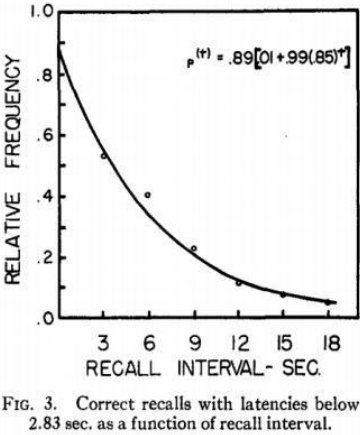
Keppel & Underwood suggested that the drop-off in memory was due not to decay of the memory trace, but to proactive interference.
Interference:
Forgetting information due to competition with other memory information.
Proactive interference: Old information interfere with new information when we try to recall new information.
Retroactive interference: New information interfere with old information when we try to recall old information.
Testing for STM capacity:
1 measure is provided by the digit span.
Digit span: The number of digits a person can remember.
Classic digit span:
Using an piece of paper to cover all the numbers below. Move the card to uncover the 1st string of number.
Read the numbers, cover them up and then write in the correct order, move to the next string of numbers.
Repeat until you make errors. The longest string without errors is your digit span.
The average capacity of STM is about 5 to 9 items.
Measured the capacity of STM by flashing 2 arrays of colored squares separated by a brief delay. The participants’ task was to indicate whether the second array was the same as or different from the first array.
Performance was almost perfect when there were 1-3 squares in the arrays, but performance decreased when there were 4+ squares.
Miller introduced the concept of chunking to describe the fact that small units can be combined into larger meaningful units.
Chunk: A collection of elements that are strongly associated with one another but are weakly associated with elements in other chunks.
How information is coded in STM:
Coding: The way information is represented.
How a stimulus is represented by the firing of neurons is a physiological approach to coding.
Types of coding:
Auditory: Ex: Sound of the person’s voice.
Visual: Ex: Image of a person
Semantic: Ex: Meaning of what the person says.
Auditory coding:
Representing items in STM based on their sound.
Conrad’s experiment: Participants saw a number of target letters flashed briefly on a screen and were told to write down the letters in the order they were presented.
Results: Participants made errors, they were most likely to misidentify the target letter as another letter that sounded like the target.
Thus, even though the participants saw the letters, the mistakes they made were based on the letters’ sounds.
Letters with similar sounds (ex: "P", "D", "T") proved more difficult to recall correctly than letters with different sounds (ex: "D" & "O") even though the different sounding letters looked more similar.
Visual coding:
Involves representing items visually. Ex: remembering the details of a floor plan.
Participants saw patterns ranging from small (2×2 matrix with 2 shaded squares) to large (5×6 matrix with 15 shaded squares), with half of the squares being shaded in each pattern.
Participants were able to complete patterns consisting of an average of 9 shaded squares before making mistakes.
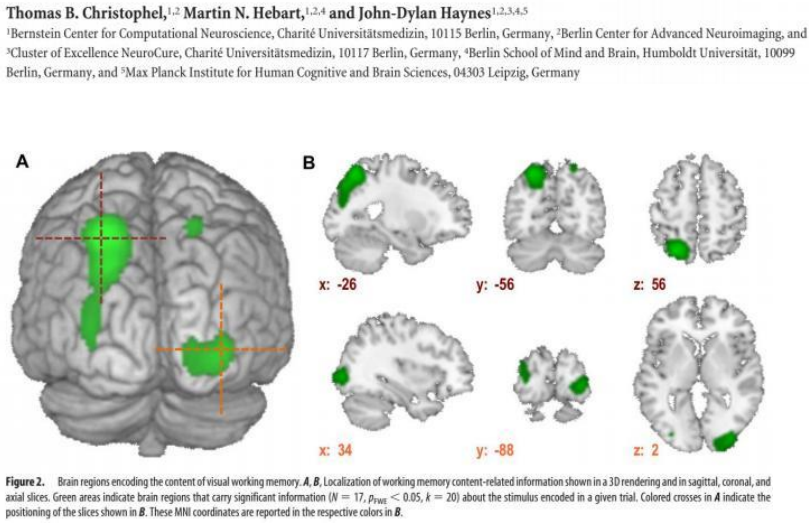
Neurobiology of visual STM:
Decoding contents of visual STM from human visual and parietal cortex.
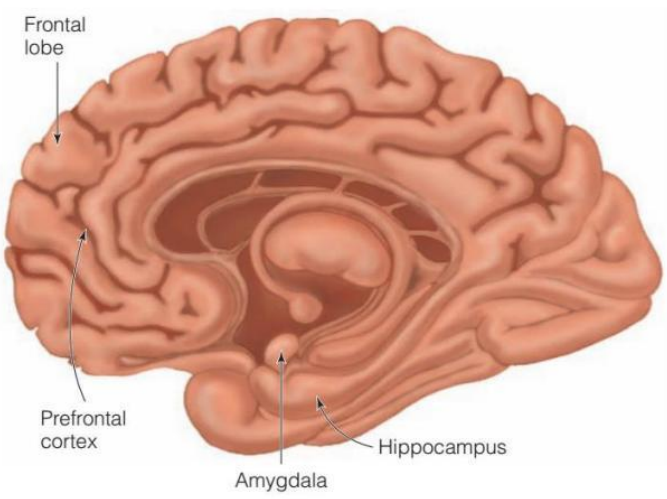
Animal studies with brain lesions:
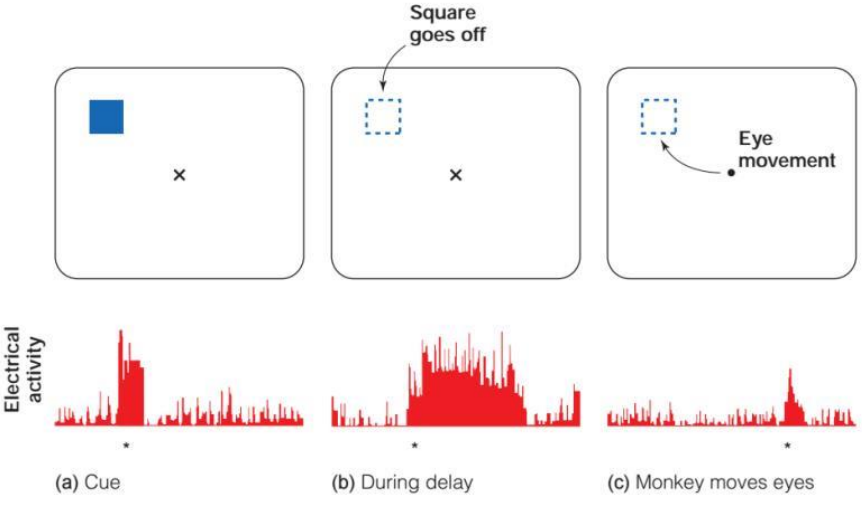
Early research on the frontal lobe and memory was carried out in monkeys using a task called the delayed-response task.
Required a monkey to hold information in working memory during a delay period.
Monkey who had their prefrontal cortex removed, their performance drops to chance level, so they pick the correct food well only about half of the time.
Single-cell recording research:
Funahashi et al. conducted an experiment in which they recorded from neurons in a monkey’s PF cortex while the monkey carried out a delayed-response task.