Nov8. Complex Experimental Designs
Complex Experimental Designs
Overview
Key Topics Covered
Definition of factorial designs
Explanation of IV x PV (Independent Variable by Participant Variable) designs
Methods of participant assignment in factorial designs
Expansion possibilities for factorial designs
Simple Experiments Recap
Basic experiments involve one IV with two levels:
Example Study:
IV: Alcohol Intake (Placebo vs. Drunk)
DV: Aggression measured by intensity and duration of shocks
Results are shown with a graph illustrating the effects of different conditions.
Factorial Designs
Factorial Design: A Research design with two or more IVs (called factors in this experimental design).
Pro: Allows exploration of interaction effects between variables, which cannot be done with two single-factor designs
To examine more complex, real-life situations researchers often add more than 1 IV to their study design
Interaction Effects
Interaction Effects: An interaction occurs when the effect of one IV depends on the level of another IV.
Example: Temperature of food and type of food affect preference (e.g., cold pancakes vs. hot pancakes).
Common Factorial Designs
In most common factorial designs, researchers cross the IVs - they study all possible combinations of the IVs.
Example 1: Effect of alcohol and body weight on aggression.
IV1: Alcohol intake (Placebo/Drunk)
IV2: Body weight (Light/Heavy)
DV: Aggression level measured.
Factorial Design Examples
Example 2: Investigated if thinking about alcohol influences aggression:
IV1: Photo Type (Alcohol/Plant)
IV2: Word Type (Aggressive/Neutral)
DV: Reaction Time.
Main Effects: Assessing the independent effect of each IV on the DV.
Interaction Effect: Evaluation of combined impacts shown on graphs.
3 results to inspect
Main effect of IV 1
Main effect of IV 2
Interaction effect
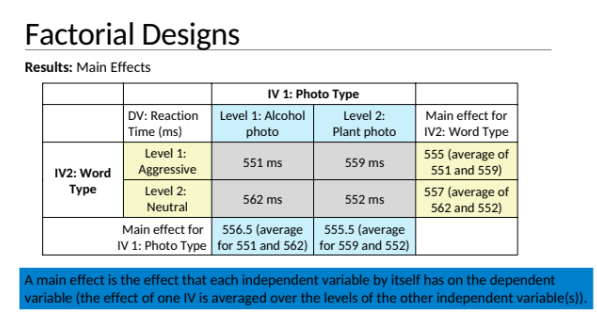
Is there a significant diff. btwn levl1 vs. lvl. 2? in word type?
Is there a significant diff. in photo type vs. lvl. 1 vs. lvl. 2?
Results: Interaction effect
While it is possible to compute interaction effects from a table, it is sometimes easy to notice them on a line graph
can also notice the interaction on a bar graph
Assigning Participants
Methods:
Independent Groups Design: Different participants for each condition.
Repeated Measures Design: Same participants across all conditions.
Both designs can be combined in more complex experiments.
Types of Factorial Designs
Factorial designs can vary in complexity based on the number of levels and IVs:
Examples:
2x2 (two IVs with two levels each)
2x3 (two IVs: one with two levels and another with three levels)
... and so on for more factors and levels.
Key Terms to Review
Factorial design
Interaction
IV x PV design
Levels
Main effect
Mixed factorial design
Review Questions
Why use multiple levels for an IV?
Definition and reasons for using factorial designs.
Main effects vs. interactions in data analysis.
Usefulness and conditions for IV x PV designs.
Next Steps
Submit research proposal revisions by the end of the day on November 8th.
Data matching study designs will be provided next week.