Training for Performance
Chapter 21: Training for Performance
Copyright Information
Copyright © 2018 McGraw-Hill Education. All rights reserved. No reproduction or distribution without prior written consent.
Lecture Outline
Training Principles
Components of a Training Session: Warm-up, Workout, and Cool-Down
Training to Improve Aerobic Power
Injuries and Endurance Training
Assessments for Aerobic Power
Training for Improved Anaerobic Power
Training to Improve Muscular Strength
Concurrent Strength- and Endurance-Training Programs
Nutritional Influence on Training-Induced Muscle Adaptations
Training for Improved Flexibility
Year-Round Conditioning for Athletes
Common Training Mistakes
Training Principles
Overload:
- Defined as the increased capacity of a system in response to training above the level it is accustomed to.
- Important to note: Too much overload leads to overtraining or overreaching.Specificity:
- Refers to the specific muscles involved and the specific energy systems that are utilized during training.
- Example: Training for a sprinter involves high-intensity sprints, whereas training for a marathoner includes long-distance runs that primarily utilize aerobic metabolism.Reversibility:
- Refers to the loss of training effects when training is stopped.
- Significant reduction can occur within two weeks of cessation of training. For instance, studies show significant reductions in within this period.
Aerobic and Anaerobic Energy Systems in Sports
Energy Systems:
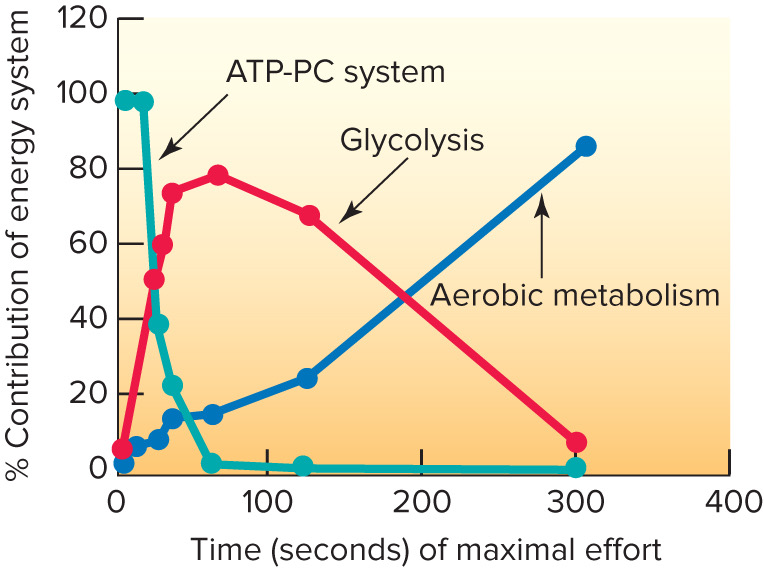
- ATP-PC System: Contributes primarily to short intensity activities lasting up to 10 seconds.
- Glycolytic System: Engaged during high-intensity activities lasting between 20-60 seconds.
- Aerobic System: Fuels prolonged activities, especially in endurance sports.Training Program Example: Tailoring training to match the anaerobic and aerobic demands of specific sports is essential.
Training Sessions
Objectives of Sport Conditioning:
- To improve performance by enhancing muscle force/power output, muscular efficiency, and muscle endurance.
Components of a Training Session
Warm-up:
- Increases cardiac output and blood flow to skeletal muscle.
- Raises muscle temperature and enzyme activity.
- Potentially reduces the risk of exercise-induced muscle injuries.Workout:
- Represents the main training session, following training principles like overload, specificity, and reversibility.Cool-down:
- Aids in returning blood "pooled" in muscles back to central circulation.
Training to Improve Performance
Different performances require distinct training strategies based on specificity:
- Aerobic Performance: Training directed at events lasting longer than 3-5 minutes.
- Anaerobic Performance: For events lasting less than 60 seconds.
- Strength Performance: Focus on maximal force production and muscular endurance.
- Flexibility Performance: Aimed at enhancing range of motion.
Training to Improve Aerobic Power
Training Methods:
- Interval Training
- Long, Slow Distance
- High-Intensity Continuous Exercise (Pace Tempo)Goals of Aerobic Training:
- Improve , lactate threshold, and running economy.
Interval Training
Involves repeated bouts of high-intensity exercise separated by brief recovery periods:
- Work Interval: Defined by either distance or time.
- Rest Interval: Light activity (e.g., walking).
- Training Outcomes: Improvements in , running economy, and lactate threshold may be superior to low-intensity intervals.
High-Intensity Interval Training (HIIT)
Historical context: Established by Roger Bannister when he broke the 4-minute mile in 1954.
Advantages: Time-efficient, effective for anaerobic systems, can enhance mitochondrial volume with sessions as short as 30 seconds.
Long, Slow Distance Training
High-volume, low-intensity exercise popularized in the 1970s.
Target intensity is approximately 50-65% of .
Primarily aims to increase aerobic capacity through volume.
Training duration often greater than event or competition
However, short-term, high-intensity training is better for improving VO2 max
turtle pic
High-Intensity Continuous Exercise
Typically conducted above lactate threshold and increasing VO2 Max
Target intensity between 80-100% of VO2 max for most athletes.
Monitoring can be achieved via heart rate tracking.
Determining Intensity and Duration for Training
pic
Altitude Training & Exercise Performance at Sea Level
Altitude training may not always improve aerobic performance at sea level
Lower training intensity at altitude may result in de-training
Live-High, Train-Low
Spend sleeping and resting time at altitude
Increases RBC volume and oxygen transport capacity of blood
Train at lower altitude
Allows higher intensity of training sessions
Does LHTL increase performance at sea level?
Does increase performance in some athletes but not all
LHTL may impact elite athletes less than trained subjects
Enhancement in Endurance Performance: What are the physiological limits?
Although many physiological factors contribute to endurance performance, three key elements of success include:
a high VO2 max;
superior exercise economy/efficiency; and
a high lactate threshold and critical power
The genetic makeup of an individual is referred to as a “genotype” and genetics plays an important role in determining VO2 max
Influence of Genetics
Genetics plays an important role in how an individual responds to training
High responders vs. low responders
Can only reach genetic potential
Anaerobic capacity is more genetically determined than aerobic capacity
Training can only improve anaerobic performance to a small degree compared to aerobic training
Mostly by improving pH buffering
Dependent largely on fast (IIx) fibers … (% fiber type)
Determined early in development
Assessments for Aerobic Power
VO2 max: Best predictor of success in endurance activities, ideally measured through direct laboratory tests with a metabolic cart.
Direct criteria include:
- Plateau in with increasing work rate.
- Respiratory exchange ratio of ≥1.15.
- Heart rate within ±10 beats/min of age-predicted max.
- Blood lactate concentration >8 mmoles•L–1.
Influence of Genetics
Genetic predispositions (high responders vs. low responders) impact training outcomes; notably, anaerobic capacity is more genetically determined than aerobic capacity.
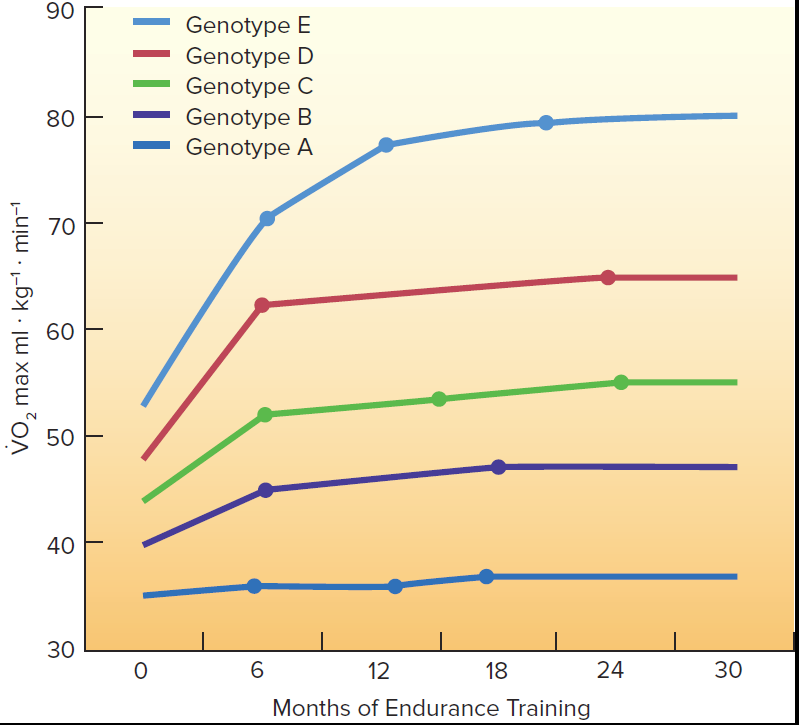
Individuals labeled as "genotype A" have lower initial and respond minimally to training, while "genotype E" has higher potential.
Enhancement in Endurance Performance: What are the physiological limits?
Individuals labeled as “genotype A” (bottom line) possess a relatively low VO2 max in the
untrained state and often, these individuals are also “low responders” to exercise as training
improves VO2 max by 5% or less.
Individuals with the ideal
genetic makeup required for
champion endurance athletes
(Genotype E) possess an
elevated VO2 max in the
untrained state and are “high
responders” to exercise training
as training can often increase
their VO2 max by 50%.
Influence of Gender and Initial Fitness Level
Men and women respond similarly to training
Differences are generally due to body size/composition
Exercise prescriptions should be individualized
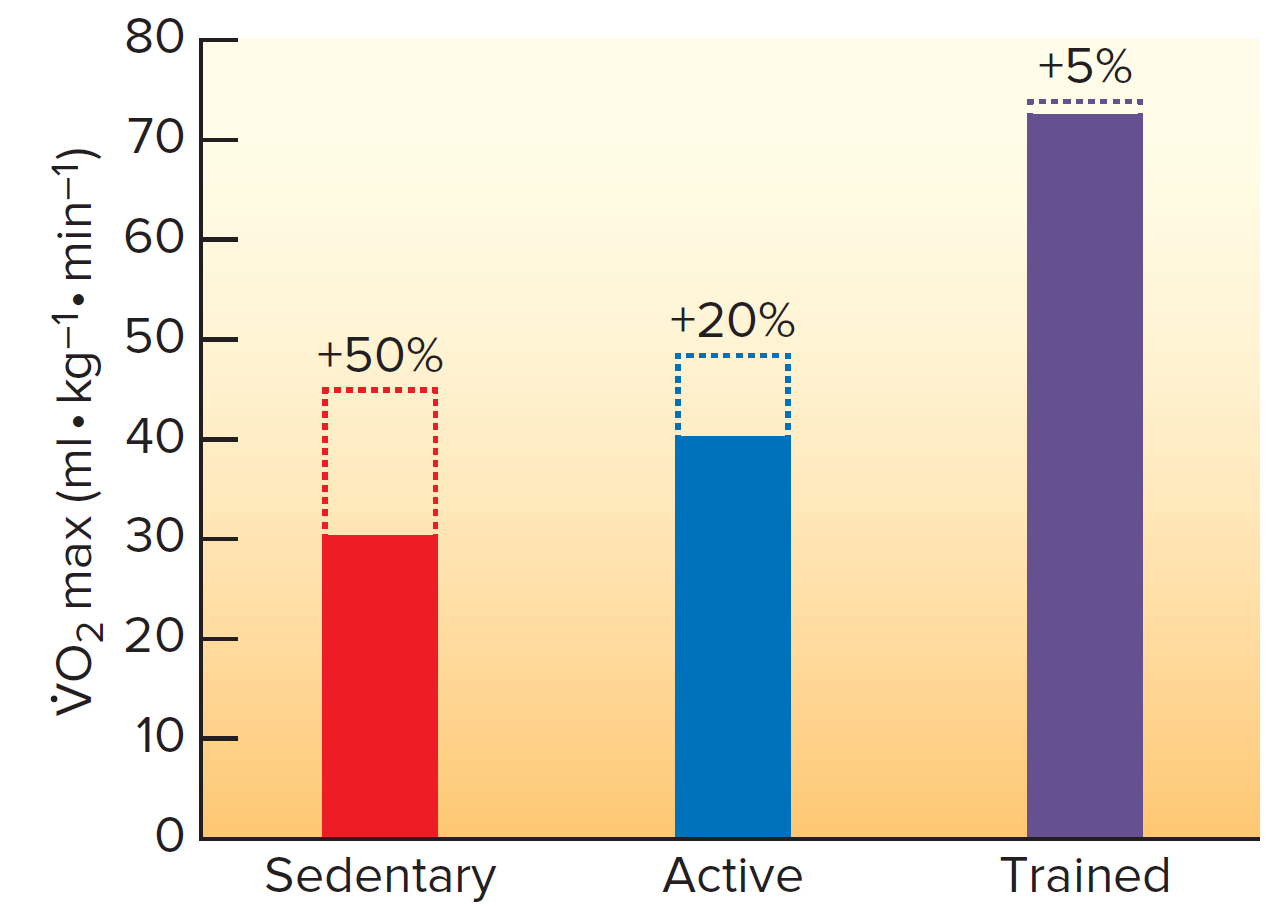
Training improvement is usually greater in individuals with lower initial fitness
50% increase in VO2 max in sedentary adults
10–20% improvement in normal, active subjects
3–5% improvement in trained athletes
May be an important difference
Avoiding Injuries with Endurance Training
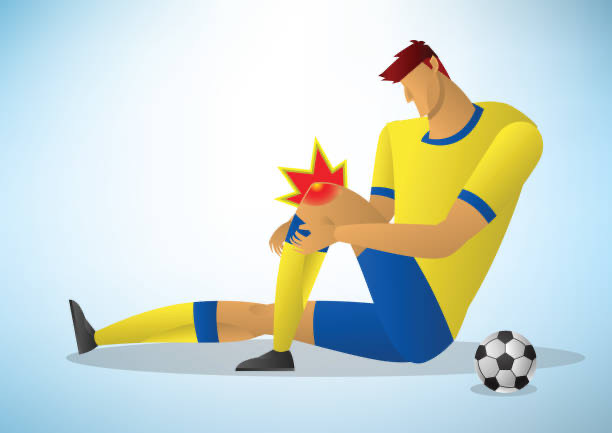
Most injuries stem from overtraining, which can be mitigated by following the 10 percent rule for training load increases.
Short-term, high-intensity exercise
Prolonged, low-intensity exercise
Other factors increasing injury risk include strength and flexibility imbalances, inadequate footwear, and poor training surfaces, Malalignment, Disease (arthritis)→ only increases if excessive running also higher arthistus in sedentary ppl
Direct Testing of Maximal Aerobic Power
VO2 max is considered the best test for predicting success in endurance events
Other factors are also important
Better predictor in heterogeneous groups
Most accurate means of measurement is direct testing in laboratory (metabolic cart)
Specificity of testing
Should be specific to athlete’s sport
Runners tested on treadmill
Exercise Test Protocol to Directly Determine VO2 max
Should use large muscle groups (i.e., legs)
Optimal test length 10–12 minutes
Start with 3–5 minute warm-up
Increase work rate to near maximal load
Increase load stepwise every 1–4 minutes
Criteria for VO2 max
Plateau in VO2 with increasing work rate
Rarely observed in incremental test
Respiratory exchange ratio (equal/greater than)_>1.15
HR in last stage +- 10beats x min -1 of age-predicted HRmax (keep in mind that HRmax may be wrong)
Blood lactate concentration of >8mmoles xL-1
Assessment of running performance
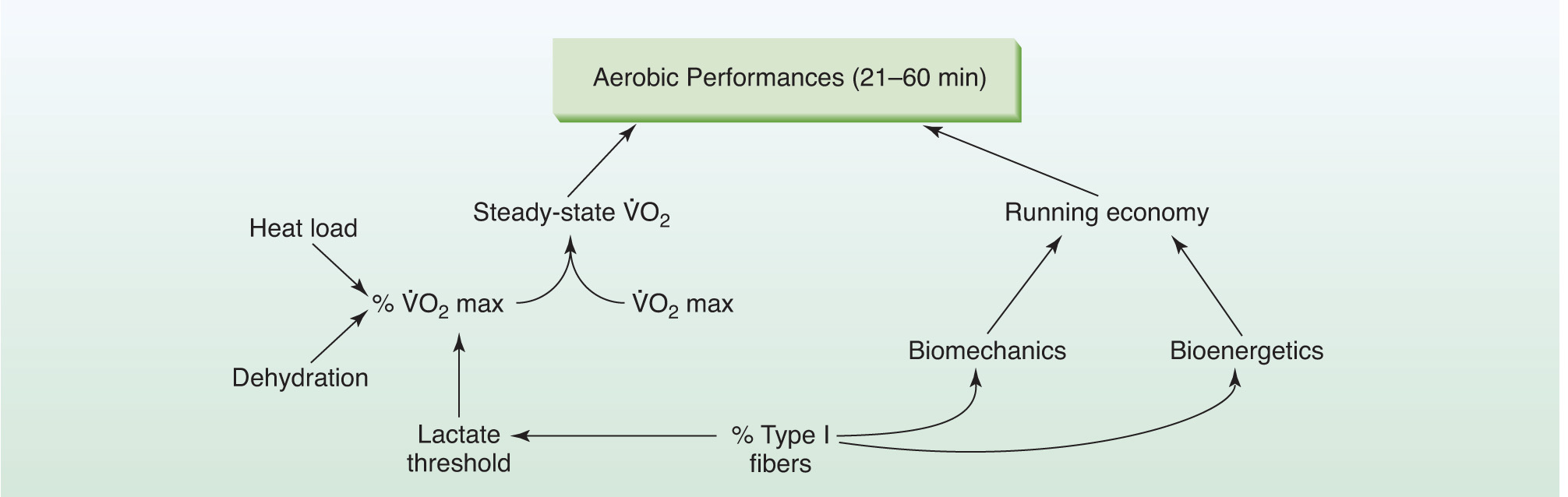
You will recall from Chapter 19 that Maximal Aerobic Capacity is not the only determinant of success
VO2max may be best in predicting performance among a
heterogeneous population, however it does not predict well within a
more homogeneous population (like elite endurance athletes)
Laboratory Tests to Predict Endurance Performance
Peak running velocity
Highest speed that can be maintained for >5 sec
Lactate threshold
Exercise intensity at which blood lactate begins to systematically increase
Direct measurement with blood samples and Estimation by ventilatory threshold
Critical power
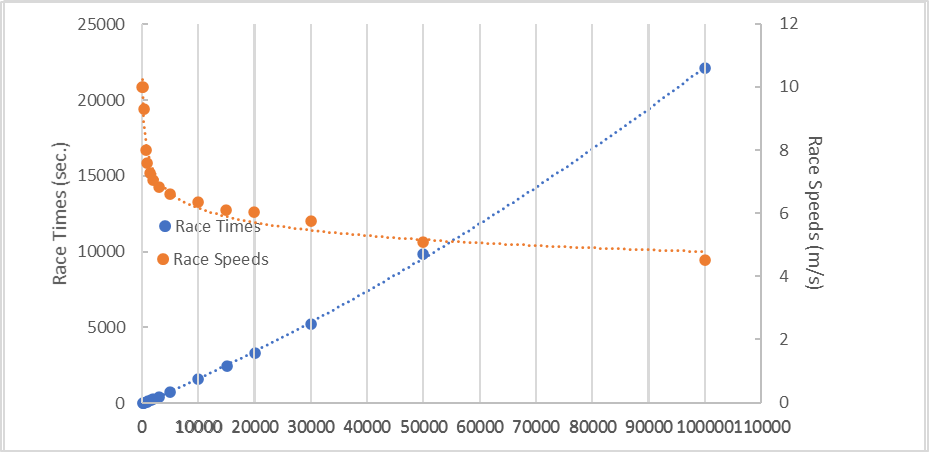
Speed at which running speed/time curve reaches plateau
Measurement of Peak Running Velocity to Predict Performance
Peak running velocity
Tested on treadmill or on track
Progressively increasing speed on treadmill (every 30 sec.)
Highest speed that can be maintained for >5 sec
Excellent predictor of 5 km run performance
Strong correlation
r =-0.97
May also be a good predictor of 10-90 km race performence, but less studied (intervals)
image
Use of the Lactate Threshold to Evaluate Performance
Lactate threshold estimates maximal steady-state running speed
Predictor of success in distance running events
Direct determination of lactate threshold (LT)
2–5 minute warm-up
Stepwise increases in work rate every 1–3 minutes
Measure blood lactate at each work rate
LT is the breakpoint in the lactate/VO2 graph
image
Prediction of the LT by ventilatory alterations
Ventilatory threshold (Tvent)
Point at which there is a sudden increase in ventilation
Used as an estimate of LT
2images
Measurement of Critical Power
Critical power
Running speed at which running speed/time curve reaches a plateau
Power output that can be maintained “indefinitely”
However, most athletes fatigue in 30–60 min when exercising at critical power
Measurement of critical power
Subjects perform series of timed exercise trials to exhaustion
Prediction of performance in events lasting 3–100 min
Highly correlated with
High VO2 max
high LT
Critical Power
Critical power is defined as the running speed (i.e., power output) at which the running speed/time curve reaches a plateau.
Tests to Determine Exercise Economy
Higher economy means that less energy is expended to maintain a given speed
Runner with higher running economy should defeat a less economical runner in a race
Measurement of the oxygen cost of running at various speeds
Plot oxygen requirement as a function of running speed
Greater running economy reflected in lower oxygen cost
Estimating Distance Running Success Using LT and Running Economy
Close relationship between LT and maximal pace in 10K m race
Race pace at 5 m•min–1 above LT
Predicting performance in a 10K race
Measure VO2 max
Plot VO2 vs. running speed
Determine lactate threshold
Plot blood lactate vs. VO2
VO2 at LT = 40 ml•kg–1•min–1
VO2 of 40 ml•kg–1•min–1 = running speed of 200 m•min–1
Estimated 10K m running time
10,000m ÷ 205 m•min–1 = 48.78 min. to complete race
2images
Training to Improve Anaerobic Power
Target training protocol for the ATP-PC system:
Focus on short, high-intensity bursts (5-10 seconds).
30 yard dashes for football players
30-60 second rest intervals
little lactic acid is produced, so recovery is rapid
Glycolttic systems
short 20-60 seconds, high intensity work intervals
May deplete muscle glycogen levels
may alternate hard and light training days
Contribution of the ATP-PC system, anaerobic glycolysis, & aerobic metabolism during max effort
Strength-Training Principles
Includes Isometric(force without joint movment), Dynamic, and Isokinetic(includes variable resistance excersise) exercises, emphasizing progressive overload to improve strength across different muscle types.
General Strength-Training Principles
Focus on a range of repetitions (8-12 RM) tailored to the athlete’s level.
Considerations for optimal strength gains include frequency, volume, intensity, and exercise specificity.
Resistance Training Guidelines
Table 21.3 illustrates variations in training protocols for maximizing strength gains versus muscular endurance.
Note differences in approaches, rest intervals, and repetitions based on training experience (novice, intermediate, advanced).
Nutritional Influence on Training-Induced Muscle Adaptations
Carbohydrate Availability: Influences endurance adaptations, with strategies including dietary restriction or training with low glycogen reserves to enhance mitochondrial formation.
Protein Availability: Essential for muscle protein synthesis; timing and amount around workouts are vital for recovery and gains.
Delayed Onset Muscle Soreness (DOMS)
DOMS arises from microscopic tears in muscle fibers or connective tissue, usually 24-48 hours post-exercise.
Treatment includes RICE (Rest, Ice, Compression, Elevation) and anti-inflammatory medications (e.g., ibuprofen).
Year-Round Conditioning for Athletes
Emphasizes the structured approach to athlete conditioning consisting of off-season, preseason, and in-season phases to control fitness and performance.
Tapering
Involves a short-term reduction in training load before competition to enhance performance, allowing for recovery and glycogen resynthesis.