3.1.3 Carbohydrates
Glucose
- @@C6H12O6@@
- Glucose exists in two structurally different forms – @@alpha (α) glucose and beta (β) glucose@@
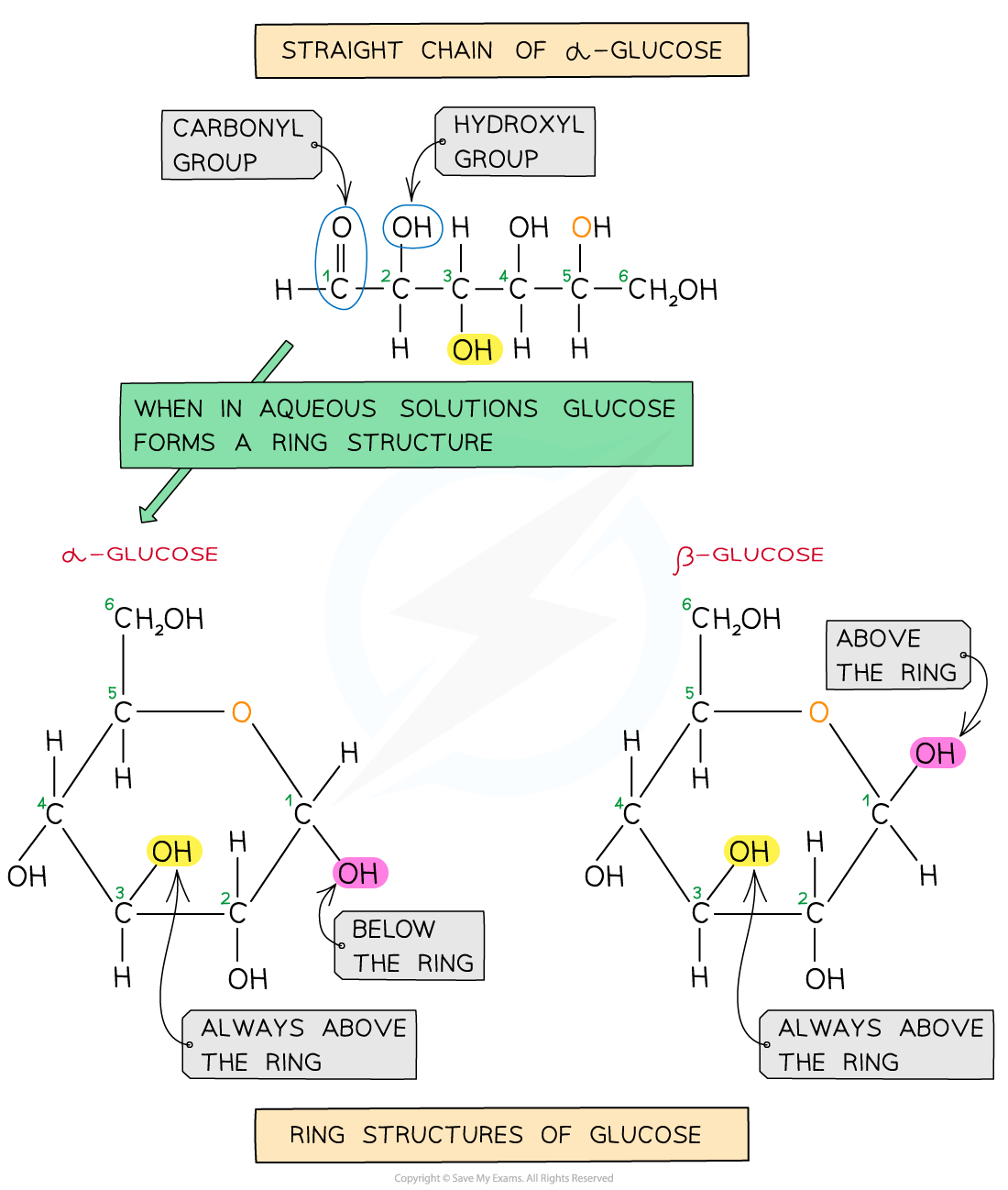
- Different isomers of glucose appear in different molecules
Glycosidic Bonds
- Disaccharides and polysaccharides are formed when @@two hydroxyl (-OH) groups (on different saccharides) interact to form a strong covalent bond@@ called the glycosidic bond (@@the oxygen link that holds the two molecules together@@)
- Every glycosidic bond results in @@one water molecule being removed@@, thus glycosidic bonds are formed by @@condensation@@
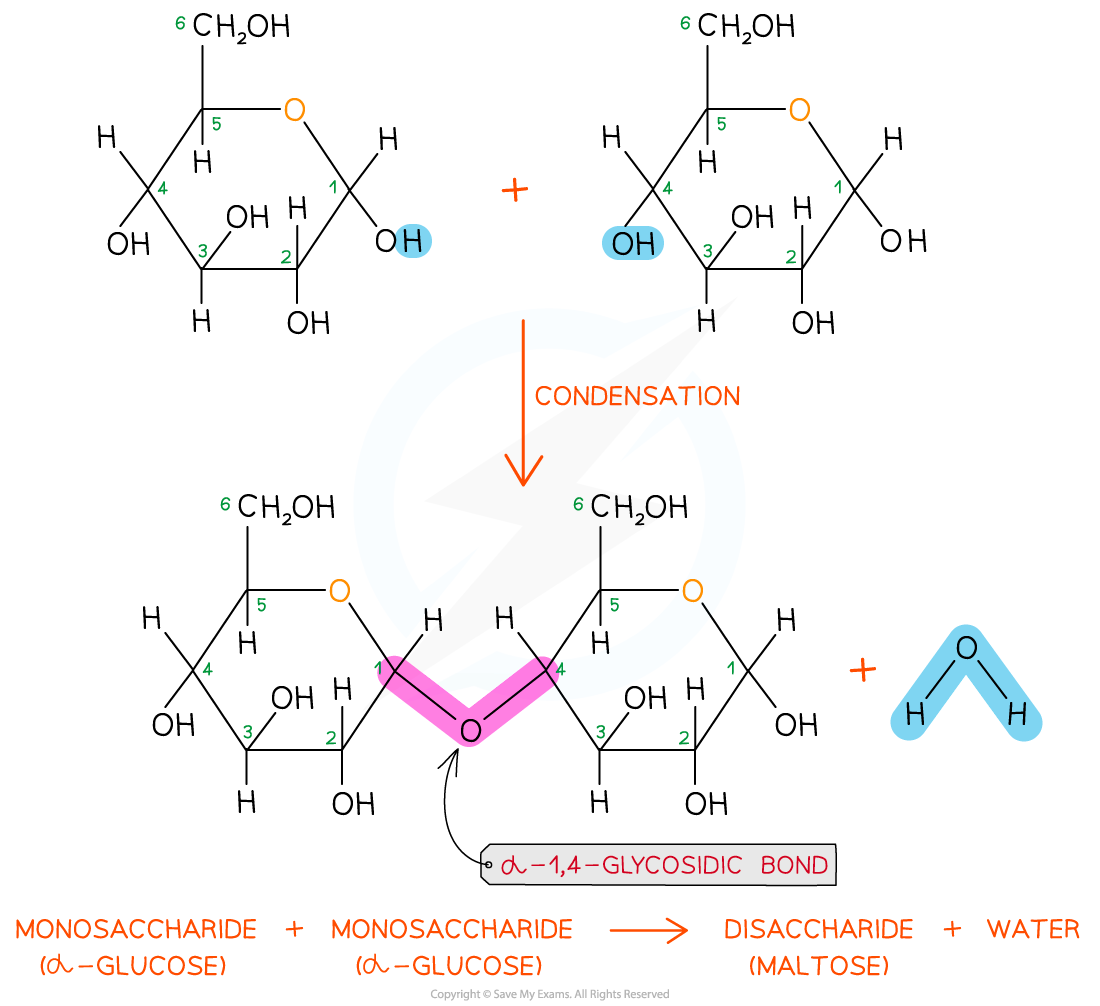
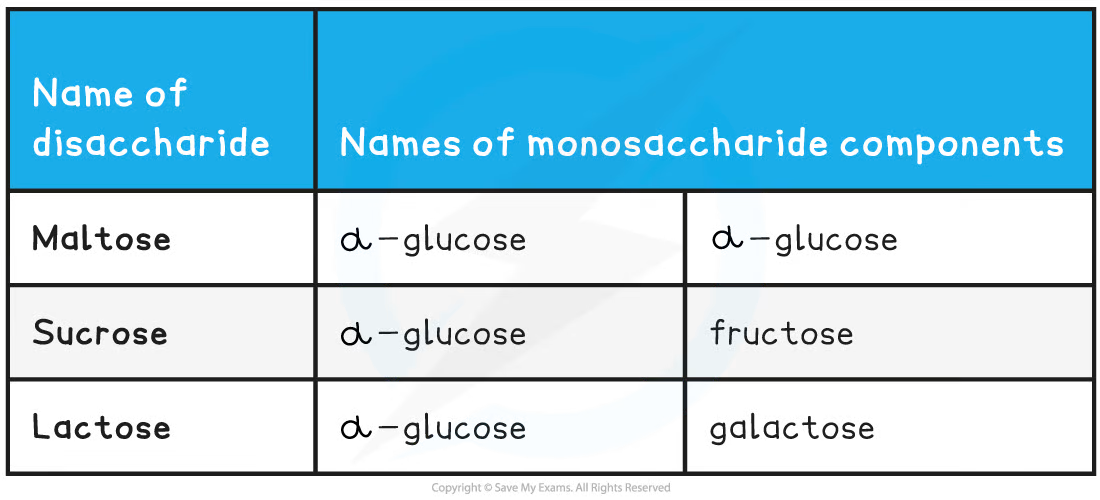
- As there are many different monosaccharides this results in different types of glycosidic bonds forming (e.g maltose has a α-1,4 glycosidic bond and sucrose has a α-1,2 glycosidic bond)
Breaking Glycosidic Bonds
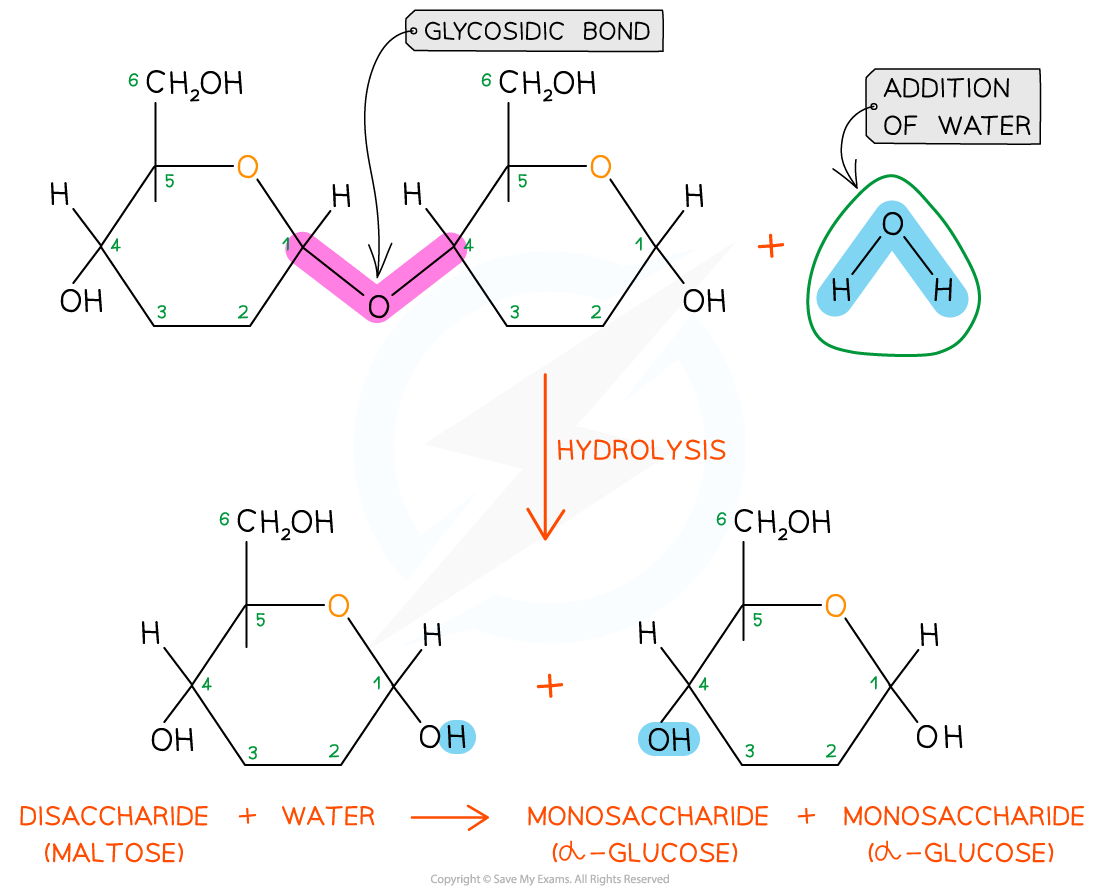
- As forming the bond is a condensation reaction (removing water), to break the bond it must be @@hydrolysed (add water)@@
Disaccharides
Starch and Glycogen
Starch and glycogen are storage polysaccharides because they are: @@Compact@@ (so large quantities can be stored) @@Insoluble@@ (so will have @@no osmotic effect@@, unlike glucose which would lower the water potential of a cell causing water to move into cells, cells would then have to have thicker cell walls - plants or burst if they were animal cells)
Starch
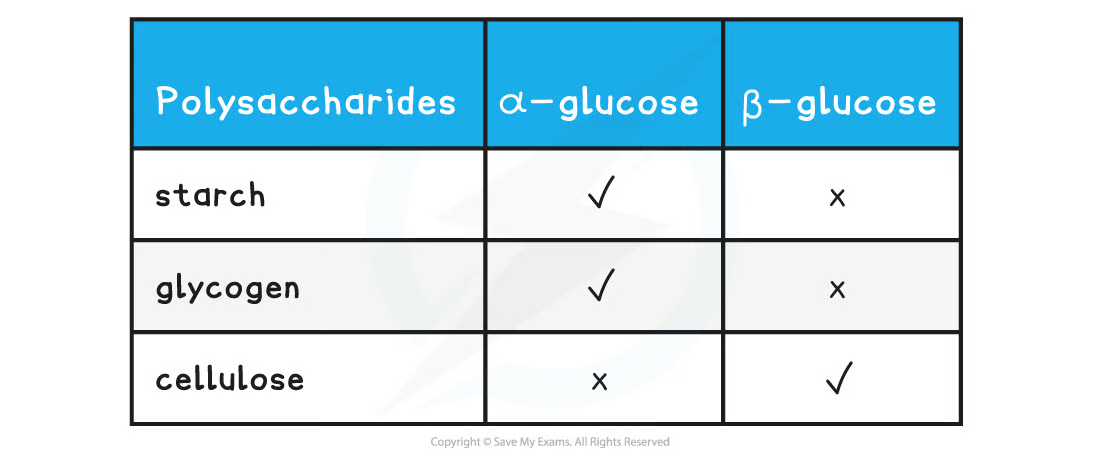
- Starch is the @@storage polysaccharide of plants@@. It is stored as granules in plastids (e.g. chloroplasts)
- Due to the many monomers in a starch molecule, it takes @@longer to digest@@ than glucose
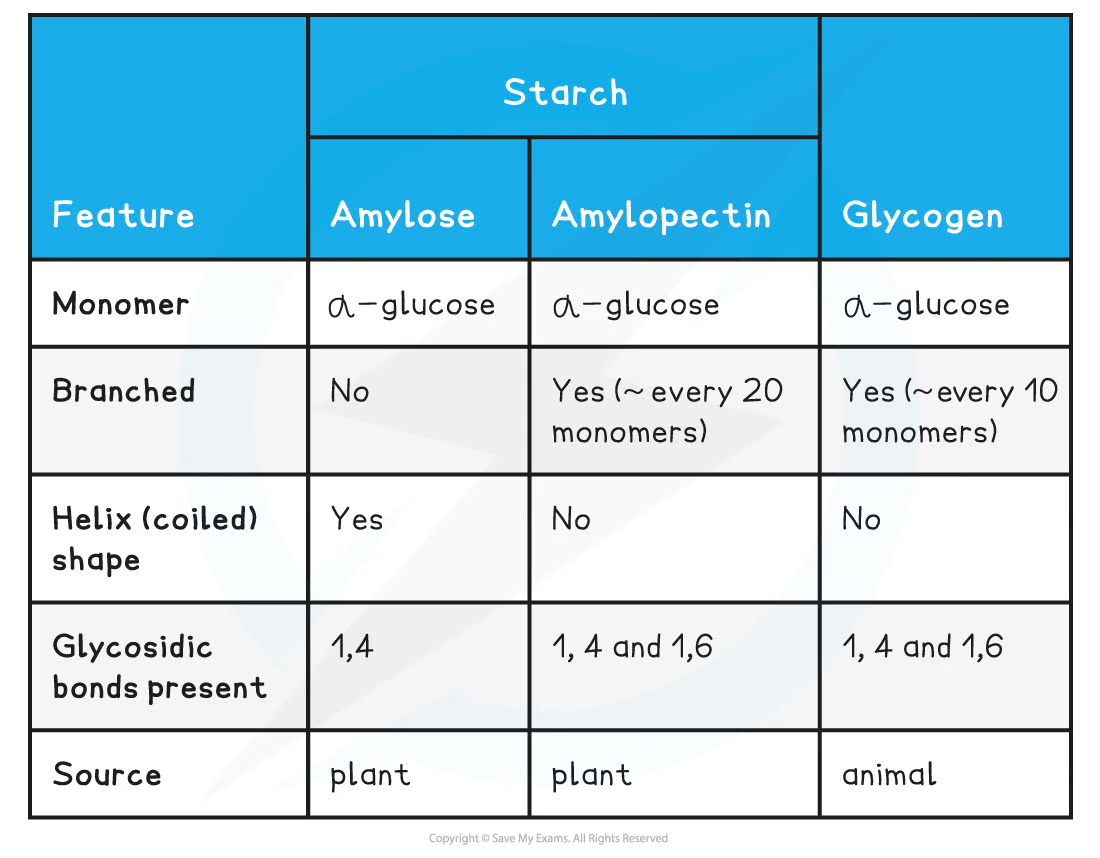
- Starch is constructed from @@two different polysaccharides@@:
- Amylose (10 - 30% of starch)
- @@Unbranched@@ helix-shaped chain with @@1,4 glycosidic bonds@@ between @@α-glucose@@ molecules
- @@The helix shape enables it to be more compact and thus it is more resistant to digestion@@
- Amylopectin (70 - 90% of starch)
- @@1,4 glycosidic bonds@@ between @@α-glucose molecules@@ but also @@1,6 glycosidic bonds@@ form between glucose molecules creating a @@branched molecule@@
The branches result in many terminal glucose molecules that can be @@easily hydrolysed for use during cellular respiration or added to for storage@@
Glycogen
- Glycogen is the @@storage polysaccharide of animals and fungi@@, it is @@highly branched@@ and @@not coiled@@
- Liver and muscles cells have a high concentration of glycogen, present as visible granules, as the cellular respiration rate is high in these cells (due to animals being mobile)
- @@Glycogen is more branched than amylopectin making it more compact which helps animals store more@@
- The branching enables @@more free ends where glucose molecules can either be added or removed allowing for condensation and hydrolysis reactions to occur more rapidly – thus the storage or release of glucose can suit the demands of the cell@@
Properties
Cellulose
- Is a polymer consisting of long chains of β-glucose joined together by 1,4 glycosidic bonds As β-glucose is an isomer of α-glucose to form the 1,4 glycosidic bonds consecutive β-glucose molecules must be rotated 180° to each other
- Due to the inversion of the β-glucose molecules many hydrogen bonds form between the long chains giving cellulose it’s strength
- Cellulose is the main structural component of cell walls due to its strength which is a result of the @@many hydrogen bonds found between the parallel chains of microfibrils@@
- The high tensile strength of cellulose allows it to be @@stretched without breaking which makes it possible for cell walls to withstand turgor pressure@@
- The @@cellulose fibres and other molecules (eg. lignin) found in the cell wall form a matrix which increases the strength of the cell walls@@
- The strengthened cell walls @@provides support@@ to the plant
- @@Cellulose fibres are freely permeable which allows water and solutes to leave or reach the cell surface membrane@@
- As few organisms have the enzyme (cellulase) to hydrolyse cellulose @@it is a source of fibre@@
\n