Socially Used Drugs
Professor Susan Duty's Lecture on Socially Used Drugs
Lecture Overview
Institution: King’s College London, Institute of Psychiatry, Psychology & Neuroscience, Wolfson SPARC Sensory, Pain and Regeneration Centre
Subject: Pharmacology & Therapeutics
Lecture Outcomes
After this lecture, students should be able to:
Recount the mechanism of social drug-evoked pleasure
Describe the basic pharmacology of cigarette smoking, cannabis, and ecstasy
Align social drug-desired effects to their pharmacology
Recall the main toxic effects of cigarette smoking, cannabis, and ecstasy
Consider toxicity as a rationale for the legal status of drugs
Definitions of Social Drugs
social drugs are taken by choise - not because of medical advice
Classification of Social Drugs:
- Legal Drugs: e.g., caffeine, alcohol, cigarettes
- Illegal Drugs: e.g., heroin, cocaine, hallucinogens, cannabis, ecstasyPharmacologically Heterogeneous Group: Social drugs are diverse in terms of pharmacological actions and effects.
Pleasing Effects: Linked by the pleasurable (hedonic) effects they produce.
Self-prescribing Nature: Taken by choice rather than for medical advice, as opposed to medicinal drugs.
Mechanisms of Drug-Evoked Pleasure
Activation of Dopaminergic Reward Pathway:
- Pathway runs from the ventral tegmental area (VTA) to the nucleus accumbens.
- Dopamine (DA) is the key neurotransmitter involved.
Reward Pathway Activations
tonically active
firing can be increased by direct or indirect mechanisms
direct activation (1)
indirect activation by dis-inhibition (2)
- both means of increasing firing of VTA neurons increase dopamine release in the nucleus accumbens, which evokes pleasure.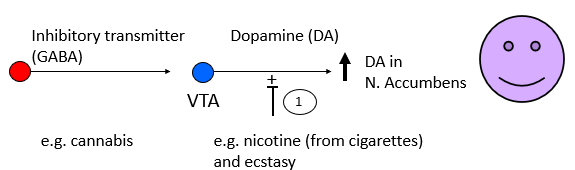
Types of Mechanisms:
1. Direct Activation
- e.g., caffeine, alcohol
2. Indirect Activation by Dis-inhibition
- e.g., cannabis, nicotine, ecstasy
Psychological and Physical Dependence
Dependence Issues:
1. Physical Dependence:
- Withdrawal has an aversive effect on the individual.
2. Psychological Dependence:
- Characterized by craving and positive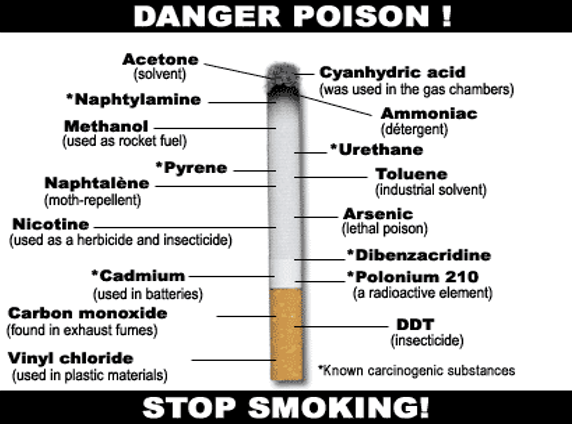
reinforcement from drug use.
- May dominate an individual's lifestyle, leading to criminal behavior to finance habits and resulting in personal harm and toxicity.
Legal Drugs: Cigarette Smoking
Prevalence and Statistics
Cigarette Smoking Deaths:
- Biggest killer among socially used drugs.
- 74,600 deaths attributable to smoking in the UK in 2020.
- 3% decrease from 2018 (77,000 deaths).
- 9% decrease from 2009 (82,000 deaths).
- An estimated 7 million smoking-related deaths worldwide in 2021 (WHO).UK Smoking Statistics:
- In 2011, approximately 20.2% of adults (18+) smoked (~10 million people).
- By 2024, the percentage decreased to 10.6% (~5.3 million).
- Highest prevalence in ages 25-55 and among unemployed individuals.
- NHS spends roughly £2.6 billion per annum on smoking-related diseases.E-Cigarettes:
- In 2024, 6.7% of people aged over 16 in Great Britain reported daily use, up from 5.9% in 2023.
Desired Effects of Cigarette Smoking
Psychoactive Effects: Acts as a stimulant and relaxant, dependent on dosage, with aims for euphoria, increased alertness & concentration, and relaxation.
Source: Derived from Nicotiana Tabacum.
Contents:
- Nicotine: The primary addictive constituent, alongside approximately 5,000 additional chemicals (e.g., formaldehyde).
Toxic Components of Cigarette Smoke
a. Dangerous Chemicals:
- Examples include:
- Acetone (solvent)
- Naphtylamine
- Methanol (rocket fuel)
- Carbon monoxide (from exhaust)
- Arsenic (lethal poison)
- Polonium 210 (radioactive element)
- Known carcinogens like DDT
Pharmacology of Nicotine
Mechanism of Action:
- Nicotine acts as an agonist at nicotinic acetylcholine (nACh) receptors.drives influx of cations, so membrane depolarisation
in the periphery:
excites autonomic ganglia and causes adrenaline release from adrenal medulla leading to: tachycardia, vasoconstriction, increased blood pressure
CNS Effects: Causes widespread neuronal excitation and releases neurotransmitters including:
- Dopamine (associated with euphoria)
- Acetylcholine (linked to concentration)
- Serotonin (involved in relaxation)
Toxic Effects of Cigarette Smoking
Statistics:
- Smoking is responsible for around 80% of lung cancer deaths, 14% of heart disease deaths, and 25% of all cancer deaths.Toxicity Factors:
- Carbon Monoxide:
- Binds to hemoglobin displacing O2, forming carboxyhemoglobin.
- Effects: Decreases oxygen carriage and increases the risk of ischaemic heart disease.
- Nicotine: A vasoconstrictor and increases platelet aggregation, increasing coronary thrombosis risk by 60% when consuming 20+ cigarettes per day.Related Cancer Risks:
- Cigarette tar and irritants increase lung cancer risk, significantly affecting various demographics based on usage patterns.
- Reported incidence for males aged 50-69:
- Non-smokers: 3 per 100,000
- 10-20 cigarettes/day: 59 per 100,000
- 40+ cigarettes/day: 217 per 100,000.Obstetric Risks:
- Effects on the unborn child include reduced weight, increased spontaneous abortion, and prematurity.Neuroprotective Effects:
- Interestingly, smokers may have a 50% lower likelihood of developing Parkinson’s disease, with research on nicotine's potential neuroprotective properties ongoing.
Illegal Drugs: Cannabis & Ecstasy
Cannabis
Prevalence:
- Most widely used illegal drug in the UK.
- Official statistics for 2024: 6.8% of adults (16-59 years) reported using cannabis; 13.8% for ages 16-24.
- Estimated spending of over £2.6 billion annually on black market cannabis.Desired Effects:
- Psychoactive effects can vary as stimulant, depressant, or hallucinogenic, aimed at producing euphoria, relaxation, and heightened sensory awareness.Source:
- Derived from the Cannabis sativa plant; marijuana refers to dried leaves and flowers, while hashish refers to the resin.Key Constituent:
- Main psychoactive component is delta-9-tetrahydrocannabinols (D9-THC).
Pharmacology of Cannabis
Cannabinoid Mechanism:
- Cannabinoids including D9-THC activate endogenous CB1(brain) and CB2(periphery) receptorsPostsynaptic Response:
- Activation leads to the inhibition of Ca2+ channel opening, consequently reducing exocytosis and inhibiting neurotransmitter release such as Acetylcholine in the hippocampus (linked to memory), norepinephrine, and GABA in the VTA (enabling DA release).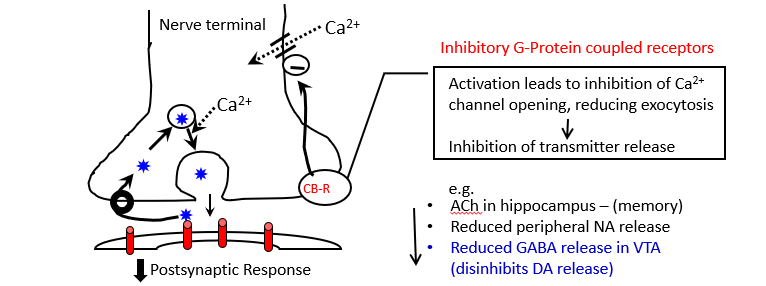
Toxicity of Cannabis
Acute Toxicity:
- Mild: Vasodilation (indicated by bloodshot eyes, decreased NA), drowsiness, confusion (decreased ACh).Chronic Toxicity:
- Long-term exposure linked to cancer (mouth, tongue, lung), confusion, memory impairment(deacreased ACh), and increased psychosis risk (six-fold higher incidence)(increased DA).
- Can influence hormone levels by reducing testosterone secretion (CB1-r mediated) and negatively affect immune response (CB2-R mostly found in lymph glands).
- Developmental abnormalities in the fetus noted in maternal cannabis usage.Fatality Statistics: In 2024, 32 cannabis-related deaths reported in England and Wales.
Ecstasy (MDMA)
Desired Effects:
- Acts as a psychoactive stimulant and empathogenic drug, sought for its effects of euphoria, arousal, empathy, perceptual disturbances, endurance, and increased self-confidence.Chemical Composition:
- Synthetically produced and predominantly known as 3,4-methylenedioxymethamphetamine (MDMA); metabolites like MDA may have even higher toxicity.Prevalence: In 2024, 1.2% of adults (16-59 years) used ecstasy, with 2.2% in the 16-24 age group.
Pharmacology of Ecstasy
Mechanism of Action:
- Ecstasy displaces 5-HT (serotonin) from vesicles leading to increased action of 5-HT by blocking its reuptake pump and enhancing noradrenaline and dopamine release, which are associated with empathy, arousal, and euphoria.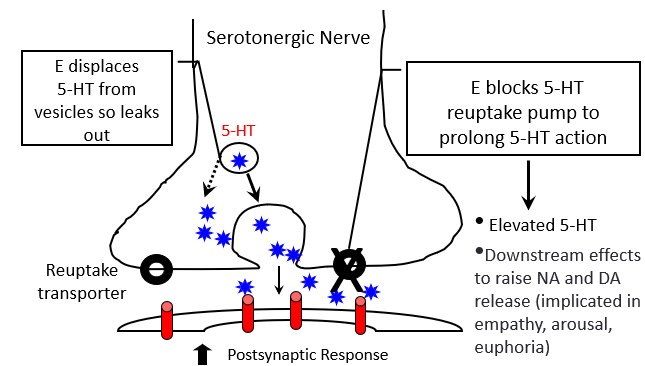
Toxicity of Ecstasy
Acute Toxicity:
- Hyperthermia: due to interference with body temperature regulation caused by noradrenaline metabolism (inc NA, inc Metabolism).
- Hyponatraemia: Due to excessive perspiration leading to salt loss, causing water retention through increased anti-diuretic hormone secretion, which can lead to water intoxication symptoms (red blood Na+ levels).inc anti-diuretic hormone secretion, so water ingested is retained
Short-term Effects: Include exhaustion, irritability, and low mood following the drug's effects, linked with decreased serotonin levels.
Fatality Statistics: In 2024, 78 ecstasy-related deaths reported in England and Wales.
Chronic Toxicity of Ecstasy
Reports indicate possible long-lasting effects including depression, anxiety, and memory impairment, alongside neurotoxic effects which entail reversible selective damage to serotonin terminals (5-HT terminals).
Legal versus Illegal Drugs
Complex Legal Status:
- Individuals often lie about the quantities of illegal drugs taken, making efficacy assessment challenging.
- Purity levels of illegal drugs vary significantly, raising concerns regarding contamination.Reasons for Legal Status:
- Cultural, social and historical reasons can dictate the legal status of drugs, including taxation views.
- Toxicology does not seem to be the main factor influencing law differences.
- Dependence liability, categorized as follows (in terms of effects):
- Heroin ≥ cocaine > nicotine > ethanol > ecstasy = cannabis ≥ caffeine
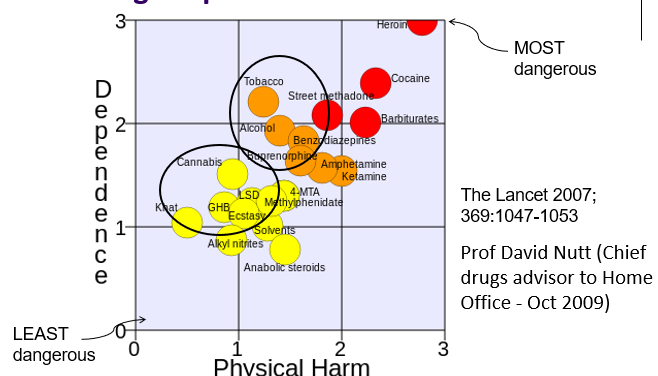
Assessment of Drug Harm
Reference to The Lancet (2007): Developing a rationale scale to assess the harms associated with drugs of potential misuse, ranking from most dangerous to least dangerous.
Conclusion
This comprehensive lecture by Professor Susan Duty provides insights into the pharmacology, legal considerations, and toxicological profiles of commonly used social drugs, emphasizing the need for understanding both their pleasurable effects and associated risks.