Longitudinal waves
Longitudinal waves are defined as
“Waves which vibrate parallel to the direction of energy transfer”
Longitudinal waves:
vibrate in the same direction as the direction of travel
transfer energy, but not matter
can move in solids, liquids and gases
cannot move in a vacuum as there are no particles
The key features of a longitudinal wave are where the points are:
close together, called compressions
spaced apart, called rarefactions
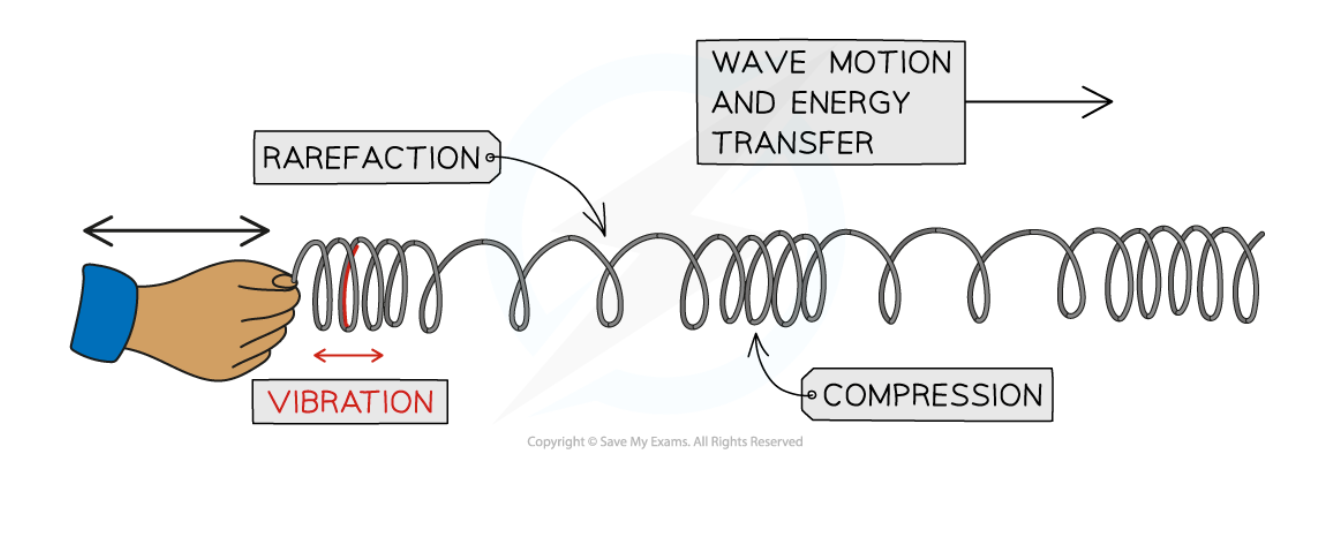
Example of a longitudinal wave
Longitudinal waves can be demonstrated in a slinky spring when it is moved quickly backwards and forward
Examples of longitudinal waves are:
sound waves
P-waves (a type of seismic wave)
pressure waves caused by repeated movements in a liquid or gas
Representing longitudinal waves
Longitudinal waves are usually drawn as several lines to show that the wave is moving parallel to the direction of energy transfer
Drawing the lines close together represents the compression
Drawing the lines further apart represents the rarefactions
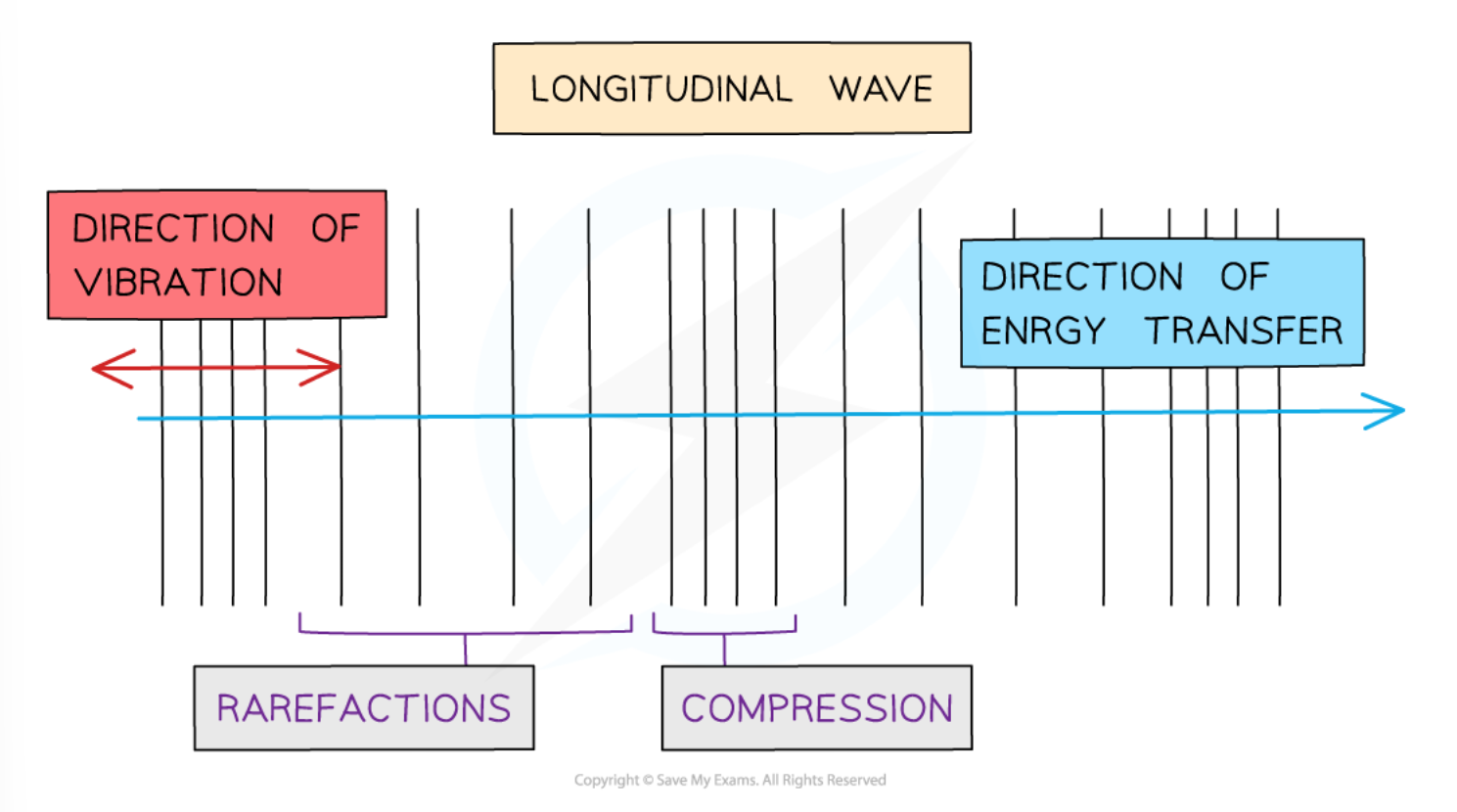
Longitudinal wave rarefactions and compressions
Longitudinal waves are represented as sets of lines with rarefactions and compressions
Transverse v Longitudinal Waves
Wave vibrations can be demonstrated on ropes (transverse) and springs (longitudinal)
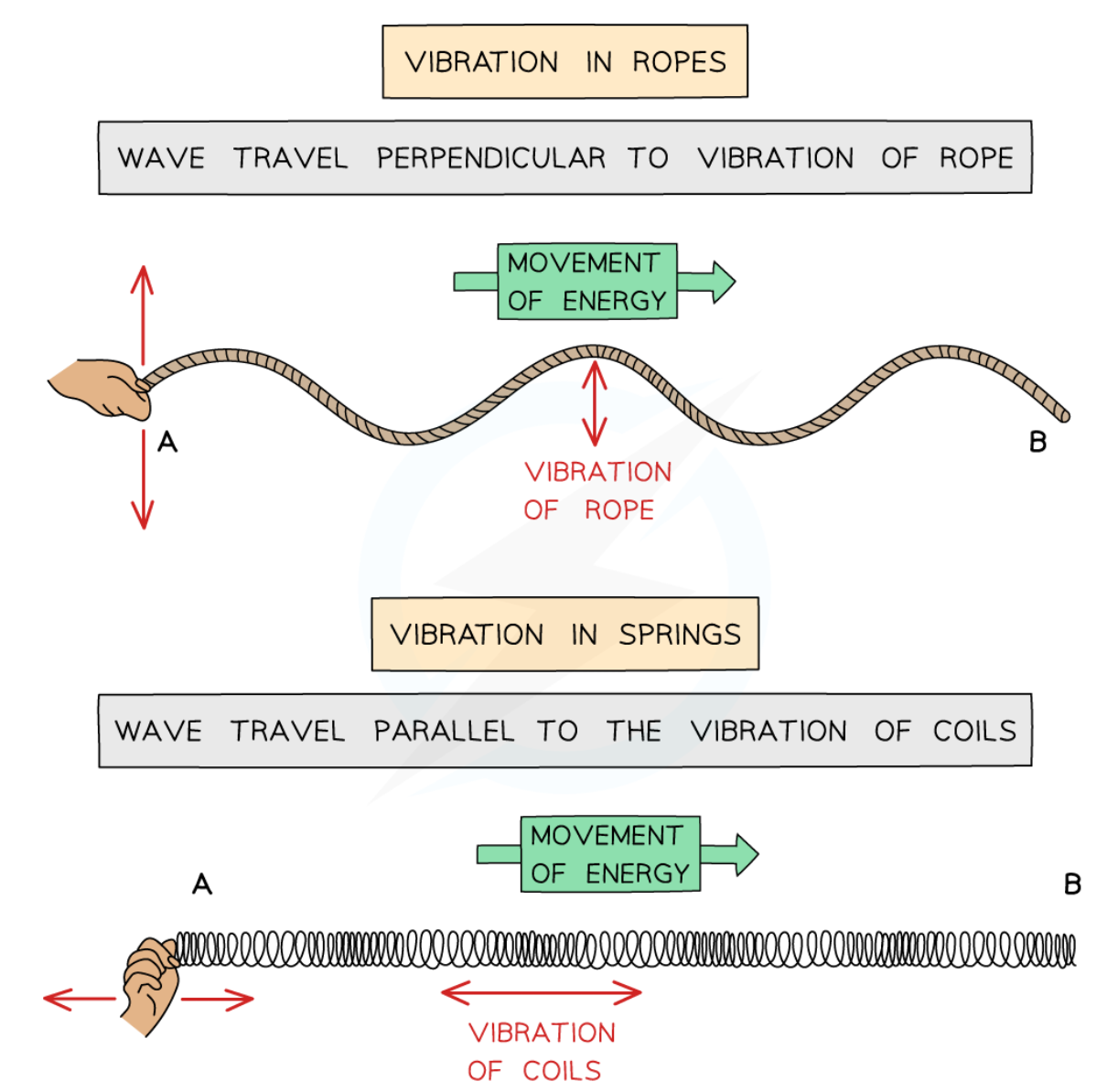
A comparison of longitudinal and transverse waves
Wave motion can be demonstrated through vibrations in ropes or springs
Property | Transverse waves | Longitudinal waves |
Structure | Peaks and troughs | Compressions and rarefactions |
Vibration | Right angles to the directions of energy transfer | Parallel to the direction of energy transfer |
Vacuum | Can travel in a vacuum (electromagnetic waves only) | Cannot travel in a vacuum |
Material | Can move in solids on the surface of liquids | Can move in solids, liquids and gases |
Pressure | Pressure is constant | Pressure is not constant |
Speed of wave | Depends on the material it is travelling through (fastest in a vacuum) | Depends on the material it is travelling through (fastest in a solid) |
Wavefronts
Both transverse and longitudinal waves can be represented as wavefronts
This is where the waves are viewed from above
For a transverse wave:
One line represents either a peak or trough
For a longitudinal wave:
One line represents either a compression or rarefaction
The arrow shows the directions the wave is moving and is sometimes called a ray
The space between the lines represents the wavelength
When the lines are close together, this is a wave with a short wavelength
When the lines are far apart, this is a wave with a long wavelength
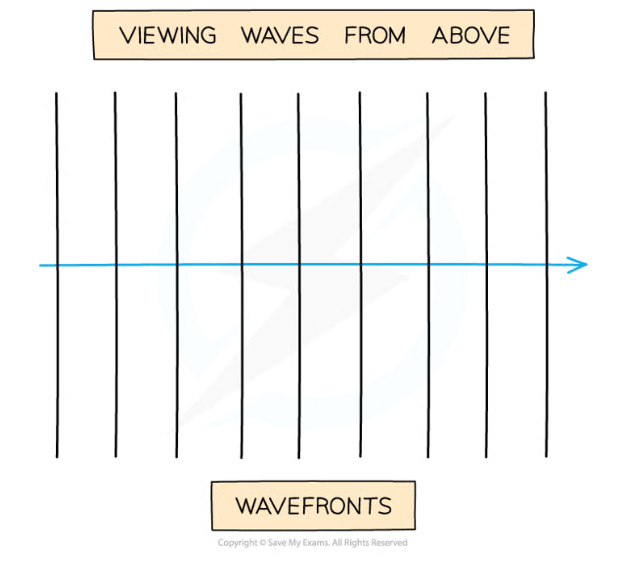
Wavefronts as viewed from above
Diagram showing a wave moving to the right drawn as a series of wavefronts
Examiner tips and tricks
Exam questions may ask you to describe waves, and this is most easily done by drawing a diagram of the wave and then describing the parts of the wave - a good, clearly labelled diagram can earn you full marks!
Make sure you know the difference between the wave front diagram and the longitudinal wave diagram; do not confuse the two!