Memory
Multi-Store Model
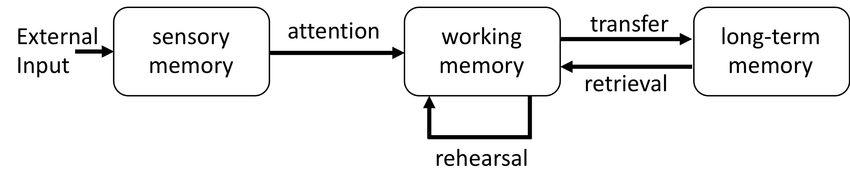
- Sensory register- receives raw sense impressions, passes info to STM if attention is paid to it
- Short-term memory- receives info from sensory register by attention or LTM by retrieval, sends info to LTM if rehearsed
- Long-term memory- receives info from STM if rehearsed
| Coding | Capacity | Duration | |
|---|---|---|---|
| Sensory Register | Sense dependent | Very large | 1-2 seconds |
| STM | Mainly acoustic | 7 +/- 2 | 18-30 seconds |
| LTM | Semantic | Theoretically unlimited | Potentially lifetime |
:) Baddeley- immediate recall was worst for acoustically similar and recall after 20 mins was worst for semantically similar
:) Peterson and Peterson- recall of trigrams (e.g. HFR, TKD) was under 10% after 18 seconds if performing an interference task (e.g. counting backwards)
:) Bahrick- recall of classmates in photographs was 90% after 15 years and 80% after 48 years, :) used meaningful info so high ecological validity, :( little control over extraneous variables
:) Henry Molaison- hippocampus removed (associated with LTM), could remember things for only a few minutes, suggests he damaged LTM
:( KF- suffered brain damage from a motorcycle accident, lost STM but kept LTM, impaired verbal STM and intact visual STM, MSM says info must go through STM to get to LTM
:( Oversimplifies STM- appears to be much more complex than it is presented to be, WMM explains it more
Types of LTM
- Episodic- experiences and events, declarative
- ‘Time-stamped’ (reference to time and place)
- Associated with hippocampus and prefrontal cortex
- Semantic- facts, meanings and knowledge, declarative
- Associated with Perirhinal cortex
- Procedural- unconscious memories of skills, non-declarative
- More resistant to forgetting than episodic or semantic
- Associated with motor cortex and cerebellum
:) Clive Wearing- has retrograde amnesia. Can’t remember his musical education (episodic), remembers facts about his life (semantic) and how to play piano (procedural). Can’t encode new episodic memories but can gain new procedural ones
:) Henry Molaison- hippocampus removed to prevent seizures, lost ability to make new episodic and semantic memories but kept procedural memory
:( Based on case studies- lack control to establish a cause and effect relationship, hard to generalise
Working Memory Model
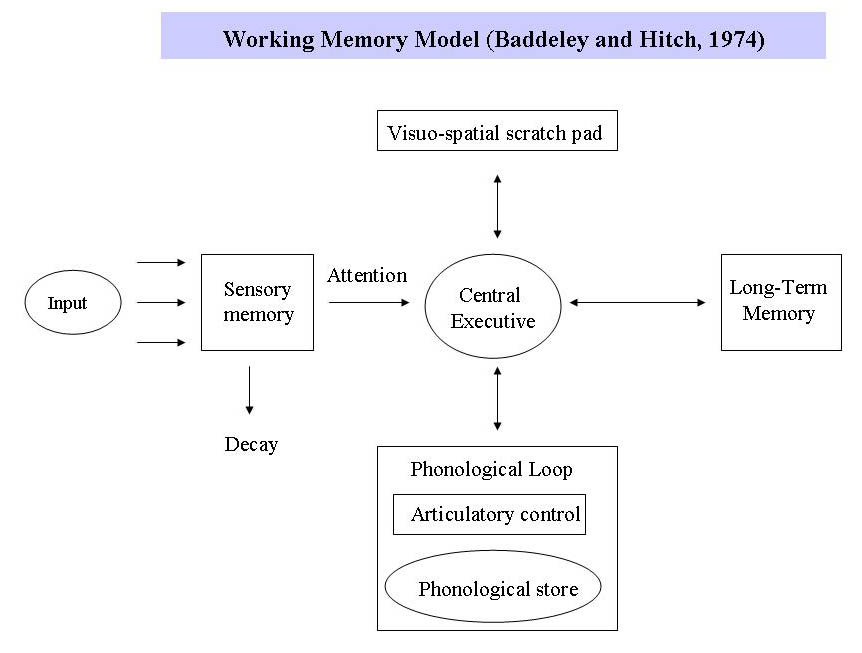
- Central executive- filters info and allocates it to the ‘slave’ systems
- Episodic buffer- general (multimodal) store to hold and combine information from other stores
- Phonological loop- processes sound information
- Phonological store- acts as a filter for auditory and verbal information, stores it for 1-2 seconds
- Articulatory process- stores auditory and verbal information while needed for an ongoing task
- Visuo-spatial sketchpad- processes visual and spatial information
- Visual cache- stores visual information
- Inner scribe- stores spatial information
:) KF- suffered brain damage from a motorcycle accident, lost STM but kept LTM, impaired verbal STM and intact visual STM, explains it as his phonological loop could be damaged but visuo-spatial sketchpad and episodic buffer were okay
:) Baddeley- dual-task procedures, one group did two visual tasks and the other did one verbal and one visual task. Second group performed better because two tasks used different stores
:( Central executive lacks falsifiability (results can always be argued to support) and may be more than one component, e.g. planning, attention and response inhibition
:( Relies on lab studies- may lack ecological validity and generalisability
Explanations for Forgetting
Interference
- Where information becomes confused with each other
- Proactive interference- old info disrupts retrieval of new
- Retroactive interference- new info disrupts retrieval of old
- More likely when the two pieces of information are similar
:) Underwood and Potsman- two groups of participants had to learn a list of word-pair lists, experimental group then had to learn another list where the first word of each pair was the same as the first list. Experimental group recalled first list worse due to retroactive interference
:) Schmidt- the more times someone moved house, the fewer street names could be recalled- retroactive interference, remembering new streets makes recalling old names harder
:( Only explains forgetting when the memories are similar
Cue-dependent Forgetting
- When a memory is encoded, information around the memory is also remembered
- Info is in LTM but there are no retrieval cues to remember
- Context-dependent cues- environment e.g. school, forest
- State-dependent cues- internal states e.g. sad, cold
:) Godden and Baddeley- divers learnt info underwater or on land then were tested either in same or different environment, recall was best when in the same environment (environmental cues)
:) Overton- students learnt information drunk or sober, recall was best when in the same state (state cues)
:( Based on lab experiments with meaningless information- lacks ecological validity and generalisability
:( Less relevant to procedural memories
Factors Affecting EWT
Leading Questions
- Questions that imply a particular answer, can influence recall and make us remember things that didn’t really happen
:) Loftus and Palmer- participants shown clips of traffic accidents then asked a leading question about the speed of the cars, if “contacted” estimated speed was 32mph, if “smashed” it was 41mph. A week after seeing the clip, if asked, “Did you see the broken glass?”, some participants said yes even if there was none :( Demand characteristics :( Lab experiment, low ecological validity
Post-event Discussion
- People discuss an event after it happens, can cause re-interpretation and mis-remembering of the event
:) If witnesses are warned of the impact of post-event discussion, they can avoid it
Anxiety
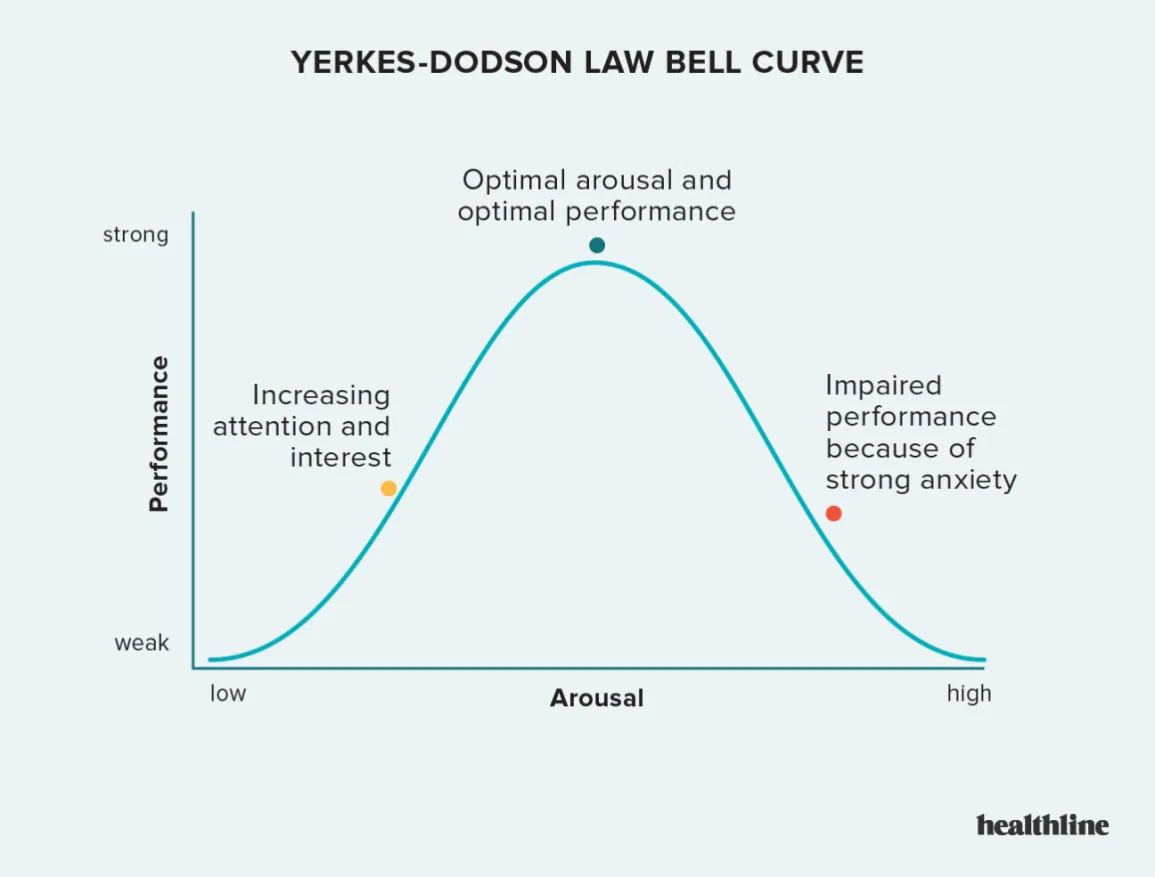
:) Loftus- participants saw a man either holding a pen covered in grease or a knife covered in blood, had to identify the man from 50 photos. Low anxiety were 49% accurate, high anxiety were 33% accurate
:( Yuille and Cutshall- real witnesses of a shooting (high anxiety) had very good memory accuracy 5 months later :( Real event so hard to control extraneous variables
Schemas
- If parts of a memory are forgotten, schemas will fill in the gaps
- This can lead to false memories that fit in with the schemas
The Cognitive Interview
- Context reinstatement- mentally returning to the crime scene, triggers retrieval cues
- Recalling thoughts and feelings can help with internal cues
- Recalling experiences can help with external cues
- Report everything- all details, even if they seem irrelevant, should be mentioned- could be actually relevant or act as retrieval cues
- Change perspective- consider point of view of another witness or perpetrator to disrupt schemas
- Change order- switch to a different chronology to check accuracy and disrupt schemas
- Enhanced cognitive interview- focuses on building trust, better for children
- Includes avoiding interruption or distraction, gives witness more control over flow of info and encourages witnesses to not guess and say when they are unsure
:) Geiselman- during a real lecture, got an intruder with a blue backpack to steal a slide projector, 2 days later students were interviewed. Half standard interview, half cognitive interview, all asked a leading question saying the backpack was green. Later asked to recall the colour, cognitive group were less likely to say it was green
:( Time consuming- needs more time than the police have available, also ineffective in improving recognition of suspects in photographs
:( Less effective on children- more susceptible to leading questions, can become anxious, some techniques can be too complicated for them