Internal Influences on Businesses
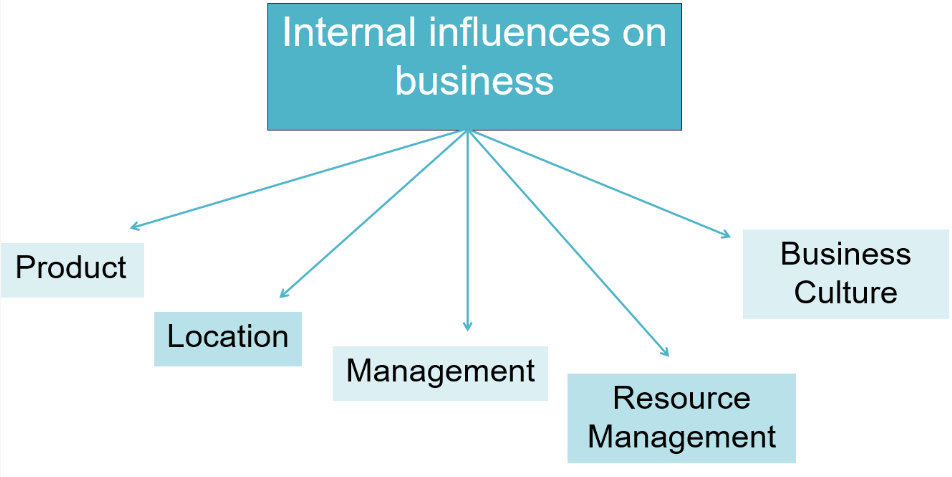
Product Influences
There are 3 main product influences:
the type and range of goods and services provided (large goods or require lots of input, business will structure differently to a service based or small goods)
the type of business (the business structure differs across industries)
the size of the business (the larger the business, the more goods and services produced, the more complex operational structure)
Location Influences
Complementary business; one that sells a similar range of foods and services.
These can be beneficial to location next to as they attrac similar customers to a single site. (e.g., cars and petrol, bedding and furniture)
There are 5 main location factors:
Proximity to Support Services→ activities adn services neeed to assist the core operations
Proximity to Customers → depends on the type of business (e.g. retail vs. manufacturing)
Proximity to Suppliers→ minimises transport costs, ensures stable supply chain, beneficial for larger goods
Cost→ leasing/purchasing in a centre is more expensive as it guarentees traffic, a business must be confident in generating success if the cost is unavoidable.
Visibility→ if not visible customers will not make the effort, only required for certain business types.
Resource Influences
Four main resources available to businesses are:
Human resources→ employees (most important assest)
Information resources→ knowledge and data required by the business
Physical rsoueces→ equipment, buildings, machinery, input, etc.
Financial resources→ funds used to meet obligations to creditors.
Management Influences
Businesses have begun to “flatten” their structure so that there are fewer levels of management to give greater responsibility to individuals, quickly adapt ot changing consumer needs, and to repsond to fluctuating marketing conditions.
Characteristics of traditional organisational structures (less fluid)
task/activity centered
division of labour, labour specialisation
rigid structure, hierachical
power not shared (exclusive)
delegation, top down
Characteristics of new and emerging organisational structures (more fluid)
people centered
multi-task, multi-skilled
flexible structure
democratic
communication, by consensus.
Business Culture
Business culture refers to the values, ideas, expectations, and beliefs shared by a business.
Knowing and appreciating a business’s culture allows things to get done faster, intiate a change, clear expecations, and create a sense of belonings.
Failure to understand will result in business failure.
Business culture elements:
Values
Symbols
Rituals, rites, and celebrations (e.g. social gatherings that develop a sense of belonging)
Heroes
Employees, especially managers, need to be role models and reflect values that the business considers important.