Historical Perspective
Definition (#f7aeae)
Important (#edcae9)
Extra (#fffe9d)
LEARNING OBJECTIVES:
Describe key beliefs and treatments in different eras.
Identify Freud’s major contributions to modern psychotherapy.
Summarize core ideas of behaviorism, CBT, humanistic, feminist and postmodern therapy.
Trace the evolution of mental health care in Malaysia.
Timeline:
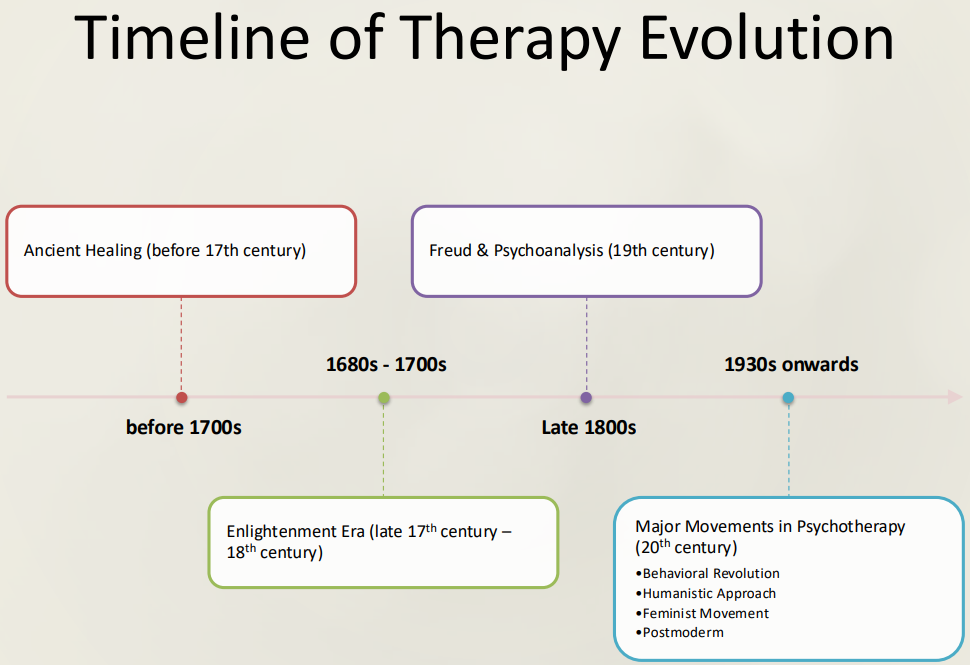
Ancient Healing:
Mental illness: spiritual/ moral imbalance.
Shamans, rituals, ancient Greek medicine, ayurveda, Qi-based medicine.
Ritualistic dance, spiritual storytelling, community support, guided visualization.
Enlightenments Era:
17-18th century.
Rene Descartes, John Lock, David Hume, Immanuel Kant.
Rationality, mind-body dualism.
Shift from viewing mental illness as criminal to treatable—emphasizing dignity and humane care over confinement.
Philippe Pinel, humane treatment (moral era).
Freud & Psychoanalysis:
Unconscious, hysteria, free association, dream analysis. Exploration of childhood and unconscious drives.
Post-Freudian Thinkers - Carl Jung, Alfred Adler, Erik Erikson, Karen Horney.
Laid the foundation for modern psychotherapy by suggesting that emotional release and insight could reduce symptoms; marking a revolutionary shift from physical to psychological treatment of mental illness.
Major Movements in Psychotherapy:
Behaviorism & CBT:
Observable behaviour.
Watson, Skinner, Beck, Ellis, Bandura.
Humanistic:
Emphasized free will, growth, hierarchy of needs.
Rogers, Maslow.
Feminist:
Focused on gender oppression and societal injustice.
Miller, Comas-Diaz, Hooks, Brown.
Postmodern:
White, Epston (Narrative); reality is socially constructed and linguistically constructed.
DeShazer (Solution-Focused)
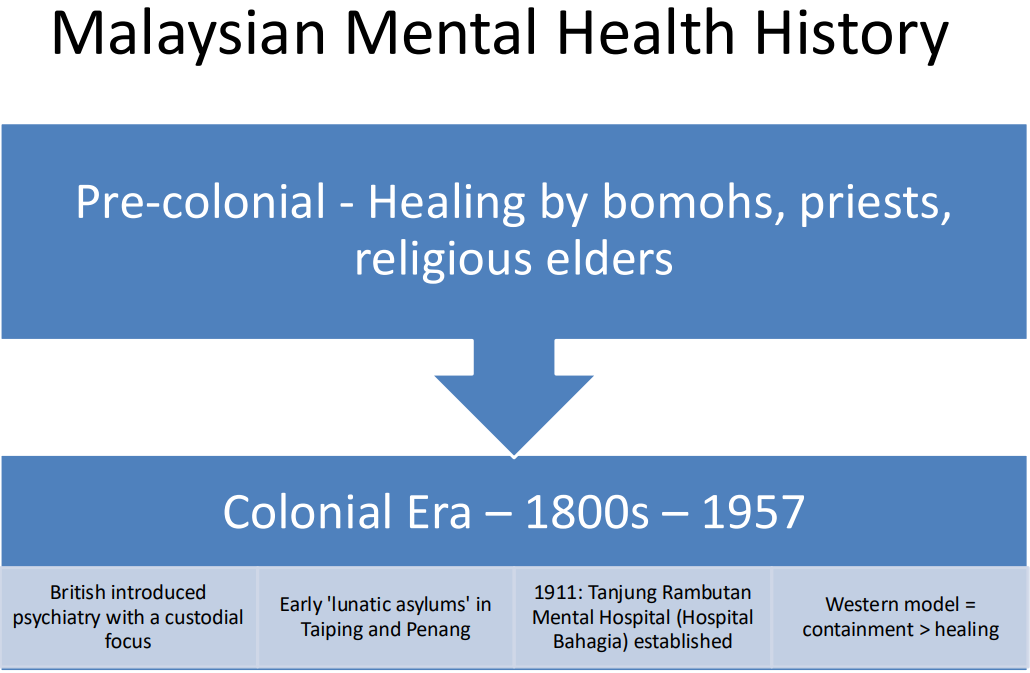
MALAYSIAN MENTAL HEALTH HISTORY:
Post independence (1957-1980s):
Hospital Bahagia (formerly known as Tanjung Rambutan Mental Hospital) central to psychiatric care.
Widespread stigma and family secrecy.
Limited training for local mental health professionals
Modernization & reform (1990s-2000s):
Rise in depression, suicide, student burnout,
2001: Mental Health Act (MHA) enacted.
Community-based care and rights-based approach.
Mental Health Promotion Advisory Council formed
Contemporary Challenges (2010s–Today):
Online activism: #MentalHealthAwarenessMY.
NGOs like Befrienders, MIASA, SOLS Health.
COVID-19 highlighted accessibility gaps.
Challenges: therapist shortage, stigma, language, rural gaps.