Synthesising Key Research & Themes
26th
Space for gardens
Building houses will be modular because they are cheaper and quick to make
Our site is so close to the water and has so much space (tu kuupenga) makes it more suitable
Ake Ake Ake talked how the local people were upset because housing should be for them such as the rest of their whanau move in
Mainly young and old people
Sense of purpose (have purpose)
Connection between people and land
How you walk through the space
Attach houses around a courtyard but not like townhouses
Take a typology and make a twist from it (look into alternatives of that ¾ housing)
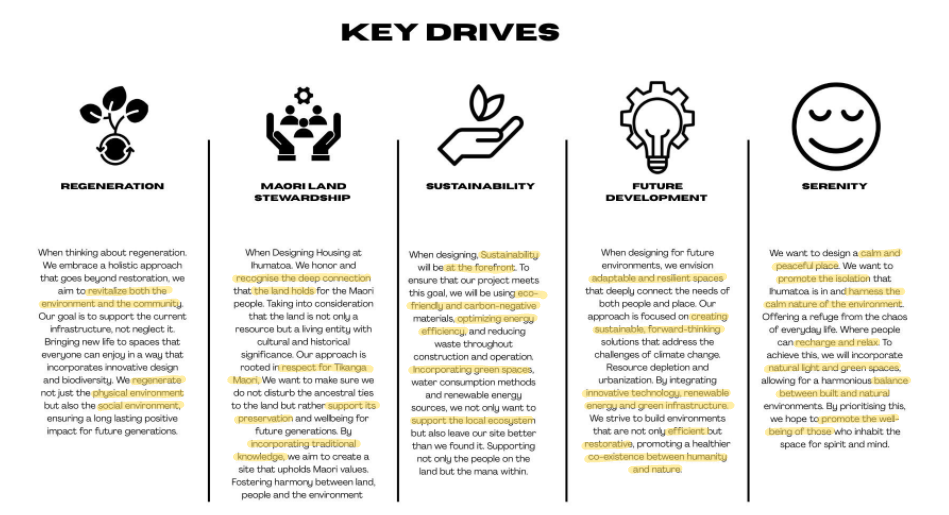
Goals: key themes to be done
Cultural relevance (past and present)
Regeneration (can be a way to restore a site)
Future development
4-5 typologies (me prob duplex)
Range of strategies to solve or target these ideas
31st
Key themes established
Design strategies implementation (Tuu penga)
Te Ahi Waru is the hapu (specific divisiion of maori) in the iwi (community)
Not to design whole block (half communal half living)
Don’t want to disturb existing village we want to make other space a communal space like a park (that has outdoor kitchen/cooking area + playground)
Good medium density for whanau
Less building footprint more green space
Little oasis from everyday life
From previous projects (entrance points, relation to maunga and marae to inform how building placement acknowledges other important significant sites in Ihumatao, relation to land, spaces for ecological and costal regeneration)
Typologies
Duplex for young families
Terrace housing
Co-housing research
Adaptive re-use (if heritage protected but none of the ones on site are)
Main talk and ideas for our group
Our foundations were discussed and started how to apply onto site
Split site into two have housing at the bottom and community area at the top (because the top road has houses there already so when you implement a new population into that same area of front road then you swamp traffic and congestion of emissions so better to free up that space, have communal to include other communities as well that can use those communal spaces)
Housing typologies to be discussed
Gardening we can have in both areas, we want to look at making a new playground and a community outdoor cooking space
Housing looking at medium density terrace housing, bring the whanau back home
How can we place buildings in a way that promotes passive heating, cooling, solar energy
2nd April
For top area
For the shed on the top of site it can be repurposed Water tank on roof, so can have a pitch on roof so water is self sustaining from itself with extension out like veranda where that space is an extension of the kitchen.
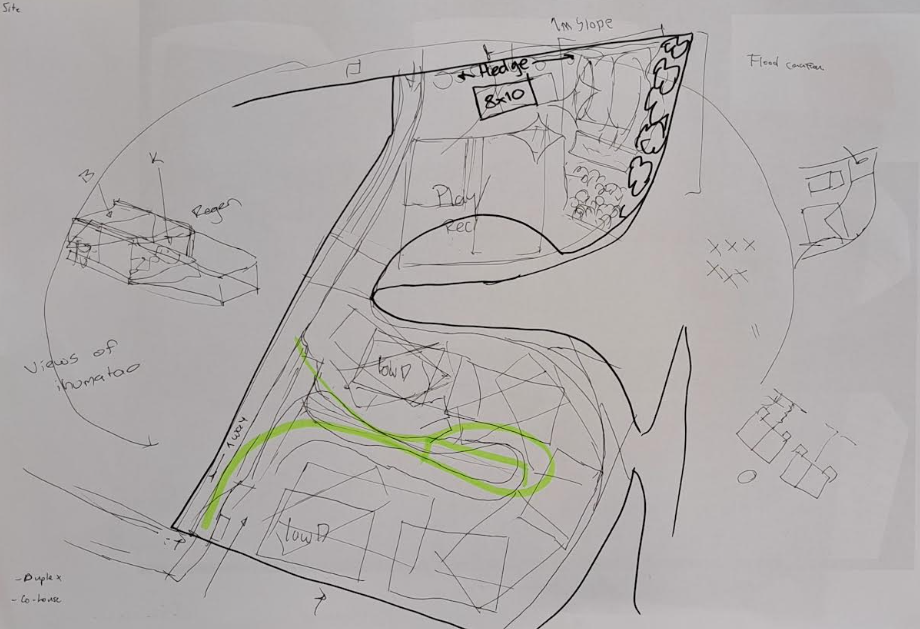
Whole site is sloped by 1m but mainly flat
Sails for shading
Every side of house is hit by sun in afternoon, passive heating strategy of heating concrete slab (if it can be to the back of the house where you can make concrete slab as shared space area that also passively heats, the shading for outdoor space can be half the size of mezzanine outdoor area and slightly over the slab so it doesn’t cover the slab for passive heating)
One of our lenses building up not only the people that live in the site but also the community so we add new playground here and so how they used to give with food baskets so we add garden areas around the area
Shed on a concrete pad so we disassemble some of it and keep concrete and build public toilets, kitchen area, sitting area on deck, relating to history space for fruit trees, hangi pits, plant boxes (lettuces, not like kumara)
Playground close to top road so other people can access it with hedges as natural fencing
Need to see distance between trees and shed is like in real life
Bottom area
incorporate terraces along the contour
Houses wrapping around that creates a path
Orientate houses based on entrance so they face cul de sac and have parking space for cars and letter boxes
Keeping environment but we keep trees and toss shrubs and do our orientation based on that way.
Low density (not tall buildings near the entrance)
Take into account viewing of site from outside
Site focuses on young and old people
Open naturous space, focus on biomimicry relation to ecology and organism
Keep courtyard and paths so you get that social interaction within community
Maori systems, base our houses on maori practices and seeing how they built in the past (eg wharenui placed ridge beams in a certain way)
Still use modern external cladding, that we all use to keep them looking similar
Have garages in their units
Not asphalt road different type that doesn’t make it feel like its an industrial road
Off-street parking (demographic is young and old and old people don’t want to walk so cul de sac will create easy access for like cars)
Prob gonna do single story with a mezzanine floor (for context of low density housing around area)
basic necessities bedroom, bathroom, kitchen, living and dining (find purpose for mezzanine for innovative aspect)
3d model of site and buildings helps with design process because it serves as a base how we’re putting stuff on here how its interacting with land and for future when we design houses we can put them on here, so have it done now so we don’t have to worry about it later.
Look into trees because there might be things we can keep and use and that’s how we’ll orient our buildings
Formal entrances to be established (curve created can influence )
Figuring out what typologies, their size, then you can figure out what you can/can’t do on site, essentially working to scale. Work out next presentation work on design strategies, typologies, site plan, as we present our masterplans next half of semester.
Contour model pretty much helps with workflow for conceptual models to be placed on, Revit good to look into as well just used rhino cuz you can work collaboratively as well. But if everyone works on it at same time it can maybe crash (Balkan Architect to fix any problems or want to do a specific task and design platform to learn)
Rhino can put in blocks (eg 6×3), from there you can produce in 3d so it’s a different type of analysis but needs to work to scale. Print out screenshots of different views and then overlay with sketches.
useful for 3D model you can start look at shadows and figuring out how buildings interact with each other, zoom in see how much space you have between buildings.
suggested one duplex, one duplex, another typology, another typology
In AutoCAD for me can draw out house floor plans and drafting etc (for later)
CNC is where rhino comes in, Revit can do everything on it just harder
Next part of assignment everyone should be on Revit (develop massing etc)
Photoshop and Illustrator more focused this year
Jye making masterplan on AutoCAD
Assignment 2 for ecologies the 3D model of structural system and cladding of house can be made from Revit (practice in holidays)
7th April & 9th (Studio & Site Visit)
Focusing on idea of shared spaces, but focus brief which is more making two families that may not be related have shared living spaces outdoor and indoor if you can (maybe the mezzanine can be shared space ‘research this‘ and lower can be individual space)
Seaweed insulation a sustainable solution for roofing (vikings used it on top of houses and its carbon neutral) / Hemp wool acts insulation & its regenerative (can be varied between our buildings and see which would suit ours better)
Glass and light wells (can be incorporated to mezzanine area)
Green roofs / Pitched roofs
Facade could utilise stone to link to scoria rock
Recycled glass
Trianlge maori entrance/Arch entrance
For me could be I’ll focus on pa system as inspiration to inspire form, design ideas of my duplex housing

Common method for our housing
foundations that are able to be removed (for like movable houses) so it doesn’t effect the land as much
Solar panels on one part of our pitched roofs cutting down costs for expenses (you need transformers along with panels)
For family need probably 4 bedrooms (one for whanau coming in and 1 for parents and 2 bedrooms for kids), could have bunk beds in two rooms so can fit up to 4 kids.
If cutting into structure then need to look at foundations
Water can be connected from solar panels, but don’t put solar panels on all the roofs as water falls into the gutters.
Base of building off wharenui (ridge beams, lashings, which is easier if gabled) and pa systems.
Different areas communicate different ideas from present and as you move in there’s more heritage and past ideas communicated through material, design etc with contemporary look
Recognising history of land
Orientation to significant areas
Relationship to land
Whakawhanaungatanga ‘communal areas’ (so mezzanine for me)
Miro
design strategies
Wood as much as possible (concrete foundations)
use of scoria around the site
sustainable insulation materials - ie hemp wool or seaweed
lots of natural lighting
minimal disruption to the land
designing for deconstruction
Gabled roof - low pitch angled, can have glass and have gutters hang off it
passive heating and cooling
water collection
aesthetically pleasing and functional but also carry meaning and connect the finished work with both people and place
aim to weave together the following key threads:
Te Ahiwaru Brief: Prioritizing whaanau aspirations, intergenerational living, cultural appropriateness, safety, security, and affordability.
Low Carbon Design: Employing sustainable materials, energy-efficient strategies, and minimizing the environmental footprint.
Innovation: Exploring new spatial arrangements, construction techniques, and integrated technologies.
Unique Design: Creating a distinctive aesthetic that reflects the identity of Te Ahiwaru and the specific papakaainga context.
Maori Architecture: Drawing inspiration from traditional forms, materials, spatial organization, and cultural symbolism.
Threads realized:
Spaces that promote connection and interaction and can be flexible (support different activities)
Use of natural materials
strong visual connection to the land
Shared amenities and living - connected ground floor?
Shared living spaces
office room areas
Universal access - cater to elderly
north facing windows
tell the story of the fletchers development in some form
To do during break
Work on your typology and applying the strategies to your design and have concepts
still waiting to know what our next steps are but pretty much we should all now be looking towards having our typology sussed, look into the Māori typology stuff they talked about the other day and start looking at and saving a bunch of diffrent forms that we can then all combine another good thing to look at would be the structuring of maraes and how wharenuis are built also have a little think about if there’s anything missing for the master plan Jye going to be refining it over the next couples days then I’ll chuck it in here
try keep up with the communal spaces on our site so just thinking about what that could look like on the ecology point
it’s important to not design the buildings by starting with a floor plan and rather designing from forms and ideas for the building otherwise you can be locked into a specific form and they want to see us developing our designs
- what are the precedents behind the building before designing the building
start with a narrative and when move it through to the final and concepts using pieces of the narrative. conceptual elements are what develops the final model
research mana whenua and from there find out about some story about a volcano that they’re tied too and then explore the qualities of that volcano and then the rock from that volcano can be used in the walls of the building
use different mediums to experiment and help find creative iterations