General Psychology Day 8
What is Lifespan Development:
Explores how we change and grow from conception to death
Maturation (biology) interacts with experience (environment)
Studied by developmental psychologists as a lifelong process across three developmental domains:
Physical
Cognitive Development
Psychosocial
Physical Development: Prenatal:
Germinal (weeks 0-2): Zygote divides, travels to the uterus, and implants
Embryonic (weeks 3-8): Organs & neural tube form; most vulnerable to teratogens like alcohol
Fetal (weeks 9-birth): Rapid growth & brain wiring; viability begins around 24 weeks
Physical Development: Infancy & Childhood:
Reflexes (rooting, grasping) give way to voluntary movement
Motor milestones follow an order: roll, sit, crawl, walk
Nutrition, sleep, and safe play shape healthy growth
Physical Development: Adolescence:
Puberty: Hormones trigger the growth spurt & sexual maturation
Timing varies widely, and early or late maturing brings social challenges
Prefrontal cortex matures into the mid-20s; reward systems come earlier
Teens need about 8-10 hours of sleep and have a later body clock
Risk-taking peaks when emotions run high and peers are present
Physical Development: Adulthood/ Late Adulthood:
Physical peak in the 20s: strength, reaction time, fertility
Gradual decline from about 30: metabolism, muscle mass, near vision
Midlife: biological women → menopause (~51); biological men → slower hormonal changes
Primary aging (universal) vs. Secondary aging (disease, lifestyle)
Exercise and social engagement protect the aging brain and body

Erik Erikson’s Stages of Psychosocial Development:
Erikson was born in 1902 in Germany; trained under Anna Freud (Sigmund Freud’s daughter)
Influences: Psychoanalysis, culture, and identity formation
Contribution: Developed the Theory of Psychosocial Development — extending Freud’s work beyond childhood to the entire human lifespan
Believed that at each stage of life, individuals face a psychosocial crisis that shapes their identity

The Framework of Psychosocial Development:
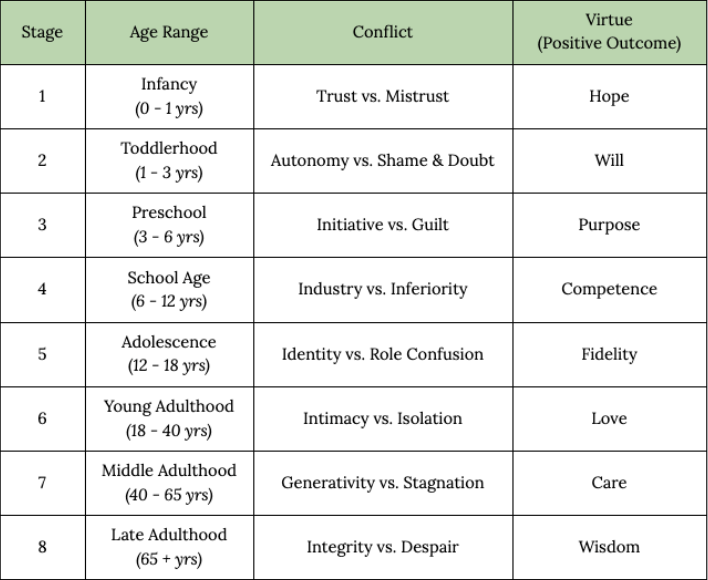
Personality develops through eight stages, each defined by a central psychosocial conflict
Each crisis must be resolved — positively or negatively — influencing later development.
Stages are cumulative and build on earlier outcomes
Development is shaped by social interaction, culture, and life experiences
Successful resolution → Strength (or “virtue”) that supports the next stage
Summary: Development is a lifelong process influenced by social and cultural experiences
Stage 1: Trust v. Mistrust (Infancy: 0-1 year):
Virtue Developed: Hope — belief that the world is safe and needs will be met.
Infants depend entirely on caregivers for food, warmth, and safety
Consistent, loving care → Trust, security, and confidence in the world
Neglect or inconsistency → Mistrust, fear, and suspicion
Stage 2: Autonomy v. Shame & Doubt (Toddlerhood: 1-3 years):
Virtue Developed: Will — a sense of independence and self-determination
Toddlers explore independence through actions like walking, choosing, and toilet training
Encouragement & Patience → Autonomy, self-control, and confidence
Criticism or Overcontrol → Shame, doubt, reluctance to act independently
Stage 3: Initiative v. Guilt (PreK/K: 3-6 years):
Virtue Developed: Purpose — confidence in one’s ability to take initiative
Children begin to initiate activities, assert power, and develop leadership
Supportive environments foster creativity and initiative
Harsh discipline or discouragement leads to guilt and self-balance
Stage 4: Industry v. Inferiority (School Age: 6-12 years):
Virtue Developed: Competence — belief in one’s ability to work hard and achieve
Focus shifts to school performance, learning, and productivity
Encouragement and recognition foster competence & motivation
Failure or comparison to peers may cause feelings of inferiority
Stage 5: Identity v. Role Confusion (Adolescence: 12-18 years):
Virtue Developed: Fidelity — commitment to self and values
Adolescents explore identity, beliefs, and future roles
Success → Stable identity and self-acceptance
Failure → Role confusion, insecurity, and lack of direction
Stage 6: Intimacy v. Isolation (Young Adulthood: 18-40 years):
Virtue Developed: Love — the ability to form lasting, committed relationships
Young adults seek deep, meaningful relationships and emotional bonds
Strong identity allows for intimacy & trust
Fear of rejection or commitment can lead to isolation and loneliness
Stage 7: Generativity v. Stagnation (Middle Adulthood: 40-65 years):
Virtue Developed: Care — concern for others and society
Focus on productivity, creativity, and legacy — through work, family, or community
Generativity means investing in others and guiding future generations
Stagnation results in self-absorption or lack of purpose
Stage 8: Integrity v. Despair (Late Adulthood: 65+ years)
Virtue Developed: Wisdom — acceptance of life & readiness for closure
Reflection on one’s life, accomplishments, and meaning
Integrity arises from satisfaction and acceptance of life
Despair occurs when one feels regret or a sense of failure
Piaget’s Stages of Cognitive Development:
Jean Piaget was a Swiss developmental psychologist known for children’s cognitive development
Worked with Alfred Binet (creator of first intelligence test), became fascinated by children’s reasoning errors
Piaget proposed that children actively construct their understanding of the world through a series of developmental stages
His theory emphasizes qualitative changes in thinking — not just accumulating knowledge but transforming how we think
Key Concept: Piaget saw children not as “miniature adults” but as active scientists constructing their own understanding of the world.
Core Concepts in Piaget’s Theory:
Constructivism: Children build mental frameworks to understand their experiences
Schemas: Mental structures or frameworks that help organize knowledge
Equilibration: The balance between assimilation and accommodation that drives development
Accommodation: Changing schemas to fit new experiences (Ex. when corrected about four-legged animals, they learn “cat” is a new category)
Assimilation: Fitting new experiences into existing schemas (Ex. a child who knows dogs may call all four-legged animals “doggies”)
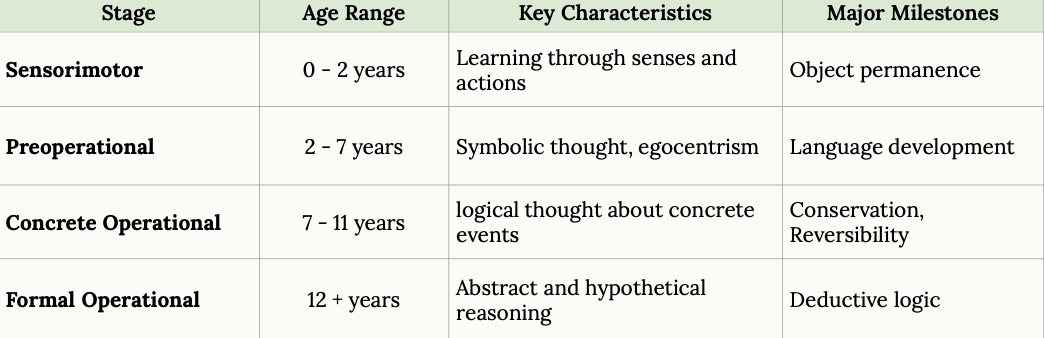
Sensorimotor Stage (0-2 years):
Infants learn about the world through sensation & movement
Actions like grasping, sucking, and looking are ways to explore and learn
Development of object permanence — understanding that objects continue to exist even when unseen (around 6-12 months)
Early signs of intentional behavior (e.g. reaching for a hidden toy
Key Concept: “Out of sight” does not mean “out of mind” — once object permanence emerges, memory and prediction begin to develop
Preoperational Stage (2-7 years):
Characterized by symbolic thought — children can use words, images, and symbols to represent objects
Growth in language and imagination
Egocentrism: Difficulty seeing the world from other's’ perspectives
Centration: Focusing on one aspect of a situation while ignoring others
Lack of Conservation: Believing that changing shape changes quantity (e.g. taller glass has “more water”)
Concrete Operational Stage (7-11 years):
Children begin to think logically about concrete events and problems
Understand conservation, reversibililty, and classification
Decentration: ability to consider multiple aspects of a situation simultaneously
Logical reasoning develops, but limited to tangible and familiar concepts
(e.g. understanding that 3+2=5 and 5-2=3)
Formal Operation Stage (12+ years):
Emergence of abstract, hypothetical, and deductive reasoning
Ability to think about possibilities and test hypotheses systematically
Understanding of moral, political, and philosophical concepts
Not all individuals reach full formal operational thinking consistently in all areas
(e.g. solving algebraic equations or thinking about “what if” scenarios)
Critiques and Modern Perspective:
Piaget underestimated children’s abilities — later research shows earlier signs of reasoning
Development may be more continuous and variable across individuals than Piaget proposed
Cultural and social influences are underemphasized in Piaget’s theory
Applications of Piaget’s Theory:
Education: Emphasized active learning and discovery through hands-on experiences
Teachers can tailor instruction to a child’s cognitive stage
Encourages curiosity and problem-solving rather than rote memorization
Classroom examples:
Sensorimotor: Play based learning
Preoperational: Use of symbols and stories
Concrete Operational: Hands-on science experiments
Formal Operational: Abstract discussions and hypothetical debates
Lawrence Kohlberg’s Stages of Psychosocial Development:
Moral Development:
How we judge right and wrong, and how we act on it
Three components: reasoning, emotion (empathy, guilt), behavior
Moral reasoning builds on cognitive growth and perspective-taking
Key Voices: Piaget, Kohlberg, Gilligan, Eisenberg
The Heinz Dilemma:
Heinz’s wife is dying, the druggist charges far more than he can pay
Should Heinz steal the drug?
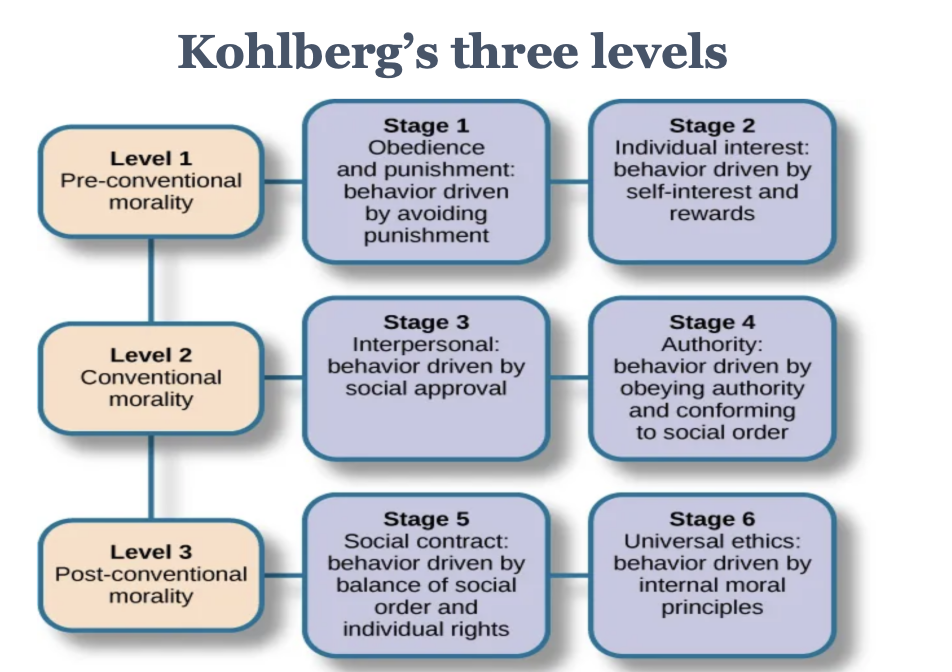
Kohlberg scored the reasoning, not the yes/no answer
“He’ll go to jail” (Stage 1) v. “Life outweighs property” (Stage 5)