CHAPTER 10: GASES
Characteristics of Gases
- Substances that are liquids or solids under ordinary conditions can also exist in the gaseous state, where they are often referred to as vapors.
- The physical properties of gases differ significantly from those of solids and liquids.
- Gases also are highly compressible: When pressure is applied to a gas, its volume readily decreases.
- The characteristic properties of gases—expanding to fill a container, being highly compressible, forming homogeneous mixtures—arise because the molecules are relatively far apart.
Pressure
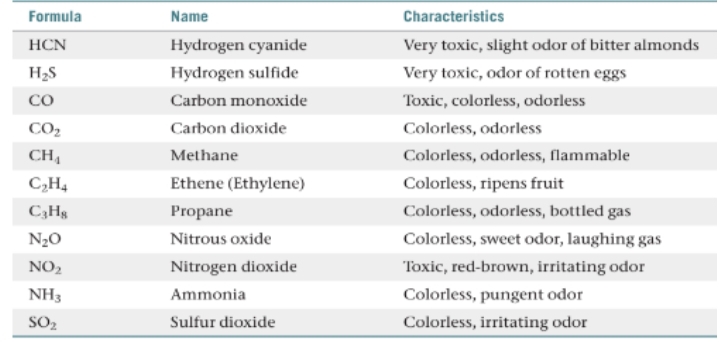
- [ ] Gases exert a pressure on any surface with which they are in contact. The gas in an inflated balloon, for example, exerts a pressure on the inside surface of the balloon.
Atmospheric Pressure and the Barometer
[ ] The SI unit of pressure is the pascal (Pa), named for Blaise Pascal (1623–1662), a French scientist who studied pressure:1 Pa = 1 N/m^2. A related pressure unit is the bar: 1 bar = 10^5 Pa = 10^5 N/m^2.
[ ] In the seventeenth century, many scientists and philosophers believed that the atmosphere had no weight.Evangelista Torricelli (1608–1647), a student of Galileo’s, proved this untrue. He invented the barometer, which is made from a glass tube more than 760 mm long that is closed at one end, completely filled with mercury, and inverted into a dish of mercury.
Standard atmospheric pressure, which corresponds to the typical pressure at sea level, is the pressure sufficient to support a column of mercury 760 mm high.
Standard atmospheric pressure defines some common non-SI units used to express gas pressure, such as the atmosphere (atm) and the millimeter of mercury (mm Hg). The latter unit is also called the torr.
In laboratories, we sometimes use a manometer, which operates on a principle similar to that of a barometer. \n
The Gas Laws
- Four variables are needed to define the physical condition, or state, of a gas: temperature, pressure, volume, and amount of gas, usually expressed as the number of moles. The equations that express the relationships among these four variables are known as the gas laws.
The Pressure–Volume Relationship: Boyle’s Law
- [ ] The British chemist Robert Boyle (1627–1691) was the first person to investigate the quantitative relationship between the pressure of a gas and its volume. He found, for example, that decreasing the pressure of a gas to half its original value causes the volume to double. Conversely, doubling the pressure causes the volume to decrease to half its original value.
Boyle’s law, which summarizes these observations, states that:
The volume of a fixed quantity of gas maintained at constant temperature is inversely proportional to the pressure.
- When two measurements are inversely proportional, one gets smaller as the other gets larger. Boyle’s law can be expressed mathematically as V = constant x 1/P or PV = constant
- Boyle’s law occupies a special place in the history of science because Boyle was the first to carry out experiments in which one variable was systematically changed to determine the effect on another variable.
The Temperature–Volume Relationship: Charles’s Law
- In terms of the Kelvin scale, Charles’s law states:
The volume of a fixed amount of gas maintained at constant pressure is directly proportional to its absolute temperature.
\
- Thus, doubling the absolute temperature causes the gas volume to double. Mathematically, Charles’s law takes the form V = constant x T or V/T = constant
\n The Quantity–Volume Relationship: Avogadro’s Law
- The relationship between the quantity of a gas and its volume follows from the work of Joseph Louis Gay-Lussac (1778–1823) and Amedeo Avogadro (1776–1856).
- Gay-Lussac was one of those extraordinary figures in the history of science who could truly be called an adventurer.
- Gay-Lussac studied the properties of gases. In 1808, he observed the law of combining volumes: At a given pressure and temperature, the volumes of gases that react with one another are in the ratios of small whole numbers. \n
- Three years later, Amedeo Avogadro interpreted Gay-Lussac’s observation by proposing what is now known as Avogadro’s hypothesis:
Equal volumes of gases at the same temperature and pressure contain equal numbers of molecules.
- Avogadro’s law follows from Avogadro’s hypothesis:
The volume of a gas maintained at constant temperature and pressure is directly proportional to the number of moles of the gas.
- [ ] [ ] \n V = constant * n or V/n = constant
The Ideal-Gas Equation \n Using the symbol ∝ for “is proportional to,”
Boyle>s law: V ∝ 1/P (constant n, T)
Charles>s law: V ∝ T (constant n, P)
Avogadro>s law: V ∝ n (constant P, T)
\
- An ideal gas is a hypothetical gas whose pressure, volume, and temperature relationships are described completely by the ideal-gas equation.
In deriving the ideal-gas equation, we make two assumptions:
The molecules of an ideal gas do not interact with one another,
The combined volume of the molecules is much smaller than the volume the gas occupies.
The term R in the ideal-gas equation is the gas constant.
The value and units of R depend on the units of P, V, n, and T. The value for T in the ideal-gas equation must always be the absolute temperature (in kelvins instead of degrees Celsius). The quantity of gas, n, is normally expressed in moles.
The conditions 0 °C and 1 atm are referred to asstandard temperature and pressure (STP). The volume occupied by 1 mol of ideal gas at STP, 22.41 L, is known as the molar volume of an ideal gas at STP.
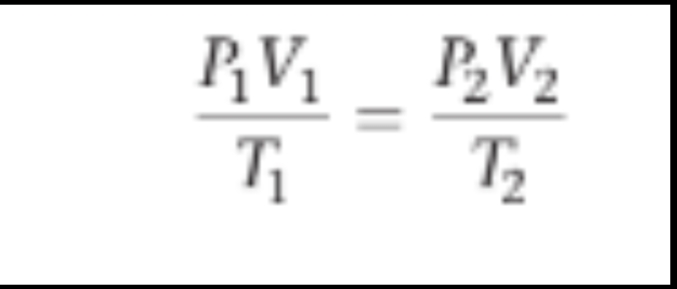
\n If we represent the initial and final conditions by subscripts 1 and 2, respectively, we can write an equation that is often called thecombine gas law:
\n Further Applications of the Ideal-Gas Equation
Volumes of Gases in Chemical Reactions
- [ ] Identifying and quantifying a gas in a chemical reaction is typically important. Calculating reaction gas quantities is useful. Calculations use mole concept and balanced chemical equations. Identifying and quantifying a gas in a chemical reaction is typically important. Balanced chemical equation coefficients show reactant and product moles. The ideal-gas equation links gas moles to P, V, and T.
\n Gas Mixtures and Partial Pressures
[ ] John Dalton made an important observation:
[ ] The total pressure of a mixture of gases equals the sum of the pressures that each would exert if it were present alone.
The pressure exerted by a particular component of a mixture of gases is called the partial pressure of that component. Dalton’s observation is known as Dalton’s law of partial pressures. \n
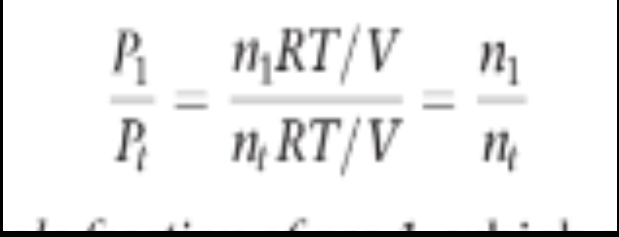
- The ratio n1/nt is called the mole fraction of gas 1, which we denote X1. The mole fraction, X, is a dimensionless number that expresses the ratio of the number of moles of one component in a mixture to the total number of moles in the mixture. Thus, for gas 1 we have

\n The Kinetic-Molecular Theory of Gases
[ ] Kinetic-molecular theory of gases, was developed over a period of about 100 years, culminating in 1857 when Rudolf Clausius (1822–1888) published a complete and satisfactory form of the theory.
The kinetic-molecular theory (the theory of moving molecules) is summarized by the following statements:
Random motion - Gases have many random-moving molecules. Even though noble gases are made of atoms, the smallest particle of any gas is called a molecule. Kinetic molecular theory relates to atomic gases.
Negligible molecular volume - The combined volume of all the molecules of the gas is negligible relative to the total volume in which the gas is contained.
Negligible forces - Attractive and repulsive forces between gas molecules are negligible.
Constant average kinetic energy - Energy can be transferred between molecules during collisions but, as long as temperature remains constant, the average kinetic energy of the molecules does not change with time.
Average kinetic energy proportional to temperature - The average kinetic energy of the molecules is proportional to the absolute temperature. At any given temperature, the molecules of all gases have the same average kinetic energy.
The kinetic-molecular hypothesis explains pressure and temperature molecularly. Gas molecules colliding with container walls create pressure. How often and hard molecules hit walls determines pressure.
Application of Kinetic-Molecular Theory to the Gas Laws
- An increase in volume at constant temperature causes pressure to decrease.
- Gas molecules have a constant kinetic energy. Molecules' rms speed remains unchanged. Volume increases molecule collision distance. Thus, container walls collide less, minimizing pressure. Kinetic-molecular theory explains Boyle's law.
- A temperature increase at constant volume causes pressure to increase.
- Temperature raises molecular kinetic energy. Because molecules are travelling faster, the temperature increase produces more wall collisions per unit time even when volume does not change. Each impact increases momentum. The idea explains why more forceful impacts increase pressure.
\n Molecular Effusion and Diffusion
- [ ] The dependence of molecular speed on mass has two interesting consequences. The first is effusion, which is the escape of gas molecules through a tiny hole. The second is diffusion, which is the spread of one substance throughout a space or throughout a second substance.
Graham’s Law of Effusion
- In 1846, Thomas Graham (1805–1869) discovered that the effusion rate of a gas is inversely proportional to the square root of its molar mass.
- Although diffusion, like effusion, is faster for lower-mass molecules than for higher-mass ones, molecular collisions make diffusion more complicated than effusion.
- Graham’s law, approximates the ratio of the diffusion rates of two gases under identical conditions.
- The average distance traveled by a molecule between collisions, called the molecule’s mean free path, varies with pressure as the following analogy illustrates.
\n Real Gases: Deviations from Ideal Behavior
- Real gases, in other words, do not behave ideally at high pressure. At lower pressures (usually below 10 atm), however, the deviation from ideal behavior is small, and we can use the ideal-gas equation without generating serious error.
- The deviation from ideal behavior increases as temperature decreases, becoming significant near the temperature at which the gas liquefies.
- Real molecules, however, do have finite volumes and do attract one another.
- Temperature determines how effective attractive forces between gas molecules are in causing deviations from ideal behavior at lower pressures. \n
The van der Waals Equation
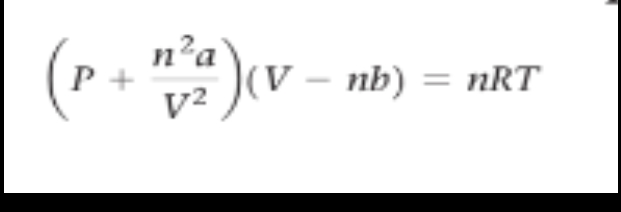
- The constants a and b, called van der Waals constants, are experimentally determined positive quantities that differ from one gas to another.
- The term n^2a/V^2 accounts for the attractive forces.
- The term nbaccounts for the small but finite volume occupied by the gas molecules \n \n