Psychoanalytic Theory by Sigmund Freud
Biography of Sigmund Freud
Born on May 6, 1856, in Freiberg, Moravia (now part of the Czech Republic)
Came from a Jewish family with modest means, had 10 other siblings
Went to the University of Vienna Medical School
Received a grant to study under Jean-Martin Charcot in Paris, learned hypnotic techniques to treat hysteria
Met Josef Breuer, who taught Freud about the concept of catharsis—the feeling of emotional and psychological burden alleviated or eased
Published "Studies on Hysteria" with Breuer, introduced the term "physical analysis" which evolved into psychoanalysis
Analyzed his own dreams and published "Interpretation of Dreams" in 1900, which brought him fame
Created the Vienna Psychoanalytic Society with members like Alfred Adler, Wilhelm Stekel, and Carl Jung
Levels of Mental Life
Freud's greatest contribution is his exploration of the unconscious and the idea that people are motivated by unconscious drives
Divided into unconscious, preconscious, and conscious
Unconscious
Contains drives, urges, or instincts that motivate our words, feelings, and actions
Often disguised or distorted to elude censorship
Can come from repression of childhood events or phylogenetic endowment
Primary Censor - prevents unacceptable thought from coming out
Final Censor - distorts the feeling or idea until deemed acceptable
Phylogenetic Endowment - traits that come from our ancestor’s behavior
Preconscious
Contains elements that are not conscious but can become conscious with ease or difficulty
Comes from conscious perception and the unconscious
Conscious Perception - Information we don’t actively think about but easily recallable when we want to
Unconscious - a thought that is buried but tries to its distorted recollection
Conscious
Plays a minor role in psychoanalytic theory
Mental elements in awareness at any given point in time
Ideas can reach consciousness through perceptual conscious system and mental structure
Perceptual Conscious System - getting ideas from our immediate environment
Mental Structure - the/our unconscious giving us ideas
Provinces of the Mind
Freud introduced a three-part structural model of the mind: id, ego, and superego
It supports the levels of the mind
The Id
The pleasure principle
Core of personality, completely unconscious
Blindly seeks pleasure without regard for what is proper or just
Operates through the primary process and relies on the ego for contact with the external world
its survival is dependent on the development of the Ego
The Ego
The reality principle
The only region of the mind in contact with reality
Grows out of the id during infancy
Decision-making or executive branch of personality (reality principle)
Must satisfy the id, conform to the superego, and do so in a realistic manner
Uses defense mechanisms to manage anxious feelings
The Superego
The moralistic and idealistic principle
Represents the moral and ideal aspects of personality
Has two subsystems:
conscience - develops due to punishment
ego-ideal - the result of good things
Controls sexual and aggressive impulses through repression
Dynamics of Personality
Freud postulated a dynamic principle to explain the driving forces behind people's actions
People are motivated to seek pleasure and reduce tension and anxiety
Dynamics include drives and anxiety
Drives
Constant motivational force
Described as powerful, innate forces that shape psychological processes
Grouped under two major headings: sex (Eros) and aggression (Thanatos)
Each drive has an impetus, source, aim, and object
Sex
Aim of the sexual drive is pleasure, not limited to genital satisfaction
Includes sexual drive (libido) and broader desire for pleasure and positive experiences (Eros)
Path to pleasure can be varied, behavior may not be recognized as sexual
Sex can take many forms including:
narcissism - excessive love for one’s self
Primary Narcissism- the love given to objects/people
Secondary Narcissism - love given to others then comes back to ourselves
love - investing libido on an object or person
sadism - the need for sexual pleasure by inflicting pain or humiliation on another person
masochism - the feeling of sexual pleasure from suffering pain and humiliation by themselves or by others
Aggression
Aim of the destructive drive is self-destruction
Life and death impulses constantly struggle against each other
Both must bow to the reality principle
It is easily fulfilled without being physically aggressive by teasing, gossip, etc.
Anxiety
Felt, affective, unpleasant state accompanied by a physical sensation
Warns against impending danger
Classified into three types: neurotic anxiety, moral anxiety, and realistic anxiety
Anxiety can be a combination of different types, such as realistic anxiety and neurotic anxiety.
Anxiety serves as a mechanism to signal danger.
Neurotic Anxiety
Apprehension about an unknown danger
Can be experienced in the presence of authority figures due to unconscious feelings of destruction against parents
Moral Anxiety
Stemming from the conflict between the ego and the superego
Arises from the conflict between realistic needs and the dictates of the superego
Realistic Anxiety
Closely related to fear
Involves a nonspecific feeling of possible danger
Defense Mechanisms
Defense Mechanisms
are unconscious strategies used to cope with emotional distress.
When taken to the extreme, they can lead to neurotic behavior.
The more defensive a person is, the less psychic energy they have to satisfy their id impulses.
Defense mechanisms help the ego avoid dealing directly with sexual and aggressive impulses.
Freud identified several defense mechanisms, including repression, reaction formation, displacement, fixation, regression, projection, introjection, and sublimation.
Repression
The most basic defense mechanism and involves pushing distressing thoughts or feelings out of conscious awareness.
Reaction Formation
A defense mechanism where a repressed impulse is expressed in the opposite form.
involves expressing the opposite of one’s true feelings when confronted with distressing emotions or desires
Reactive behavior is characterized by exaggeration and obsession.
Displacement
Involves redirecting an emotional response from its original source to a less threatening target.
Allows people to disguise or conceal their original impulses.
Fixation
Refers to a persistent focus on a particular stage of psychosexual development.
Occurs when the prospect of moving to the next stage becomes too anxiety-provoking.
Regression
Involves reverting to a less mature or earlier stage of development in response to stress or anxiety.
Adults may revert to earlier patterns of behavior and invest their libido in more primitive objects.
Projection
Involves attributing one's own unacceptable thoughts, feelings, or motives to someone else.
Helps reduce anxiety by externalizing unwanted impulses.
Introjection
The process of internalizing external attitudes, beliefs, values, or characteristics of others.
Allows people to incorporate positive qualities of others into their own ego.
Sublimation
Involves channeling unacceptable impulses into socially acceptable activities.
Seen as a mechanism that benefits both the individual and society.
Stages of Development
Freud's theory of psychosexual development outlines four stages during early childhood.
Each stage is associated with a specific erogenous zone and developmental task.
Infantile Stage
Infants possess a sexual life and go through a period of pregenital sexual development during the first 4 or 5 years after birth.
Children show an interest in their genitals and experience sexual excitement.
3 Phases in the Infantile Stage
Oral Phase
Focuses on oral pleasures such as sucking and biting.
The oral phase is divided into oral receptive and oral sadistic phases.
Oral-receptive phase - infants have their needs satisfied with minimal frustration.
Oral-sadistic period - emerges as children grow older and involves aggressive behavior.
Anal Phase
Characterized by children becoming aware of their ability to control bowel movements.
Successful toilet training is crucial during this stage.
Early Anal Phase - children find satisfaction in destroying or losing objects.
Late Anal Phase - children may take an interest in their feces and present them as a prize
Anal eroticism - characterized by orderliness, stinginess, and obstinacy and can lead to the development of the anal character
Anal Character - people who continue to receive erotic satisfaction by keeping and arranging objects in an excessively neat and orderly fashion
Phallic Phase
Occurs around 3 or 4 years of age and involves the genital area becoming the leading erogenous zone.
Masturbation is common during this stage, but it is often repressed due to parental suppression.
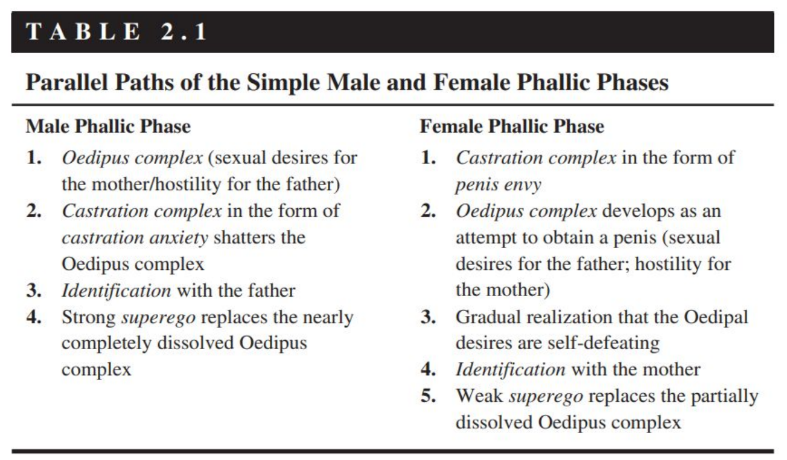
The male Oedipus complex - involves a boy identifying with his father and developing sexual desire for his mother.
Castration anxiety - Fear of punishment from fathers, often by castration, for feelings towards mothers
Belief that father possesses power to take away the source of desire (penis)
Female Oedipus Complex
Pre-Oedipal girls assume all children have similar genitals
Discover boys have different genital equipment and feel envious
Penis Envy - Desire to have a penis
experience of penis envy shapes girls' personality
Castration complex - girls establish identification with mother
Fantasize being seduced by mother
Incestuous feelings turn into hostility towards mother for not having a penis
Libido turns towards father, who can satisfy wish for a penis by giving her a baby
Simple female Oedipus complex - Desire for sexual intercourse with father and hostility towards mother
Incompletely resolved by girl's realization of potential loss of mother's love and lack of sexual intercourse with father
Summary
Differences between female and male phallic stages
Castration complex for girls takes form of penis envy, not castration anxiety
Penis envy comes before female Oedipus complex, opposite for boys where Castration Anxiety follows the male Oedipus complex
Girls do not experience traumatic event comparable to boys' castration anxiety
Female Oedipus complex more slowly and less completely dissolved than male Oedipus complex
Latency Stage
From 4th or 5th year until puberty
Period of dormant psychosexual development
Suppression of sexual activity by parents leads to repression of sexual drive where the Psychic energy is directed towards school, friendships, hobbies, and nonsexual activities
Continued latency reinforced by suppression from parents and teachers, feelings of shame, guilt, and morality
Sexual drive still exists but its aim has been inhibited
Sublimated libido expressed in social and cultural accomplishments
Genital Stage
Begins at puberty
Individuals seek healthy, mature relationships and express sexual desires in socially acceptable ways
Adolescents give up autoeroticism and direct sexual energy towards another person
Reproduction becomes possible
Vagina obtains same status for girls as penis had during infancy
Sexual drive takes on more complete organization, genitals become primary erogenous zone
Maturity
Genital period begins at puberty and continues throughout individual's lifetime and a stage attained by everyone who reaches physical maturity
Psychological maturity seldom happens due to opportunities for pathological disorders or neurotic predispositions—refers to an individual's inclination or tendency to experience neurotic anxiety
Critiques of Freud
He did not understand women and sexuality hence, was heavily biased against them
He was not a scientist so he could not provide scientifically accurate facts