newton.
 1st Law: Law of Inertia
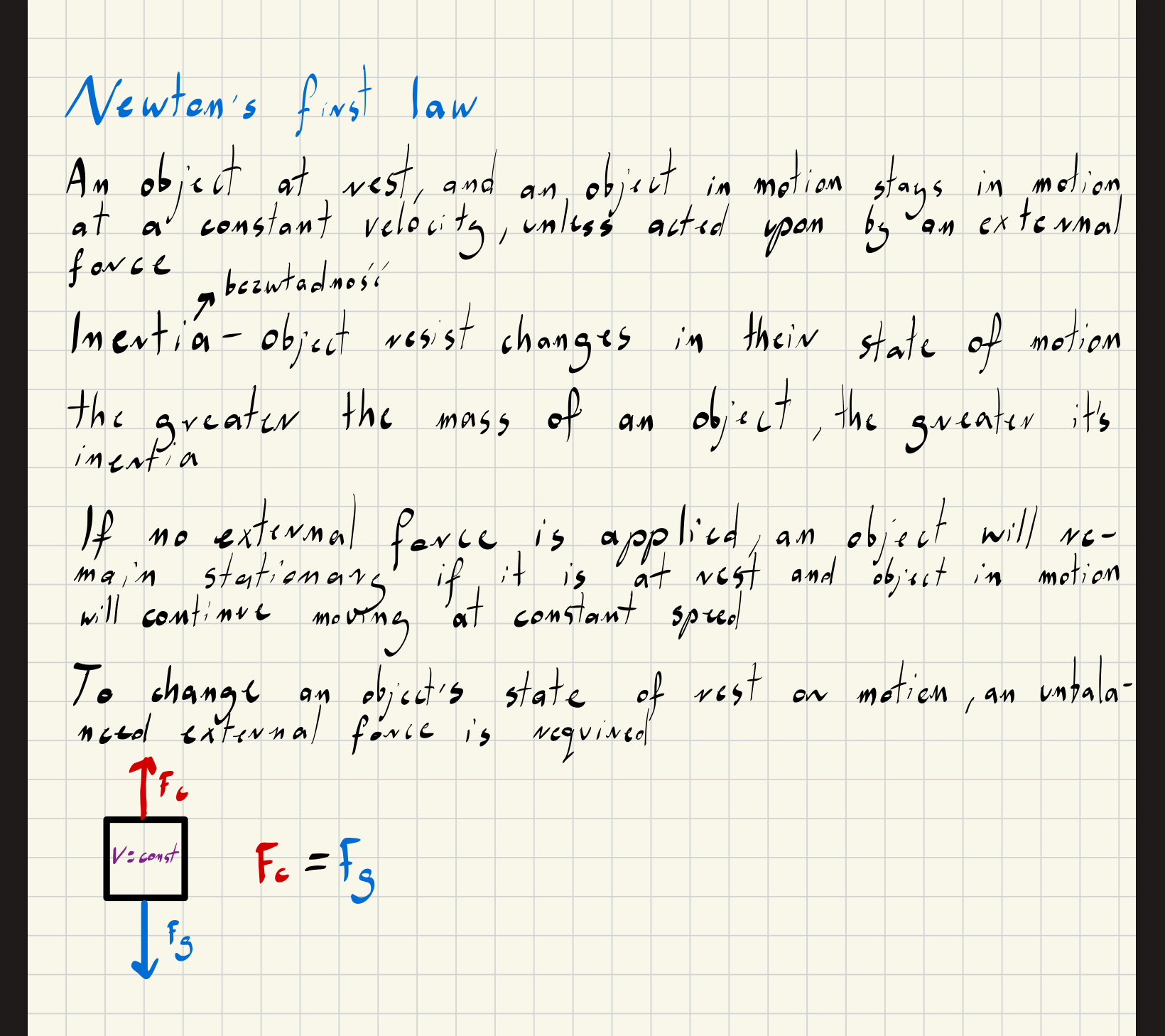
💡 "An object at rest stays at rest, and an object in motion stays in motion with the same velocity unless acted upon by an external force."
Key Points:
If no net force acts on an object, its velocity remains constant (either at rest or in uniform motion).
Inertia is the tendency of an object to resist changes in its motion.
Mass (mm) is a measure of inertia → larger mass = more inertia.
🛑 Example:
A book on a table stays at rest until you push it.
A moving car continues moving until brakes (friction force) stop it.
2nd Law: Law of Acceleration
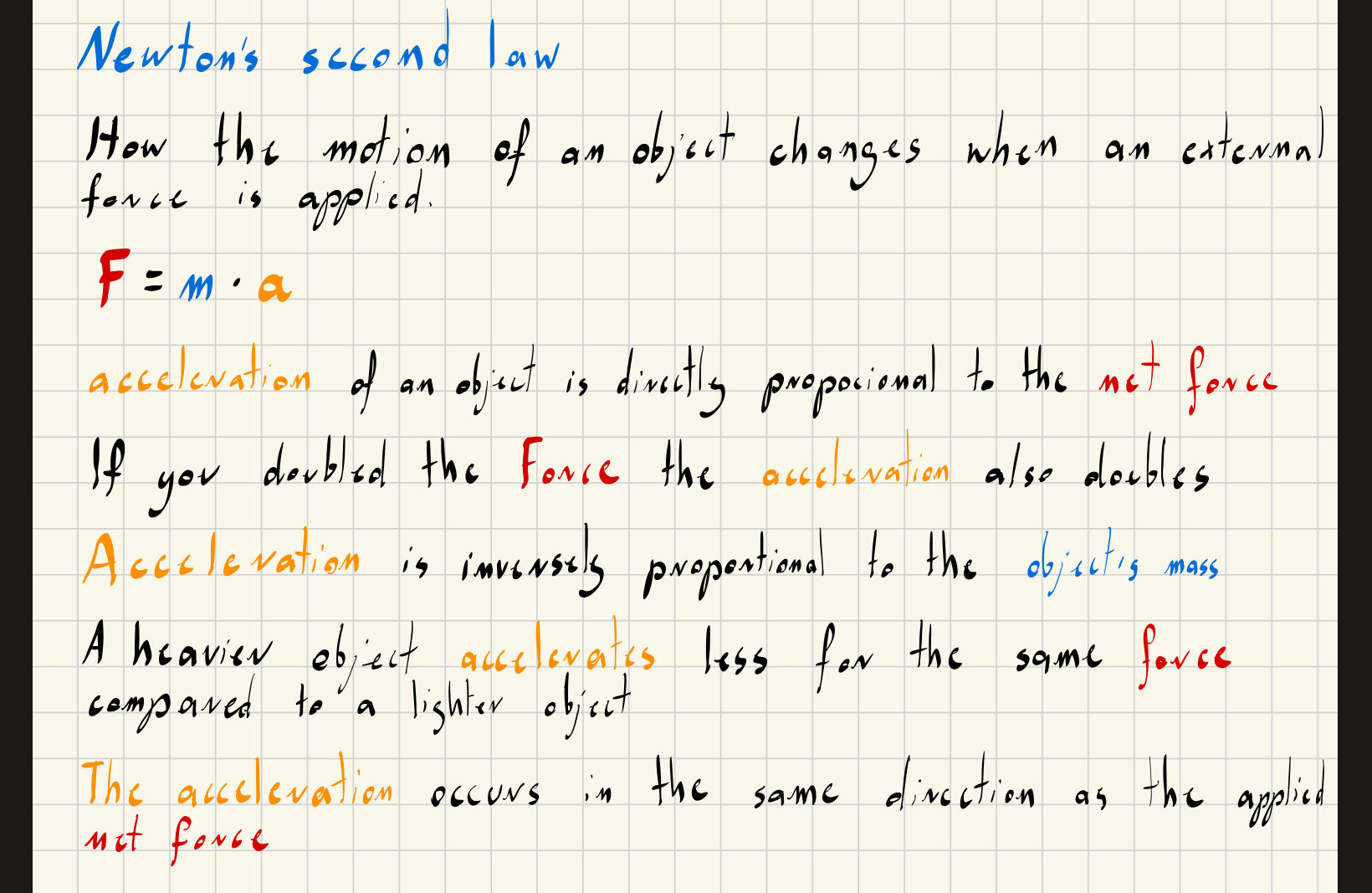
💡 "The acceleration of an object is directly proportional to the net force acting on it and inversely proportional to its mass."
Mathematical Formula:
F=ma
where:
F= net force (N)
m= mass (kg)
a = acceleration (m/s²)
Key Points:
A larger force produces greater acceleration.
A larger mass requires more force to achieve the same acceleration.
If no net force, then a=0a=0 (object moves at constant velocity or remains at rest).
3rd Law: Action-Reaction
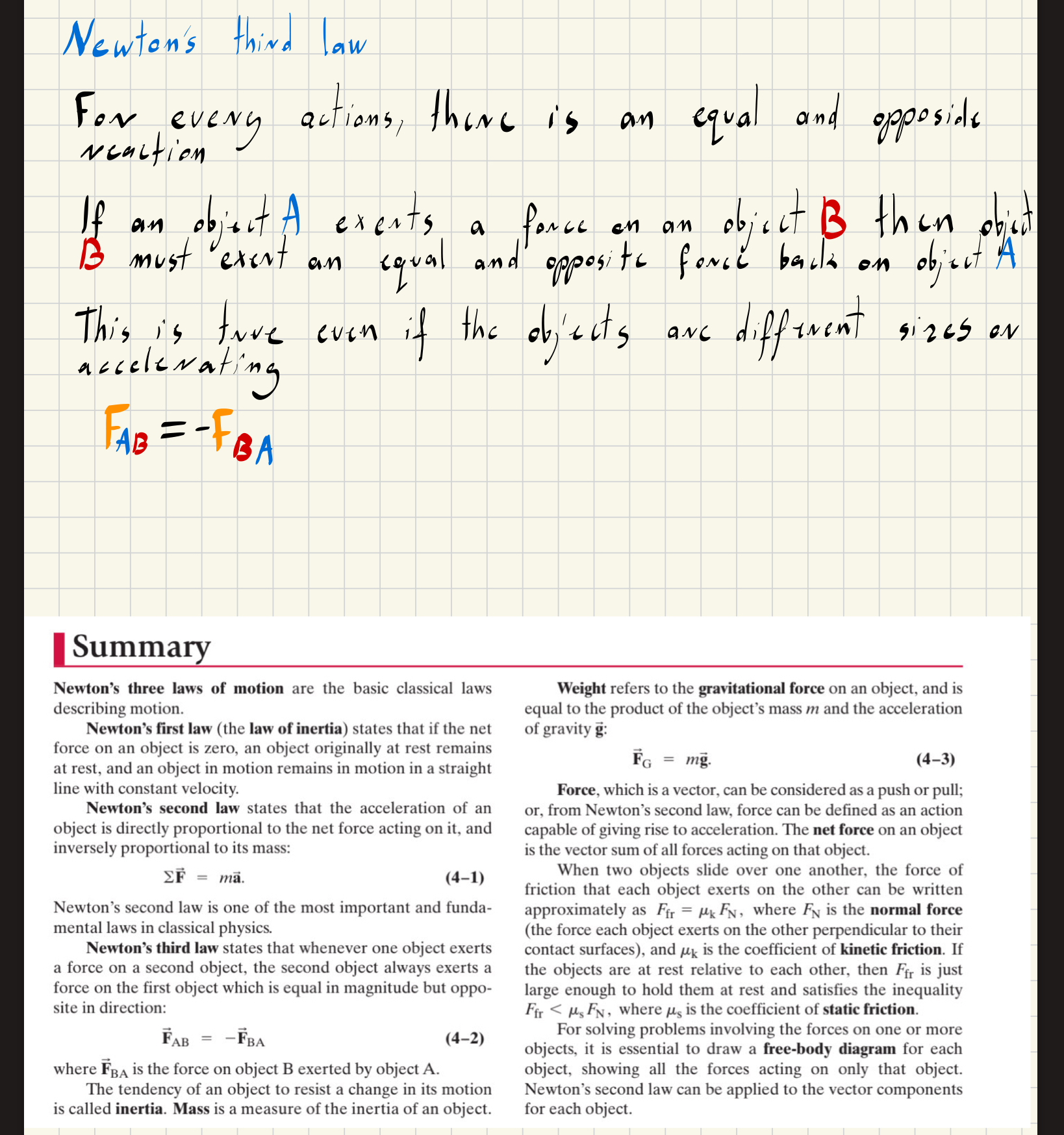
💡 "For every action, there is an equal and opposite reaction."
Key Points:
Forces always come in pairs.
If object A exerts a force on object B, then B exerts an equal force back on A in the opposite direction.
⚖ Example:
A rocket launches by pushing gases downward, and the gases push the rocket upward.
When you push against a wall, the wall pushes back with equal force.