GEOS3103
13 lecture to catch up on
Lecture 1 - Marine Provinces
ocean gateways
pericontinetal -
Epicontental sea - Caspian sea
Ocean floor subdivision; Contnental margin, deep-ocean basins, Mid-ocean Ridges
Passive Continental margins, divergent
Active margins, converganet. earthwakes and volcanic activites
Continentail margins; contnentail shelf, continentail slope, submarine canyons and turbidity currents, continential rise
Continential shelf ~ 70km, Terrigenous sediments dominate. 50% inherited from a previous phase of sedimentation
endogenous : internal processes, tectonics
endogenous: external process, climate → sea level change

east Australian current, runs on from south equatorial current
Mixed Quarts
Terrigenous Clastic
NSW Continental margin
mass movement features; Slab slide, debris flows and canyons
movement from steep unstable slopes
Linear canyons → long
Box canyon short and plentiful
Continental slope; Turbidity current, carry material and stop at continental rise.
Canyons fed by rivers, coarse material
Turbidite sequence; graded bedding → current slows down, coarse material falls out, moves to finner
LGM -120 meters lower
Continental rise → formed by continental rise, pile of sediment from submarine
Indus fan - largest canyon
Abyssal plain → volcanic peaks poke through ocean - islands
look like traffic cones; guyots - flat top seamount
abyssal hills, small and gently rounded, formed parallel to mid ocean ridge
Seamounts → volcanic origin ~ 125, 000
Atlantic ocean doesn’t have many trenches
Mid ocean ridge features; Seamounts, hydrothermal vents,
Pillow basalts, undersea eruptions which wax and wane
Pelagic; water -
Benthic; Littoral Bathyal, Abyssal, Hadal
Lecture 2 - Marine Sediments
Joy’s resolution 1987 - 20, ~400km of drill core.
Divergent - Atlantic larger, pacific smaller - convergent
ocean sediment is only 8 km thick
Thick sediment thickness, glaciated along continental shelfs.
Bengal Fan, Gangies deliver huge amounts of sediment
Asian rivers deliver 70% of terrigenous sediment into the ocean
new oceanic crust = low sediment
Upwelling zones; California, Peru, Canary and Benguela
Contourite drifts, sediment piles that are cause by bottom currents that shift the sediment along the sea floor and get piled up against topography obstacles → Follow thermohaline circulation
Bengal Fan, ~16.5km thick. Indian monsoon developed ~23 Ma
A billion tons of Himalaya sediment get dumped into the bay every year
The Bare Zone - Far away from continents, no topographic highs to , Carbonate compensation Depth, no hydrothermal activity
CCD - depth in the water column where carbonates get dissolved.
Consolidation, squash material
Diagenesis, changes the chemical, physical and biological modification, sedimentary rock
Biogenic ooze - die, settle and

Drill core from the deep sea, layer of ash that can be dated
Fossils can be dated
hiatus - no sedimentation or sediment has been taken elsewhere; Erosion, Dissolution, Non- deposition
The challenger Expedition 1872 - 1876.
transatlantic tele graph cable, Microfossil
Lecture 3 - Biogenic Deep-Sea Sediments
Lithogenous - preexisting rock
Biogenous
Hydrogenous
Cosmogenous

Deep Sea sediment
things in the water column don’t always make it to the floor
Argo floats - measures salinity and temperature
Gyres - circular currents driven by subtropical highs
up welling of cold = high productivity
Chlorophyll concentration → ocean currents bring up nutrients.
Chlorophyll concentration low in gyers
ice excludes salt from its formation, salty water sinks
Consequences of deep-water circulation; Atlantic is carbonate- rich and the pacific is silicate rich.
Upwelling, coastal upwelling → Wind driven motion, displaces warm water to bring up cold water
Equatorial upwelling →
Ocean Gateways → openings in continents, geological record, the gateways didn’t exist in the past.
40 million years ago drake passage closed
10 million years ago the Central American Seaway closed
Dust plumes, transport dust and feed the ocean, can be deposited wet with rain
Dominate source of dust, North Africa, Sahara, Southeast Asia and China
Desert regions of the ocean, where rainfall is very low

Lecture 4 - Biogenic Deep-Sea sediments Pt2
HNLC (High Nutrient Low Chlorophyll); Grazing organisms is extremely efficient therefore productivity seems lower, growth limiting nutrient (iron) which some diatom species require.
Iron supplied to the ocean comes from dust from continents
Coccolithophoris and Diatoms require nitrate and phosphate, calcium and silicon.

DCM is the sweet spot, consistent supply of nutrients and receiving sunlight
Maximum primary productivity is below the surface
Zooplankton → Forams and Radiolarians
Phytoplankton → Coccoliths and Diatoms
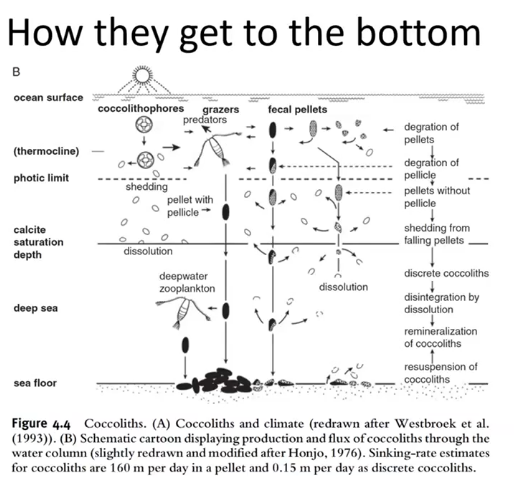
Pelagic Factories (Marine Snow); only 3-5 % makes it to the sea floor
Biological CaCO3 Aragonite or Calcite→ Pteropods A, Foraminifera C, Coccolithophores C
Biological SiO2 . nH2O (BSi) → Diatoms, Radiolarians, Silicoflagellates and Sponge Spicules

Coccolithophore - Micro fossil
are found in subtropical Zones, oligotrophic, so small nannoplankton
Extremely useful for dating the stratigraphy in the ocean, certain species lived at certain times.
Circular interlocking calcite plates - make cocosphere
Coccolithophore blooms are abundant and can be seen from space → produce DMS provide nuclei for , increase the albeado of the ocean
coccoliths to the bottom, water must be saturated in calcite unwise dissolve
Cretaceous Chalk, white cliffs of dover
formed during cretaceous, there was a big extinction event, no ice caps on the poles and sea level was really high.
Shallow seas around continents → warm water coccoliths thrived.
Sea level fell in the coccoliths migrated into the ocean → then got pelagic sediments
Pteropods
Sea butterflies (gastropod)
Prefer tropical to subtropical climates
Aragonite shells → must be above aragonite compesation depth ~2.5km
Foraminifera
Unicellular organism
Abundant in highly fertile regions → equatorial and divergence zones, Co occur with coccolithaphores
useful for biostratigraphy and paleoenvironment reconstruction. Oxygen isotopes of the calcite, temperature of sea water
Bubus looking (popcorn) floating
Common Globigerina
Benthic foraminifera, live on sea floor and burrow into sediment
Arenaceous Forams - tests mad from sand that the amoeba has collected
Nummulites, quite large, used in pyramids
Radiolarians
plankton protozoans, unicellular
Lots of ornamentation
Sponge Spivules
made of silica
Diatoms
Unicellular algae, golden brim photosynthetic pigments
Made of opaline silica
Look like sieves
oldest from the early Jurassic

Diatoms used n forensic science
each water body has its owns specific specifies
Lecture 5 - Ocean Chemistry *
Lecture 6 - Manganese Nodules, Dust and Deep-Sea clay *
Lecture 8 - Deep- Sea Sedimentary Processes *
Lecture 9 - Marine Carbonates: Formation and Depositional
2 main types of carbonate rocks dolomite and calcite
Dolomite forms from the replacement of calcite
Agarongite is more soluble than low magnesium calcite
High magnesium calcite is the most soluble of all
Different biogenic compounds are made of different materials therefore go through digensis separately
Red algae made of high magnesium calcite
Carbonates made from clear water and warm shallow water
Pelagic all over the ocean
Protozoan → dominated by reef building coral, hermatyic coral. Foram present in these carbonates as well as calcareous green algae
Heterozoan - cooler temperatures. No corals or green algae. Present- red algae, bryozoans, barnacles and exhanois and lots of mollusks
Carbonate production on a large scale accumulate much faster in warm waters rather than cool waters. - minor clastic input!
Carbonate formed by organisms, direct precipitation (ooids)
Bioerosion fine carbonate
Most carbonates deposited in the marginal marine setting, shorelines and coastal lagoons and tidal flats
Halimeda produce the most carbonate
Carbonate factory: carbonate statuation is high enough to support biogeochemically controlled carbonated precipitation, accumulation and preservation.
Lecture 10 - Classification of Carbonates *
Lecture 11- Carbonate Diagenesis
Isopachous Cement ~ equal thickness all around
Fresh water vadose; above water level not near sea
freshwater phreatic
marine phreatic
Common sea floor cements; Magnesium calcite and Argonite
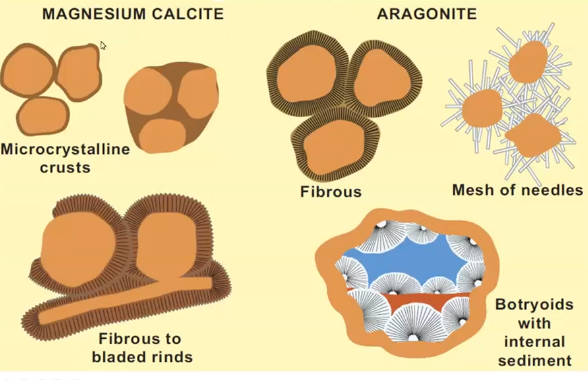
Beachrock; well cemented to friable. black is open space.
cement occurs in fully submerged
Meniscus Cement: unevenly distributed between the grains

Grain in picture is Halimeta green algae, calcareous algae. - aragonite
aragonite = beachrock
cementation occurs quickly due to evaporation and degassing of carbon dioxide from sea water
Drip meniscus cement, pendent cements
Above water table, vadose zone

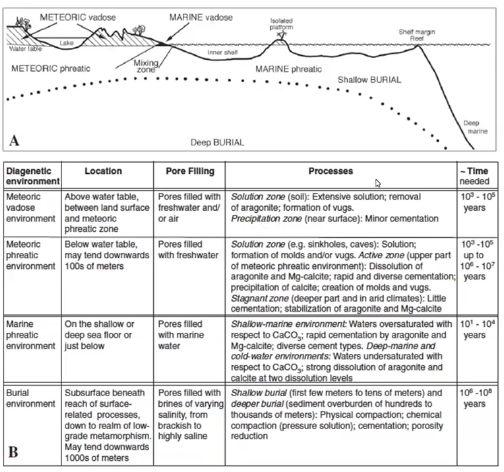
Meteoric Diagenesis
Extensive dissolution of unstable carbonate and reprecipitaion of stable carbonate
filling of primary porosity, creation of secondary porosity
vadose cements (pendant and meniscus)
phreatic cements (isopachous, equant)
freshwater meteoric cements consist mainly low-Mg - stable

Diagenesis in the Vadose zone
dissolution of aragonite and Mq - Calcite
neomorphism of aragonite to calcite
precipitation of coarse calcite cement (blocky spar /equant crystals) and micrite
Meniscus cement
may resemble beach rock but composition and crystal shapes are different - Les magnesium, no aragonite, low magnesium calcite
meniscus cement formed above the water table
Burial Diagenesis
Lecture 12 - Evapourites
Importance of evaporites
many are mined for industrial and agricultural purposes
associated
salts can move like a fluid, density inversion\
as the depth increase, buried and squashed fluid is pushed out and density increases, flow to a region where it is more stable
salt does not have permeability or porosity
Halite - food, rocksalt
Salar de Atacama in Chile is one of the world’s largest lithium-producing salt flats, supplying around 30% of global lithium

Messinian Salinity Crisis (MSC) ~ 6Ma
occured
Lecture
Lecture 13 - Major Discoveries from Deep-Sea Drilling *
Lecture 14 - Future Ocean *
Lecture 15 - Siliciclastic Sedimentary Rocks
Sandstone succession in the blue mountains
Mustone, siltstone and shale
sandstone 25%
Compemts can be highly variable due to terrigenous input
Clastic sedimentary environments;
Continental → lake, alluvial, desert and glacial
Shoeline → Delta, Beach and tidal flats
Marine → Deep sea, continental shelf and organic reefs and continental margins
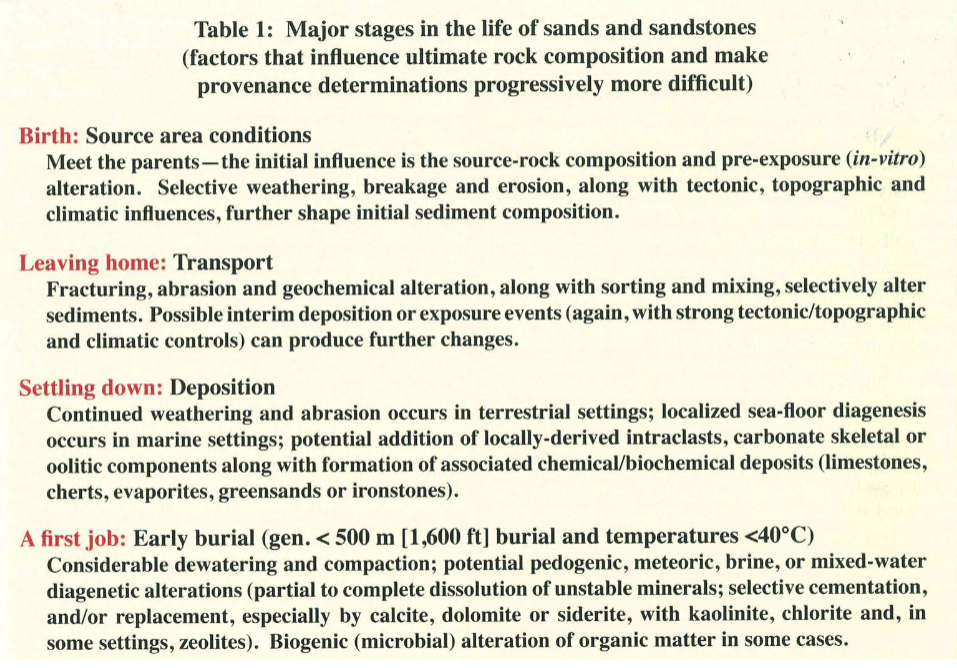
In marine environment may experience seafloor diagenesis
early burial, dewatering and diagenetic alterations and replacement.

Sandstone composition → framework grains, Matrix, Cement and Pores
Super mature and mature sandstone → Quartz is major due to its durability and comprises most of the rock
Quartz most dominant because its stable
feldspars come in metamorphic rocks - weather very easily
Lithic fragments tell us whether the material come from igneous terrain, volcanic or metamorphic. - unstable
Sandstones containing a lot of feldspars and rock fragments would be areas located close to the source regions, components don’t travel far. - tectonically active, fans and slopes
Marine environments - glauconite

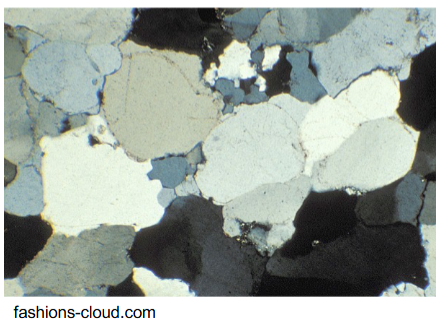

Quartz Origin
Mostly derived from granites, gneiss and schists
Folk classification , chert is included in rock count not quartz
Monocrystalline quartz is the most stable
Igneous quarts monocrystalline and specks in the quartz grains are fluid inclusions
Yellow grains are quartz grains → thin section cut too thick
Strained quartz has undulous extinction
fracture quartz cement is forming and bubbles form
Hydrothermal quartz grain - lots of fluid inclusion
Feldspars microcline (barcode0,
plagioclase (zebra stripe), potassium sodium (tartan texture) and sodium calcium feldspars
K feldspar


Lecture 16 - Marine Pollution *
Lecture 17 - Core Sampling and Field Techniques (Concepts) *
Lecture 18 - Core Sampling and Field Techniques (Applications) *
Lecture 19 - Environmental Magnetism (Concepts)*
Lecture 20 - Environmental Magnetism (Applications)*
Lecture 21 - Environmental Geochemistry (Concepts)*
XRF data → decompose and figure out where they have come from → interpretation
Research design → what are you looking for specifically

XRF tells you what is in the core, everything
Sample processing
Solid to a liquid → Digest solid in an acid
Coral can be turned into a powder (coral)
Wet sample must be dried to a sable dry mass
Redox samples cannot be exposed to air → nitrogen
particle size → changes in geochemistry are altered by particle size
Silicate covalent bonds (Si-O) need HF
Dissolve everything (HNO3 + HF)
Some things (Aqua Regia, 1M HCL)
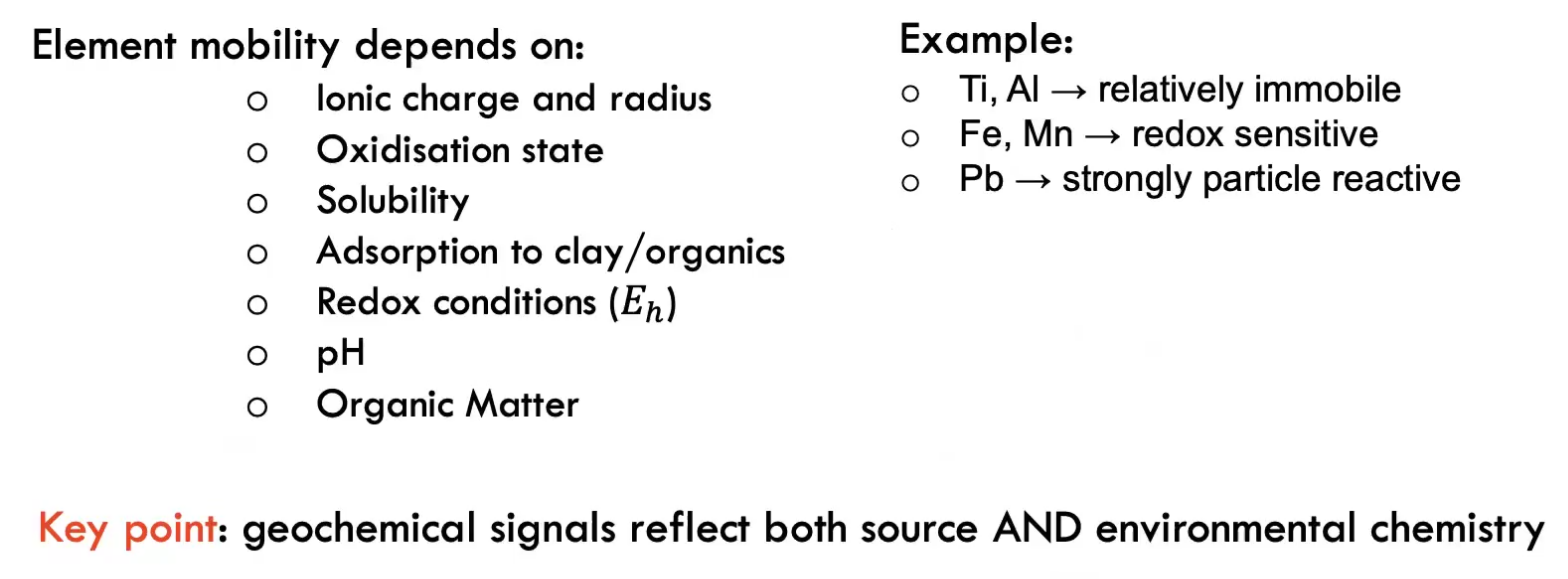
organic matter can change the pH
Ti, Al → stable
Redox Fe, Mn → oxidization of bottom waters
Lead is particle reactive and sorb to clays
Geochemistry - concentration of
Speciation matters → total concentration is not the whole story
Same elements can be in different forms → dissolved, adsorbed, oxide bound, sulphide bound, organic bound.
key point -
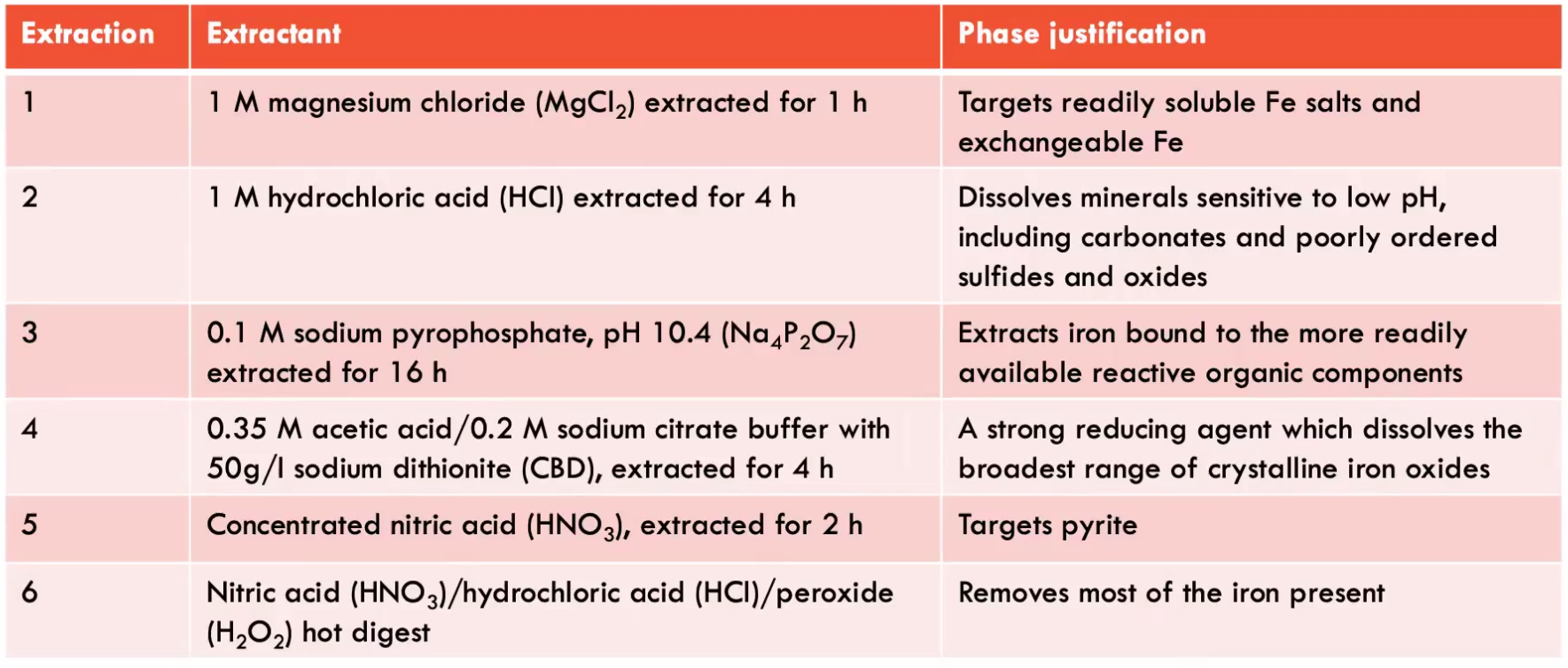
The data you want is based on there research question and what process you use

Data Quality Control
ICPMS retains a memory → blanks need to be run to flush system

LOD - Limit of detection, Lowest concentration that can be properly distinguished from black
LOQ - Limit of quantification, consider the minimum concertation that is of high confidence

XRF → Major elements Na, Mg
measures the x-ray fluorescence
can’t due below aluminum
samples are typically >1g → powder samples
can’t see O, H, C → these will dilute reading and cannot be quantified
incoming x ray knocks out the electron from inner shell, outer shell electron will fall down into the inner shell and release a distinct x-ray to expel the energy
X-ray diffraction
Energy Dispersive Spectroscopy
Interpreting Geochemical Data
Lecture 22 - Environmental Geochemistry (Applications) *
More than just concentration
chemical speciation
Redox conditions are critical
Lecture 23 - Stable Isotope Geochemistry (Concepts)*
Stable Isotope Mass Spectrometry
Isotopes are distinguished on the basis of very small differences of mass
Mass variation due to variable number of neutrons
Tritium found naturally in upper atmosphere (Heavy water)

stable isotopes aren’t able to be measured and don’t decay -’primordial’ - metastable
decay and release alpha, beta and gamma
concertation and daughters are important → half-life dating
Tl-128 → 2x 10^24 years half life
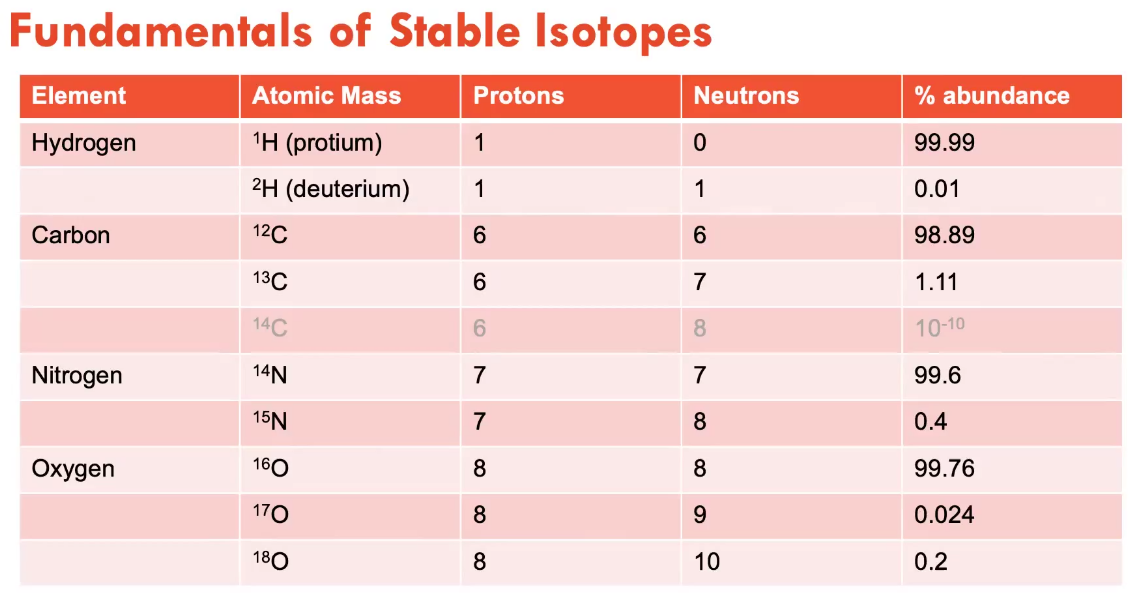
O and H tell you the same thing
C tells you about carbon cycling in the environment
C-14 occurs naturally in the upper atmosphere from the bombardment of nitrogen atoms with cosmic radiation
C-14 gets stored in pools and reservoirs; deep ocean has a distinctive radiocarbon signature vs surface ocean. → trace past oceans
Isotopic fractionation - the way isotopes leave a trace in the fossil record (form of carbonates)

need something to measure, → hard preservation of something. sensitive to some process (e.g SST, snowfall, rainfall etc)
C, H, O
Heavy isotope is given the name, ratio of O16 and O18 then O18
Lecture 24 - Stable Isotope Geochemistry (Applications)
Vietnam Cambodia → extrusive basaltic province
Mar lakes → ferromagnetic explosion craters → formed from rising magma hitting a perched groundwater table creates a big explosion and hole in the rock
Creates circular basin that has no inflow or outflow → evaporative pans
No influence from materials from a catchment, or outflow that compromises geochemistry
Research Question: What can the sediments tell about the evolution of the Asian monsoon through the Cenozoic period.
laminations are usually biogenic silica → diatoms blooms
determine whether this is sensitive
Anoxic at the bed of basin floor → no redox reaction
Green foam →
Sampling → piston core
Isotope Dynamics

Does the site conform to expected behaviour in terms of isotope balance?
is it sensitive to weather (not climate)?
GNIP: Global network of isotope and precipitation
red line is lower than the GMWL → Lake is reactive to climate processes including evaporation