Lesson 11
Lesson 11: Mixed Venous Oxygen Saturation
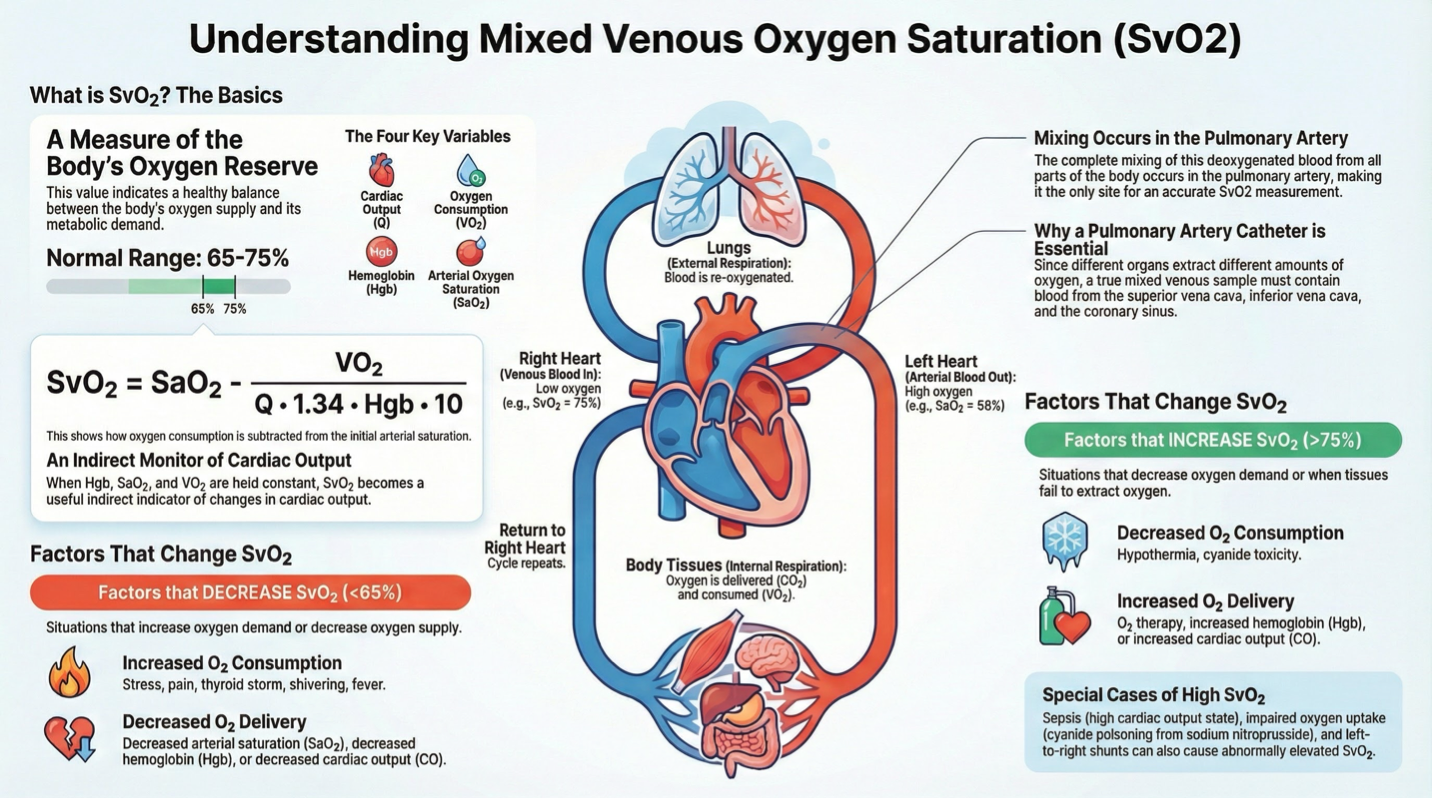
SvO2 is influenced by four key variables:
Cardiac output (Q, L/min)
Oxygen consumption (VO2, mL O2/min)
Hemoglobin level (Hgb, g/dL)
Hemoglobin saturation (SaO2, %)
SvO2 as a Monitor
Constant Hgb, SaO2, and VO2 allow SvO2 to serve as an indirect monitor of cardiac output.
Factors Affecting SvO2
Decrease SvO2:
Increased O2 consumption (stress, pain, thyroid storm, shivering, fever)
Decreased O2 delivery (decreased SaO2, Hgb, or CO)
Increase SvO2:
Decreased O2 consumption (hypothermia, cyanide toxicity)
Increased O2 delivery (O2 therapy, increased Hgb, increased CO)
Normal SvO2 Values
Normal range:
Key Causes of Increased SvO2
Sepsis: high cardiac output state, arterial admixture, elevated SvO2 despite end-organ hypoxia.
Impaired oxygen uptake (e.g., cyanide poisoning).
Left-to-right shunt: oxygenated blood mixes with pulmonary venous blood.
Measurement of SvO2
Pulmonary artery catheter needed for accurate SvO2 measurement.
A true mixed venous sample includes blood from:
Superior vena cava
Inferior vena cava
Coronary sinus
Mixing occurs in the pulmonary artery.
Relevant Formulas
CVO2 =
CaO2 =
VO2 =