AP World Chapter 16: Revolutions
Revolutionary Ideas
The Enlightenment was partly created due to the power of Issac Newton’s work. His work shaped Enlightenment thought, through the argument of rational analysis. This theory is explained in this simple sentence: Through rational analysis, new insights about humans and the natural world could lead to new innovations to transform the world.
Key Ideas:
Reason: Enlightenment thinkers believed that human reason could be used to solve problems and improve society.
Individual Rights: There was a strong focus on personal freedoms and the idea that individuals have rights that should be protected.
Skepticism of Authority: Many Enlightenment philosophers challenged the power of monarchies and the church, advocating for democracy and secular governance.
Science and Society
Enlightenment thinkers sought to find rules to society, similar to Issac Newton’s rules of motion and gravitation. But their search led to many different paths.
John Locke
John Locke was an English philosopher(1632-1704) who worked to discover the natural laws of politics.
Attacked the idea of Divine Right of Kingship
Advocated for constitutional governments
Grounds for doing so include popular sovereignty
His work provided the theoretical justification of the Glorious Rebellion of 1688 and the establishment of the British constitutional monarchy.
Adam Smith
Adam Smith was a Scottish philosopher who looked at the economics of sea based empires. His work mainly dealt with:
Supply and Demand
The principles of capitalism
Charles Louis de Secondat
Often referred to as the Baron de Montesquieu, he advocated for political liberty. His work included:
Idea of separation of powers in government
The science behind politics
Establishment of political liberty
Voltaire
Originally named Francois-Marie Arouet, he published his first paper at the age of 17. By his death, he had published 10,000 letters and 70 books. His legacy marked him the model Enlightenment man. He is known for:
Criticizing religious intolerance
Promoting freedom of speech
The Belief of Deism
Deism was similar to Christianity, in the idea that there is only one singular god. However, some key differences were:
Deists denied the supernatural events in the Bible
The universe was an orderly realm
The god only watched and never interfered
Popular Sovereignty
Since ancient times, kings or emperors ruled almost entirely agricultural societies. Smaller societies did have some democracy, but even they relied on kings. Now, philosophers were challenging this new system.
Individual Freedom
Thinkers during this period addressed many issues about freedom and popular sovereignty. Philosophers disliked persecution done by the nobles and clergy, just because they were lower than them. In response, they called for religious toleration and freedom of speech.
Political and Legal Equality
Many Enlightenment thinkers also called of equality, condemning the legal and social rights of aristocrats and clergy members. The reason for this is because it was thought that many of them did not contribute to larger society. The person who most influenced the movement was a French-Swiss thinker named Jean Jacques Rousseau. His influential book, The Social Contract, argued that all members of a cohesive society should contribute to it and they are the sovereign.
Global Effect of Enlightenment Values
The Enlightenment laid the groundwork for modern political and social thought, influencing revolutions and the development of democratic governments. These values and principles became the founding base of the revolutions, which had the same goals to create an orderly society.
Revolutions
American Revolution
Causes
British Victory in the 7 Years War
Sugar, Stamp, Tea, and Townshend Taxes
Came about due to #1, which left the British in severe debt
Salutary Neglect
Quartering Act
Required settlers to provide food and shelter to soldiers
Enlightenment Ideas
John Locke’s ideas
All of these led to many revolutionary acts, such as
The Boston Tea Party
Establishment of the Continental Congress
Eventually, tensions increased dramatically until 1775, at the Battle of Lexington and Concord, thus beginning the American Revolution.
Timeline
1776: The Second Continental Congress adopts the Declaration of Independence on July 4.
1777: The Battle of Saratoga occurs, a turning point that convinces France to support the colonies.
1781: The British surrender at the Battle of Yorktown, effectively ending major combat.
1783: The Treaty of Paris is signed, officially recognizing American independence.
French Revolution
Causes
Social Inequality: French society was divided into three estates:
The Third Estate (commoners)
The First Estate (clergy)
The Second Estate (nobility)
The Third Estate was heavily taxed and had little political power, while the First (clergy) and Second (nobility) Estates enjoyed privileges.
Economic Hardship: France faced financial crises due to costly wars, including support for the American Revolution, and poor harvests. This led to rising bread prices and widespread discontent among the lower classes.
Enlightenment Ideas: Enlightenment thinkers like Rousseau and Voltaire promoted ideas about
liberty
equality
democracy
inspiring people to challenge the existing monarchy and demand rights.
Weak Leadership: King Louis XVI was seen as indecisive and ineffective. His inability to address the financial crisis and social unrest contributed to the growing frustration among the populace.
Political Conflict: The Estates-General was called in 1789 to address the financial crisis, but disputes over voting procedures led to the Third Estate breaking away and forming the National Assembly, which marked a shift toward revolution.
Timeline
1789: The Revolution begins. The Third Estate forms the National Assembly. The Bastille is stormed on July 14.
Tennis Court Oath: On June 20, 1789, members of the National Assembly vowed not to disband until they had drafted a new constitution for France. This was a big deal and showed their determination.
Goals: The National Assembly aimed to represent the people and push for reforms, including more rights and a fairer government.
Constitution of 1791: They eventually created the Constitution of 1791, which established a constitutional monarchy, limiting the king's power.
1789: The Declaration of the Rights of Man is adopted in August.
Equality: It emphasized that all men are born free and equal in rights.
Natural Rights: It highlighted rights like liberty, property, security, and resistance to oppression.
Popular Sovereignty: The document stated that the authority of the government comes from the people, not from divine right or birth.
Legal Rights: It called for fair trials and the presumption of innocence.
1790: The Church is brought under state control with the Civil Constitution of the Clergy.
1791: King Louis XVI tries to escape but gets caught.
1792: The monarchy is abolished, and the First French Republic is created.
1793: King Louis XVI is executed in January. The Reign of Terror begins.
Purpose: The main goal was to eliminate perceived enemies of the revolution and protect the republic from internal and external threats.
Guillotine: This was the infamous execution method of the time. Thousands were executed, including King Louis XVI and Queen Marie Antoinette.
Paranoia: The government was extremely paranoid, leading to mass arrests and trials. If you were even slightly suspected of being anti-revolutionary, you could end up on the chopping block.
End of the Terror: The Reign of Terror ended with the fall of Robespierre in July 1794, when he was arrested and executed.
1794: The Reign of Terror peaks, but Robespierre is overthrown and executed in July.
1795: A new government called the Directory takes over.
1799: Napoleon stages a coup and becomes the leader of France, ending the Revolution.
Napoleon Bonaparte
Born in 1769 to a minor noble family in Corsica. Because of this, Napoleon studied in French military schools, eventually becoming an officer in the French Army. Because of his innovative military tactics, he was given the title of general at age 24. He was a fervent supporter of the Revolution and took a position with them to fight counterrevolutionaries. His key military moments include:
1796-1797: Italian Campaign
Napoleon defeated Austria in Italy, establishing himself as a military genius and expanding French territory.
1798-1799: Egyptian Campaign
He invaded Egypt to disrupt British trade and promote revolution, showcasing ambition but ultimately failing, though he gained valuable scientific knowledge.
1800: Battle of Marengo
A surprise victory over the Austrians solidified Napoleon's power in France and allowed for the Treaty of Lunéville.
1805: Battle of Austerlitz
Napoleon defeated Russia and Austria, leading to the dissolution of the Holy Roman Empire and French dominance in Europe.
1806-1807: War of the Fourth Coalition
Decisive victories against Prussia and Russia solidified French control and led to the Treaty of Tilsit.
1812: Invasion of Russia
The disastrous campaign marked the beginning of Napoleon's downfall.
1814: Campaign Against the Sixth Coalition
His defeat led to abdication and exile to Elba.
1815: Hundred Days and Battle of Waterloo
Napoleon's final defeat ended his rule and led to his exile to Saint Helena.
Napoleonic France was a dominant power in Europe during the early 19th century, influencing various revolutionary movements and shaping the political landscape of the continent. The many improvements that Napoleon brought to France were instrumental in modernizing the nation, including the establishment of the Napoleonic Code, which reformed the legal system and promoted principles of equality before the law. In addition, his reforms in education and infrastructure laid the groundwork for future advancements, fostering a sense of nationalism that would inspire other countries to pursue their own revolutions.
The legacy of Napoleon's reign can be seen in the subsequent wave of revolutions across Europe and Latin America, as his ideas of liberty, equality, and fraternity spread beyond France's borders.
Haitian Revolution
Society In Saint Domingue(Haiti)
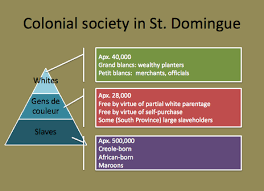
Society was structured into 4 classes:
The Grand Blancs(European Born Elite)
Colonial Administration
Plantation Owners
Only came to the island for business
The Gens de couleur(Freed People of Color)
Usually mixed race
Artisans
Domestic Servants
Plantation overseers
Very few of them owned small plantations and even slaves
The Petit Blancs
Artisans
Domestic Servants
Slaves
All four of these groups had something to be frustrated about.
The Grand Blancs(European Born Elite)
French trade laws
Government’s attempts to improve slave conditions
The Gens de couleur(Freed People of Color)
Subject to discrimination, regardless of wealth
The Petit Blancs
Resentful of the privileges that the Gens de couleur had
Were poor, so they couldn’t have slaves
Slaves
Disliked their captive state
Causes
Slavery and Oppression: The brutal conditions of slavery on plantations in Saint-Domingue (now Haiti) fueled resentment among enslaved people. They were treated like property, and many thought they were oppressed.
Influence of Enlightenment Ideas: Enlightenment thinkers like Rousseau and Voltaire inspired ideas about freedom, equality, and human rights.
French Revolution: The French Revolution in 1789 sparked hopes for change. The Declaration of the Rights of Man and the Citizen made people question why they were still enslaved while others were claiming rights.
Leadership of Toussaint L'Ouverture: This former enslaved person became a key leader of the revolution, organizing and leading the fight for freedom. He was like the ultimate revolutionary superhero!
Racial Tensions: There were tensions between the white planters, free people of color, and enslaved people. The struggle for power among these groups contributed to the chaos that led to revolution.
Timeline
1791: The Uprising Begins
On August 22, enslaved Africans in the northern region of Saint-Domingue (now Haiti) revolt against their French colonial masters, marking the start of the revolution.
1793: Abolition of Slavery
In response to the revolution, the French government abolishes slavery in the colony on February 4, 1794.
1794-1798: Internal Conflicts
The revolution sees various factions emerge, including leaders like Toussaint L'Ouverture, who becomes a prominent figure in the fight for freedom.
1801: Toussaint L'Ouverture's Constitution
L'Ouverture establishes a constitution that grants autonomy to Saint-Domingue, but he is later captured by French forces in 1802.
1804: Independence Declared
After years of struggle, Haiti declares its independence on January 1, 1804, becoming the first independent black republic and the first nation to abolish slavery.
1804-1806: Aftermath and Leadership Struggles
Following independence, Haiti faces internal power struggles, leading to the assassination of Jean-Jacques Dessalines, who had declared independence.
1825: Indemnity to France
Haiti is forced to pay a large indemnity to France, which significantly impacts its economy for decades.
Latin American Revolutions
Mexican Independence
Mexico gained its independence from Spain through a series of events that unfolded over more than a decade, starting in 1810 and culminating in 1821.
The Call to Arms
The movement began on September 16, 1810, when Miguel Hidalgo, a Catholic priest, issued the "Grito de Dolores," calling for the end of Spanish rule. This marked the start of the Mexican War of Independence.
Key Figures
Several leaders emerged during the struggle, including José María Morelos and Vicente Guerrero, who continued the fight after Hidalgo's execution in 1811. Their efforts helped to rally more support for the cause.
Struggles and Challenges
The war was marked by numerous battles, shifting alliances, and internal conflicts. The independence movement faced setbacks, but the desire for freedom continued to grow among the Mexican people.
Final Victory
In 1821, after years of fighting and negotiation, Mexico finally achieved independence when the Spanish government recognized it. The signing of the Plan of Iguala and the subsequent Treaty of Córdoba solidified Mexico's status as an independent nation.
Simon Bolivar
Simón Bolívar, often called "El Libertador," was a Venezuelan military and political leader who played a crucial role in the independence movements of several South American countries in the early 19th century.
Born on July 24, 1783, in Caracas, Bolívar came from a wealthy family and was educated in Europe, where he was influenced by Enlightenment ideas about liberty and democracy. After returning to Venezuela, he became involved in the independence movement against Spanish colonial rule.
Bolívar's military campaigns were extensive. He led forces in battles across Venezuela, Colombia, Ecuador, Peru, and Bolivia, achieving significant victories that helped liberate these nations from Spanish control. His vision was to create a unified Latin America, which he attempted to realize through the establishment of Gran Colombia, a republic that included modern-day Colombia, Venezuela, Ecuador, and Panama.
Despite his successes, Bolívar faced numerous challenges, including political infighting and regional rivalries. Gran Colombia eventually dissolved due to these conflicts, leading to the emergence of separate nations. Bolívar's later years were marked by disappointment and disillusionment with the political situation in the region.
Brazilian Independence
Brazil gained its independence from Portugal in a relatively peaceful manner compared to other Latin American countries. The process began in the early 19th century, influenced by the Napoleonic Wars, which led to the Portuguese royal family fleeing to Brazil in 1808.
In 1821, King João VI returned to Portugal, leaving his son, Dom Pedro, in charge of Brazil. As tensions grew between the Brazilian population and the Portuguese government, Dom Pedro declared Brazil's independence on September 7, 1822, with the famous cry, "Independência ou Morte!" (Independence or Death!).
Brazil officially became an independent empire in 1824, and Dom Pedro I was crowned as its first emperor. The transition was relatively smooth, with fewer violent conflicts than in other regions of Latin America.
Consequences of Major Revolutions
When talking about major revolutions, like the American, French, and Haitian revolutions, there were significant consequences that shaped the world.
1. Political Change
Rise of Democracy: The American Revolution (1776) inspired democratic ideals, leading to the establishment of republics and constitutional governments.
Introduced the idea of liberalism and conservatism
End of Monarchies: The French Revolution (1789) challenged the absolute monarchy, leading to the rise of republicanism and the eventual spread of democratic ideas across Europe.
2. Social Change
Class Struggles: Revolutions often highlighted class inequalities. The French Revolution, for example, led to the rise of the bourgeoisie and the decline of feudal privileges.
Abolition of Slavery: The Haitian Revolution (1791-1804) was the first successful slave revolt, leading to the establishment of Haiti as the first black republic and inspiring abolitionist movements worldwide.
3. Nationalism
Emergence of National Identities: Many revolutions fostered a sense of national identity. The struggles for independence in Latin America, led by figures like Simón Bolívar, created new nations and a sense of nationalism.
4. Economic Impact
Shift in Economic Power: The revolutions often disrupted traditional economic systems. For instance, the Industrial Revolution gained momentum partly due to the political changes in Europe and America, leading to new economic models.
5. Global Influence
Inspiration for Future Movements: The ideas and outcomes of these revolutions inspired countless other movements around the world, from the 1848 revolutions in Europe to independence movements in Asia and Africa.
The New Nations and Nationalism in Europe
Nations and Nationalism
The most influential political idea of modern political thought is the idea of a nation.
Nation: A type of community with ethnically similar peoples living in an area
Intense feelings about nations are the driving force of nationalism
Cultural Nationalism
The goal of early nationalist thought was to create appreciation for the history of their land.
Example of this: Johann Gottfried von Herder, who sang praises of the German Volk(people) and their heritage.