Christianity
Basic Facts
Denominations:
Roman Catholic & Orthodox: Rome vs. Constantinople based on the West-East divide.
Transubstantiation: Eucharist becomes the body and blood.
Roman Catholic: the largest denomination of Catholicism, has 33 branches.
Protestantism: from the 2nd schism, separated and believes in consubstantiation: the body and blood remind us of Christ.
Polytheism: multiple gods in a religion
Monotheism: one god in a religion
Religious Pluralism
Census: Canadians understand diversity in our religions through a survey of the population.
Agnostic peoples: peoples who believe that God may exist but that humans cannot know about it for certain.
Atheist: no belief in a God.
Race: biological characteristics
Ethnicity: self-definition, where you are from.
Culture: cultures and practices in a group.
Religious Pluralism: co-existence of religions living in a society. In Canada, people are free to practice — this is not always the case worldwide. Tolerance for other religions.
Catholic understanding of religion: the Holy Spirit works within us as world religions are learned.
“We are each other’s business”: gives themes of religious pluralism; we all live in peace but not explore our diversity; we must support oneanother’s religions and prevent harm stemming from beliefs.
Christian Symbols
Chi-Rho: ☧ symbol used to denote Christians when Christians were persecuted before year 300.
Abrahamic Religions
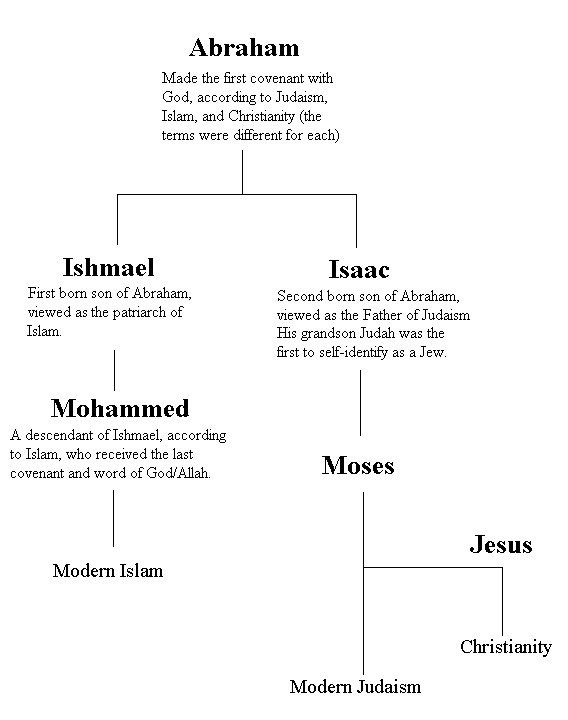
Abraham: source of all Abrahamic Religions.
Ishmael: son of Hagar (a handmaid), who created Islam. Ends up in Saudi Arabia, Mecca.
Mohammed: descendant of Ishmael.
Isaac: son of Sarah, conceived by God for Sarah, who was incapable of conception. Founded Judaism.
Jacob has 12 sons, including Joseph. Becomes renamed Israel.
Joseph: becomes sold into slavery as the eldest brother, becomes right hand man of the Pharaoh for dream interpreting abilities.
7 year famine: a famine by divine power that resulted in an influx of Israelis entering Egypt.
Moses: freer of the Israelites, brings them back to Israel after enslavement.
Esau: brother of Jacob.
Protestantism: branches off of Catholicism.
Establishment in the Roman Empire/Israel/Palestine areas
Romans: Caesar | ||
|---|---|---|
Rome: political control | Judaism: religious control | |
Governor: Ponticus Pilate | High Priest (Jerusalem’s temple) | |
Great Sanahandriem (high court, could convict) | ||
Scribes/pharacies | ||
Rabbis |
Jesus’ Life
Jesus Christ: central figure of the Christian faith. Born at 4BCE, crucified in 30CE. Life, death and resurrection enables Christians to find meaning in life and instruction in how to live life.
Timeline
4BCE: conceived by the power of the Holy Spirit to Mary, his virgin mother. Born in Bethlehem, in Palestine.
Nazareth: the city which Jesus grew up in, in the province of Galilee.
Few records of Jesus before his ministry exist, except for the story of him in the Temple, which is an establishment of the divinity. King Harod was fearful of Jesus’ power, therefore ordered all first borns killed: the killing of the innocents.
Mary and Joseph: Jesus’ parents whom raised him.
Ministry
30 years old/26 BCE: Jesus began public ministry and was baptized in the River Jordan by John the Baptist, his cousin, who proclaimed repentance.
Baptism: a form of cleansing, how a connection to God begins.
Jesus then went to the desert for 40 days and was tempted by the devil 3 times.
12 ordinary men to become his disciples, from all walks of life.
Teachings
The Kingdom of God was at hand, a kingdom of justice where the poor and oppressed would be freed.
Love the Lord your God with all your heart, all your mind, and all your being: the Greatest Commandment, in which the law and the 10 Commandments are fulfilled.
The Golden Rule: Love your neighbour as you love yourself.
Sermon on the Mount: Jesus lays the 8 Beatitudes and fulfills Moses’ law.
Beatitudes: 8 rules that blesses Christians on how to live.
Moses’ Law: instructions on how to live as a Christian.
Miracles: casted demons, resurrected the dead and taught Parables to illustrate the Kingdom of God. Proclaimed a radical message that left people in awe.
Teaches Christians how to be in relationship with God the Father and oneanother.
Forgiveness and conversion were essential to teachings and message of love.
Jesus’ Trials, Death and Resurrection - ~30 CE
Palm Sunday
Jesus enters Jerusalem on Palm Sunday, called Palm Sunday because of how Jesus was greeted with palms.
Given welcome given news about how powerful and revolutionary he is.
Raising Lazarus from the dead, before Palm Sunday, sets his passion into motion.
Jesus enters the Temple in Jerusalem, which hosts the Arc of the Covenant (the 10 Commandments)
The same people who greeted Jesus with palms will then demand his death 4 days later.
Judas: betrays Jesus after being paid with 30 pieces of silver by the Great Sandraheim
Last Supper - Holy Thursday
In a locked room, on the ground, Jesus shares the Jewish passover meal with his disciples.
Transubstantiation: the bread and wine becomes the body and blood of Jesus.
Judas is sat beside Jesus — Jesus knows that one of his disciples will betray him.
Washing of the Feet: Jesus broke down societal stereotypes at the last supper, becoming a servant to his disciples.
Garden of Gethsemane - Holy Thursday
The disciples leave the Last Supper and go to the Garden.
The Disciples fall asleep twice despite Jesus’ requests to monitor.
Jesus is arrested, Judas betrays Jesus via a kiss on the cheek and Peter denies Jesus three times, as per his prediction.
Jesus is subsequently accused of blasphemy: making himself God.
Pontus Pilate: roman Governor who sentences Jesus to death via crucifixion for treason against Caesar. Barabus is set free in exchange of Jesus.
Into Good Friday
Jesus becomes scourged, mocked with the Crown of Thorns and Robe.
Jesus is moved to Golgotha, does not carry cross (impossible for him to carry alone)
Golgotha: “the skull”
Sign is nailed to cross: “king of the Jews”
Jesus is nailed in wrists and ankles and is pierced in the side to verify his death.
Jesus is buried immediately, linen wrapped in the Shroud of Trinn and laid in a mosolium.
Shroud of Trinn: the linen which Jesus was wrapped in: image of Jesus’ body was imposed, crown of thorns and side wounds present.
Understanding of Resurrection
the body and soul of Jesus were resurrected 3 days after his death on Easter Sunday.
Thomas doubted his resurrection and Mathias replaced Judas, who committed suicide.
The Early Church
Jesus promised to send the Holy Spirit to guide his followers in wisdom until his return. 40 days after resurrection, Jesus ascended into Heaven. Mary is the only other person in Christianity to have her body and soul risen: the Assumption.
Early Christians believed that Jesus was to return quickly. Disciples were locked and isolated, then on the Pentecost, the Holy Spirit came in tongues of fire to give languages to the disciples.
Pentecost: the birthday of the Church around 30 AD.
Speaking in tongues: the Holy Spirit working through us.
Early Church Teachings
Initially, Christianity was illegal for the first 3 centuries of the Common Era (40CE - 313CE): all disciples except for John died for their beliefs: martyrs.
The Apostles Creed: prayer developed in 150 CE, what we all believe in as Christians.
1 God, 1 son, conceived by the Holy Spirit.
Hell: at the time, a term for death.
Jesus is seated at the right hand of God.
There will be a second coming.
The communion of Saints will be continually praying for the deceased.
Paul of Tarsus: originally a Jew and a Roman citizen, he persecuted Christians before being struck blind on route to Damascus in search of Christians and converting to Christianity.
He became an evangelist of the Good News: the Gospel.
Primary author of the New Testament: 3/4ths are his letters to peoples struggling with faith.
Roman Emperor Constantine: legalizes Christianity and makes it the official religion of the Roman Empire in 313 CE. Had a dream in which all Roman wars were to be won with the Chi-Rho.
Divisions within Christianity
The Great Schism - 1054 CE
A split of the Church into east and west: the Roman Empire and the Byzantine Empire with its 4 patriarchates.
Roman Catholic (Universal) Church: Latin Speaking, with Rome, the burial place of St. Peter as the central location. Believed that the Bishop of Rome (the Pope) should have primacy: priority/importance. The Pope leads the church.
Byzantine Empire (4 patriarchates): Greek speaking, with Constantinople (Istanbul), Antioch, Alexandria and Jerusalem as centres of faith and culture. Rome should be given respect, not priority. Patriarchs, fatherly figures, lead the Eastern Churches. Orthodox means “true”
The Crusades
The Crusades/The Holy Wars: from the 11th to 13th centuries, Christian armies tried to take back Jerusalem from the Muslims. Six major crusades took place where armies from Europe descended upon Muslims to reclaim the Holy City.
St. Francis of Assisi (1182 - 1226 CE): reforms the church, founding a religious order that takes a vow of poverty and detachment, imitating Christ and living with the poor. Back to roots of the Church.
Reformation: 16th century
Martin Luther: a german priest who was the catalyst for Reformation of the Church. Creates the Protestant church.
95 theses: demands of reforms within the church.
Authority should lie solely with the Bible and not with church tradition or leaders.
Salvation comes from faith, not actions. Beliefs and faith are more important than participation in Church.
Lutherans: followers of Martin Luther.
Mormonism stems from Reformation and Protestantism.
Calvinists and Reformers: created new religious communities and denominations of the Church, retained liturgical practices. Formed in Europe.
Anabaptists, Mennonites and Puritans: established simpler forms of worship and opposed infant baptism. Formed in Europe.
Anglican Church: formed when the Pope would not grant King Henry VII authorization to divorce Catherine of Aragon and marry Anne Boleyn. Henry declares himself head of the Catholic Church of England. The King of England is always the leader of the Anglican Church.
Protestant beliefs: salvation is by faith alone, authority on matters of faith is determined by the Bible, Baptism and Eucharist are the only sacraments.
Fundamentalism: what was written in the bible is to be understood in the most literal sense, no interpretation possible.
Evangelicalism: emphasizes personal faith in Christ and the Bible as an individual’s sole religious authority, witnessing or sharing the faith is imperative.
Pentecostalism: emphasizes the “gifts of the Holy Spirit”
Council of Trent (1545 - 1563)
The Council of Trent: when the Roman Catholic Church responded to the issues of the reformers and Martin Luther. Affirmed papal supremacy.
Salvation comes from faith and works - belief and attending church and receiving sacraments
Jesus is truly present in the bread and wine during Consecration (transubstantiation)
The Priest acts “in persona Christi” during consecration, into the body and blood of Christ.
Priests go through 7 years of seminar to become priests, receive a theology degree.
Named 7 sacraments (baptism, reconciliation, eucharist, confirmation, marriage, holy orders and anointing of the sick)
Priests cannot become married, they are married to the Church.
Age of Enlightenment (17th century)
Rationalism: the power of human reason. Reason and knowledge versus religion and emotion.
Empiricism: reality is only perceived through 5 senses. Emphasized that people could determine their own destiny and had little need for God. Tangible proof needed to believe.
Separated church and state.
World Council of Churches - 1948
World Council of Churches: leadership from various Christian churches gathered to bring understanding between Christian communities.
Ecumenism: efforts to maintain and build the global Christian community in commonality of their beliefs in Jesus and Baptism.
Vatican II - 1962 - 1965
Significant council in the 20th century, with the Catholic Church defining its identity with scholarly research, affirming the validity of various world religions by Pope John XXIII.
Receiving Eucharist in hands, language of mass changed from Latin to native languages.
Canon Law - 1983 by Pope John Paul II → Vatican II becomes Church Law as does the Theology of the Body.
Sacred Scripture
the Bible: core teachings of Christian faith, compiled into the Old & New Testament. Divided into books, which contains chapters, which contains verses.
Old Testament: 46 books, shared with Judaism, containing history of the Jewish people, prophets, kings, creation.
New Testament: 27 books, an account of Jesus after his death and resurrection.
73 books for Catholics, 66 for Protestants. Versions stem from language.
Christian Denominations
Catholicism
Founded in 1054
Founded in Rome & the Western Roman Empire
Founded by St. Peter (catholics only believe this) and various bishops of Rome.
1.5 billion adherents (members)
Original language was Latin.
The Roman Missal is the worship guide.
Orthodox
Founded in 1054, Great Schism.
Founded in Constantinople and the Eastern Roman empire.
Founded by various church fathers, Patriarch Michael Cerularius in 1054.
225 million adherents (members)
Original language was Greek.
No worship guide.
Lutheran
Founded in 1530 AD in Germany by Martin Luther.
66 million adherents worldwide.
Primary language is German.
Book of Concord is the worship guide. King James Version Bible has 66 books.
Anglican/Episcopalian
Founded in 1534 AD in England by King Henry VIII.
70 million adherents in 161 countries.
Original language was English
Book of Common Prayer is the worship guide.