Geological Structures GEOL120
Structural geology is a foundational sub-discipline of geoscience in addition to:
tectonics
igneous petrology
metamorphic petrology
minerology
palaeontology
sedimentology
This means that in order to have a proper basis for which to understand the geological literature, there must be an understanding of principles of structural geology.
What is it?
Study of distribution of rocks in 3D
Study present day rock structures to determine history of past deformation and the ancient stress fields that produced them
The geologist can then reproduce past evolution of the area (tectonics)
Structural geology is also used to produced geological maps!
Tectonic forces are continually squeezing, stretching, bending and breaking rocks in the lithosphere.
When forces are applied to a object, the body is under stress.
Deformation of rocks is best described in terms of strain → changes in size and/or shape as a result of stress.
Deformation
Folding - ductile material
Faulting - brittle material
Deformation of rocks
Deformation: general term that refers to all changes in the size, shape, orientation, or position of a rock mass
Every body of rock has a point beyond which it will ‘flow’ or fracture
Most crustal deformation occurs along plate margins
Evidence of deformation - folds, faults, joints, shear zones, fabrics (deformational textures)
Stress vs Strain
Deformation structures in rocks are the result of physical changes (strain) caused by the action of forces (stress)
Stress - Measure of the applied force per unit area. Stress=force/area
Confining stress - uniform in all directions (affects size not shape of rock)
Differential stress - non-uniform (causes rock bodies to change shape)
Changes in size and shape of the body undergoing differential stress:
change in length/width (tensional or compressional stress)
change in angular relations (shear stress)
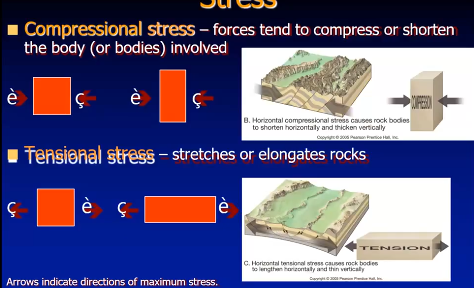
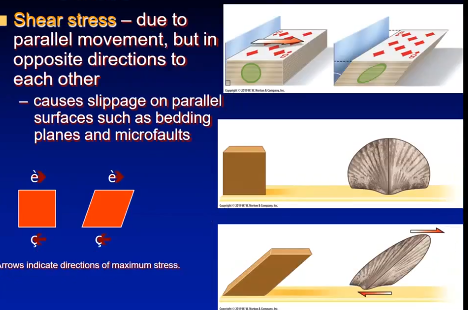
Stages of deformation
Rock subjected to increasing stress passes through three stages of deformation:
elastic
ductile (plastic deformation)
fracture (brittle deformation)
Elastic deformation
Reversible or nonpermanent change in the volume or shape of a rock under stress
A deformed body recovers it’s original size/shape after the stress is reduced
Elastic limit - point beyond which rock will not be returned to original shape/size → permanent deformation
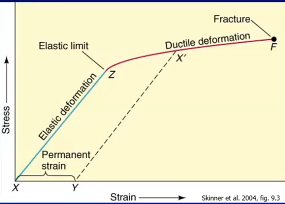

a - elastic
b - ductile
c - fracture
Bend or break?
whether a rock will bend or break is determined by these factors:
Brittle - low confining P, low T, High strain rate and/or low water content
Ductile - High confining P, High T, low strain rate and/or high water content
Brittle vs Ductile
Brittle - Minor internal strain, catastrophic break (like bending glass at room temp)
Ductile - Smooth, continuous plastic deformation (like slowly bending an aluminium plate)
Variables that control response:
Temp
Confining pressure
Strain rate
Water availability
Rock types


Strike and Dip
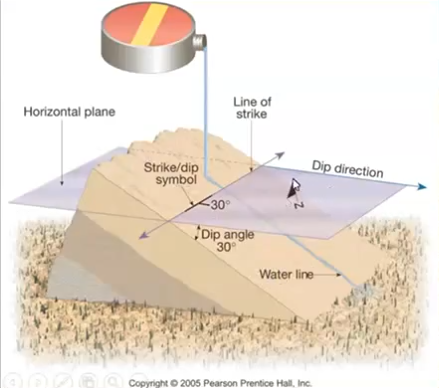
Folds -
bends or flexures in rock, result of ductile deformation under the action of compressional or shear stress.
May be broad, gently warping over 100’s of Kms
Tight flexing at a microscopic scale
Common form of deformation observed in layered rocks
Shapes and patterns of folds reveal much about the nature and extent of the forces of deformation that created them
Fold teminology:
Hinge or axis - an imaginary line on the folded surface where the curvature of the surface is greatest
Limbs - sides of the fold (regions on either side of the hinge)
Axial plane - An imaginary plane that divides the fold symmetrically
Plunge - The angle between a fold axis and the horizontal
Plunging fold - fold with an inclined axis


Antiform and Synform
Antiform - an arch-like fold in which the limbs dip away from the hinge (no information about the age of the strata)
Synform - trough like fold in which the limbs dip towards the hinge (no information about the age of strata)

Anticlines and synclines are similar to their ‘form’ counterparts, however they differ in the fact that you know the age of strata in the cline. E.g. Syncline has the youngest strata on the top near the hinge, and anticlines have the oldest strata on the bottom near the hinge.
Anticlines as petroleum traps - Oil and gas accumulates in the axis of the fold

Types of folds -
Monocline
Step like folds in otherwise horizontal strata
Result of reactivation of fault zones in basement rock

Basically there is a fault in the basement rock, and any sediments on top with water still in them will fold (as shown in the image above).
Chevron - straight limbs and narrow or sharp hinges
Sinusoidal - continuously changing curvature, from straight limbs to curved through hinges
Circular - constantly or nearly constant curvature all around a fold
Box - Multiple hinges

Parasitic fold - folds within folds

There is asymmetry in parasitic folds on either side of the hinge. On each limb there are Z-folds and S-folds and on the hinge there are M-folds. These signify which part of the folded strata is more stretched. The top part of the letter ‘Z’ in Z-folds are the most stretched than the bottom part of the letter Z. The top part of the ‘S’ in S-folds is more stretched then the bottom part of the letter ‘S’
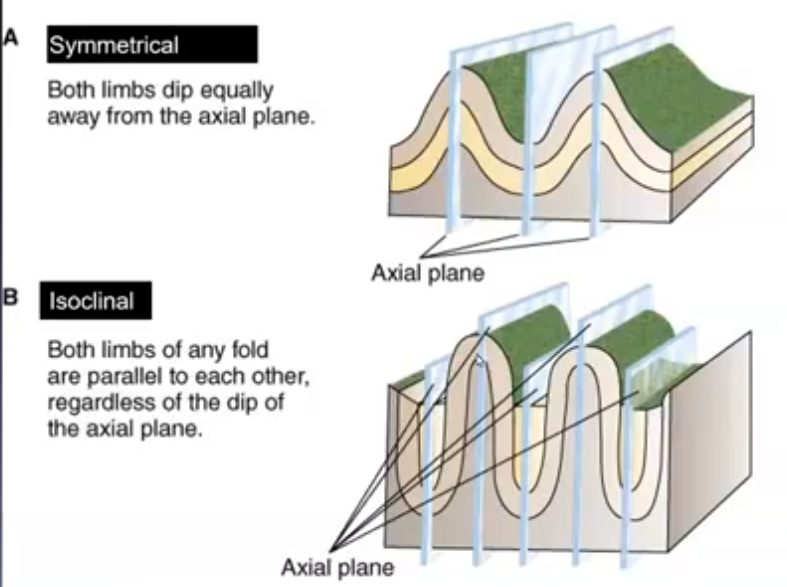

An axial plain is a plain of weakness, along the axial plain you will see mineral alignment which will turn into a cleavage or foliation plane.
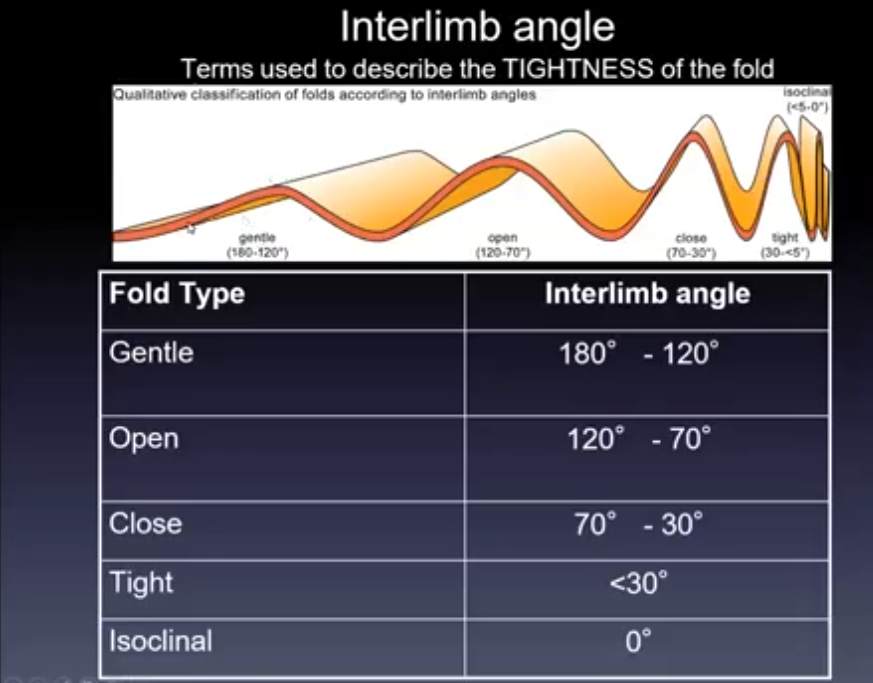
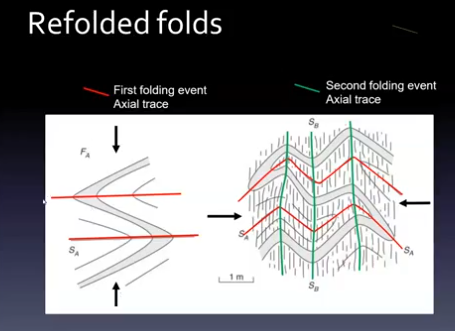
Refolding
Rocks may experience more than one episode of folding
Earlier folds become refolded about new fold axes (new folds are superimposed or overprinted on older folds)
Resulting outcrop patterns are often very complicated.

Microstructures as a result of refolding: Crenulation folds
Crenulation is a small-scale folding superimposed on folding of a larger scale.
Results from one or more episodes or ‘generations’ of refolding.

Faults - 2 major types of fracture
Joints
Faults
Joints - Fractures in rock where there has been no relative displacement. Formed by mechanical fracturing due to brittle nature of rocks. Rocks break at points of weakness when they are twisted, squeezed or stretched.
Faults - Fractures in rocks along which appreciable displacement has taken place. Most fault surfaces are inclined, therefore the terms hanging-wall and footwall are applied to the 2 bodies of rock that are separated by the fault.
Classification of faults -
Dip-slip faults: Normal fault, Reverse fault and Thrust fault
Strike-slip faults -
Dextral (right lateral)
Sinistral (left lateral)