Short Run Aggregate Supply (SRAS)
Short Run
Remember, the factors of production are land labor and capital; and input costs refers to the prices paid by firms for the purchases of these resources. Changes in input costs can significantly affect the SRAS curve, as higher costs may lead to a decrease in supply, while lower costs can increase supply, shifting the curve to the right.
Firms often fix input prices over a period of time like, wages, annual leases, and commodity prices.
The short run refers to the time period in which at least one input price is fixed
“Sticky“ input prices
The short run is however long it takes for input prices to “catch up“ with changes in price level
Sticky input prices are those that are slow to change with the change in price level.
The Short Run Aggregate Supply Curve
Aggregate supply is the quantity of aggregate output supplied in an economy.
The SRAS curve describes the relationship between the price level and the quantity of aggregate output supplied in the short run.
The SRAS is upward sloping because of sticky wages and other input prices.
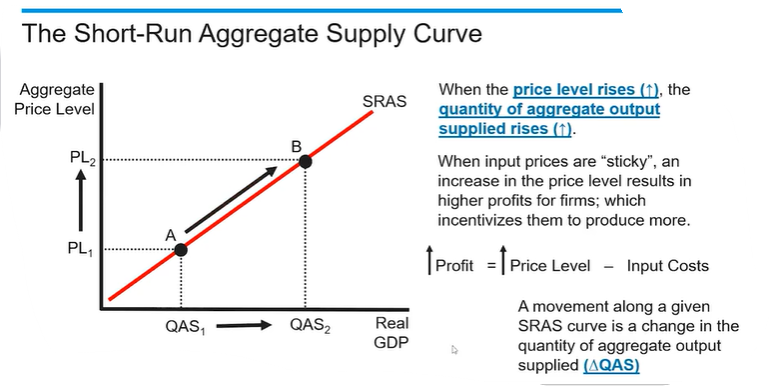
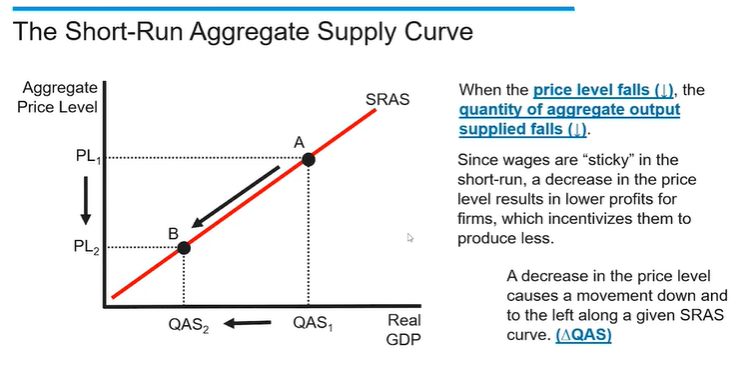
Short-run trade off between inflation and unemployment rate
As you move right, along the curve, more quantity of aggregate output supplied increases, thus more workers are hired. In addition, the price level increases, so inflation causes a decrease in unemployment rate

Difference between change in QSRAS and a change in SRAS
Firms always try to make more money
Total profits = Aggregate Price Level - Aggregate Input Cost
When profits increase, the quantity of goods and services produced increase
If profits increase due to a rise in price level, then it is a change in QSRAS.
If profits increase due to an increase in aggregate input costs, then it is a change in SRAS
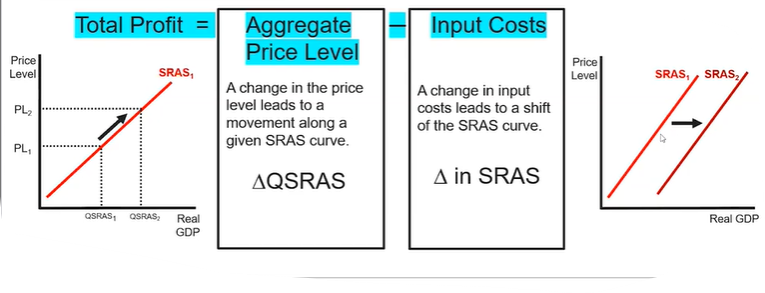
Determinants of short-run aggregate supply
Anything that makes it cheaper or easier to produce goods and services will increase SRAS, which is depicted by a rightward shift of the SRAS.
Factors that can increase SRAS include decrease in input costs (wages, and commodity prices), increase in productivity (tech advances), and government policy (deregulation and subsidies). These elements contribute to a more favorable production environment, allowing businesses to expand output without facing significant cost increases.
Apply wages to aggregate supply apply changes in income to aggregated demand
Inflationary expectations: if inflationary prices are expected to fall, they will increase production in the short run, and the SRAS curve shifts to the right