Chapter 3: Motion of Astronomical Bodies
3.1
Geocentric Universe Models
What an Astronomer sees: Retrograde Motion
backward motion
if we are interior to a planet and we are zooming past it, the planet looks like it is moving backwards because it is not as fast
Epicycles
Ptolemy - epicycles in 150 CE
circles within a circle
Heliocentric Models
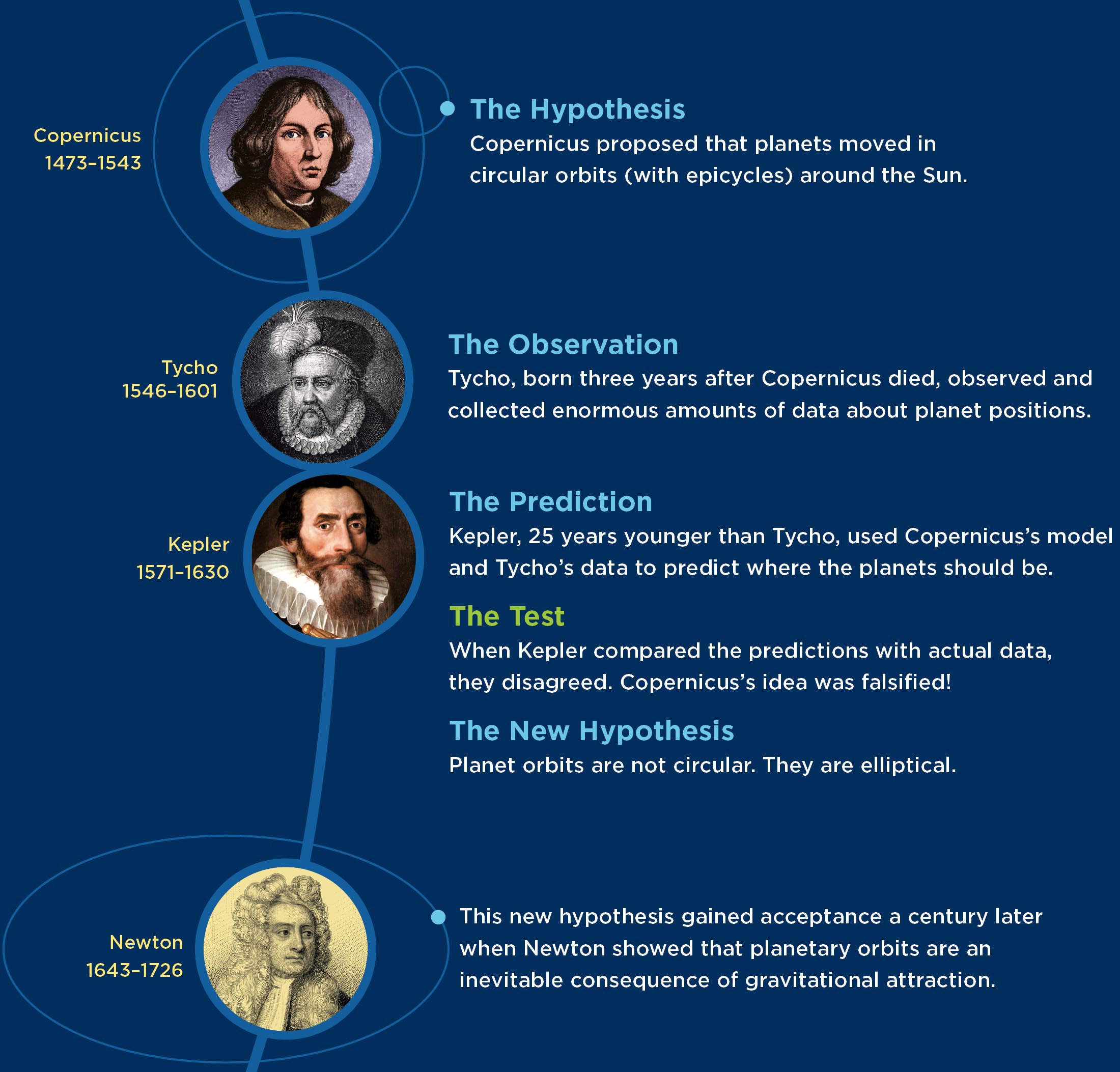
Copernicus proposed a heliocentric model
Two Types of Planets: Superior
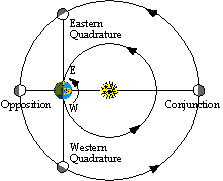
conjunction
opposition - form earth’s perspective, the sun and planet are opposite of each other
Superior - outside
best seen during opposition
Inferior
superior conjunction
inferior conjunction
inferior planets are always visible close to sunrise or sunset
Superior Planets: Periods
sidereal period
in respect to the stars
how long does one complete orbit take
synodic period
in respect to the alignment with the Earth and the sun
1/P = 1/E - 1/S
where P is the sidereal period, S is the synodic period, and E is Earth’s sidereal period, which is 1 year
Saturn is a superior planet with a synodic period of 378 days. Calculate the sidereal period.
1/P = 1/E - 1/S
1/P = 1/365.25 - 1/378
P = 10,828d/29
Inferior Planets: Periods
1/P = 1/E + 1/S
where P is the sidereal period, S is the synodic period and E is the Earth’s sidereal period, which is 1 year
Mercury is an inferior planet with a synodic period of 115.88 days. Calculate the sidereal period.
P = 87.97d
Quiz 3
3.2 Keplers Laws Describe Planetary Motion
Tycho Brahe (1546-1601_
he created geoheliocentric model with other planets orbiting the sun, but with the sun orbiting earth
begged Kepler to find a model
Johannes Kepler (1571-1630)
Johannes Kepler worked as an assistant to Tycho
Empirical rules to describe planetary orbits in a heliocentric system
these empirical rules are known as Kepler’s laws
Kepler’s First Law: Ellipses
planet orbits are ellipses, not circles
the greater the eccentricity the more elongated the ellipse
the sun is at the focus of a planet’s elliptical orbit
the average distances between the Sun and the planet is the semimajor axis
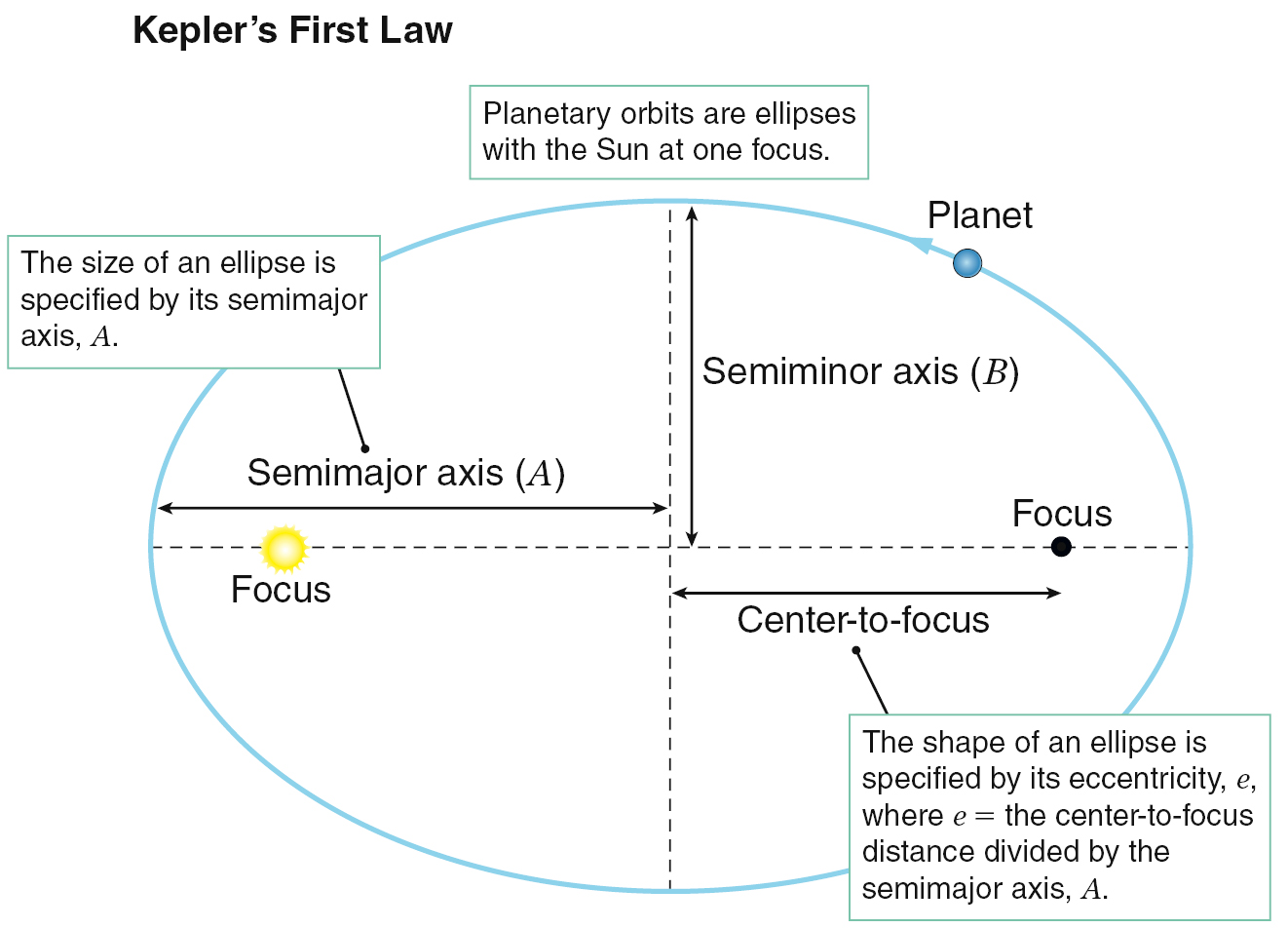
Astronomical unit = (average) distance between the sun and the earth
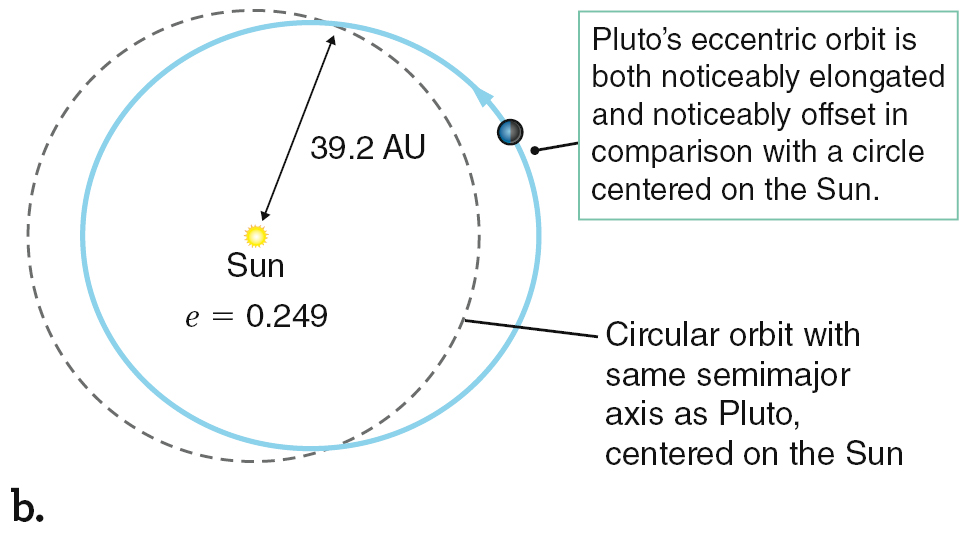
Real Shape of Planetary Orbits
in our solar system, most planetary orbits are nearly circular
Kepler’s Second Law
equal areas in equal times
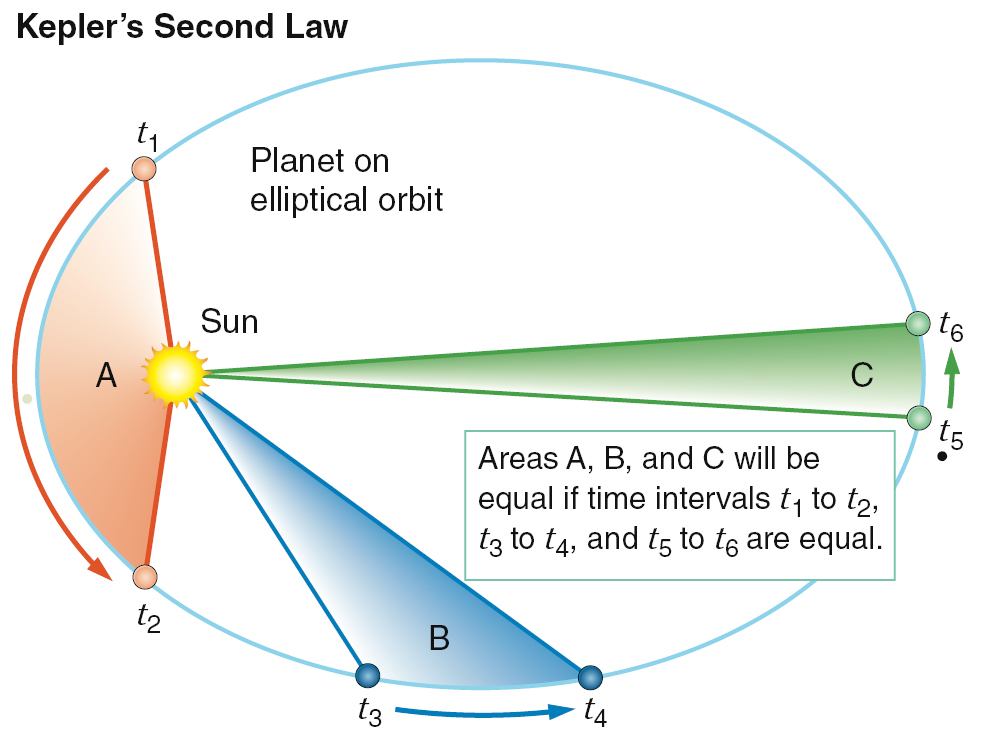
planets are moving faster when they are moving closer to the sun and slower when they are moving further away
Kepler’s Third Law
Law of Harmonies
Kepler’s third law relates the orbital period to the size of the orbit
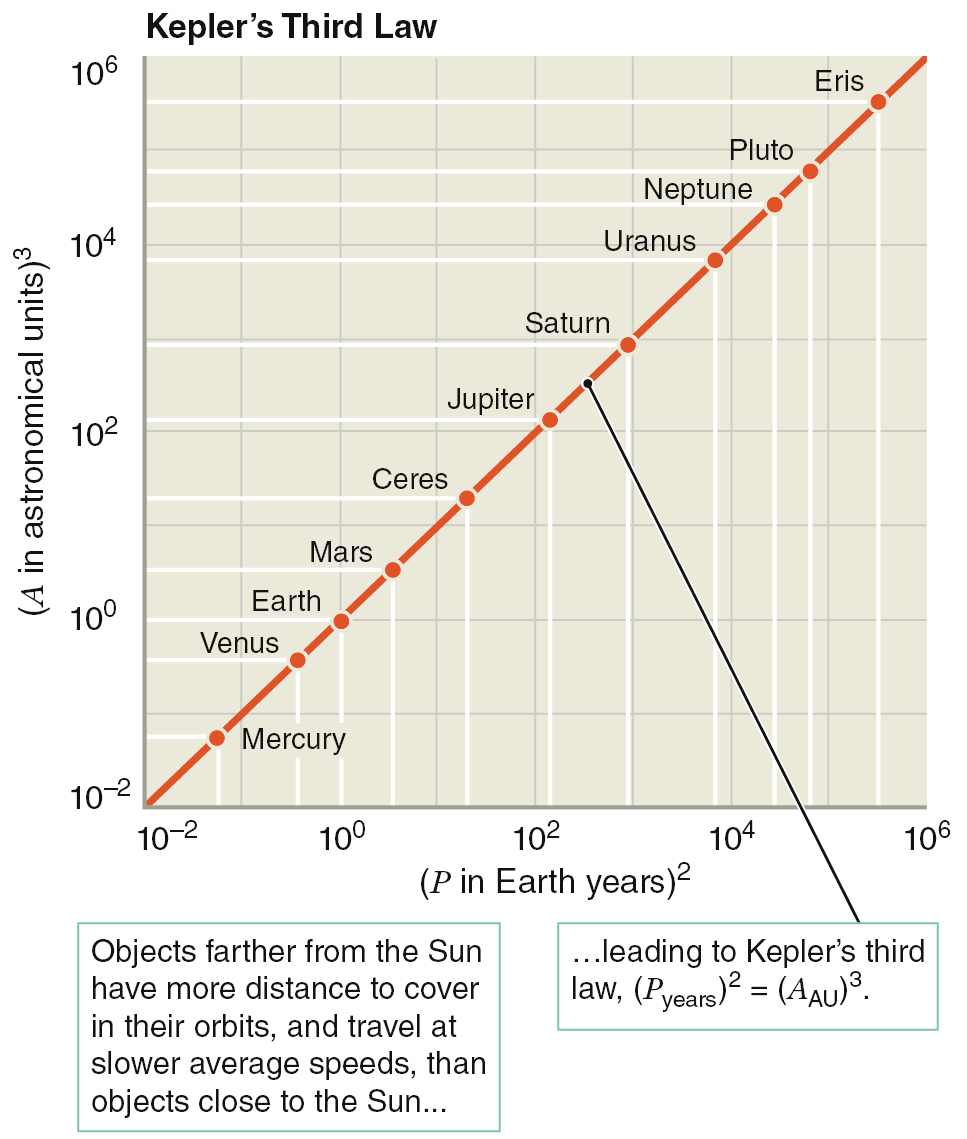
a³=p² <— orbital period of planet; years
|
semi major axis
half long axis of an ellipse; measured in Au
Practice
Planet | Periods (P) years | Semi-major Axis (A) Au |
Mercury | 0.241 | 0.387 |
Venus | 0.615 | 0.723 |
Earth | 1.000 | 1000 |
Mars | 1.881 | 1.524 |
Ceres | 4.599 | `2.766 |
Jupiter | 11.86 | 5.201 |
Saturn | 29.66 | 9.582 |
Uranus | 84.14 | 19.201 |
Neptune | 164.70 | 30.047 |
Pluto | 248.08 | 39.482 |
Eris | 556.99 | 67.696 |
3.4 Newton’s Three Laws Help Explain How Celestial Bodies Move
Isaac Newton (1642-1727)
physical laws explain how things work, while empirical laws only describe nature
Newton’s First Law of Motion
a moving object will stay in constant motion and an object at rest will stay at rest unless acted on by a net force
Galoileo’s law of inertia
“Constant” motion means at a constant speed and in a constant direction: This is an inertial frame of reference
velocity - speed and direction of an object’s motion
speed: driving 60 miles/hour
acceleration
change in velocity called acceleration
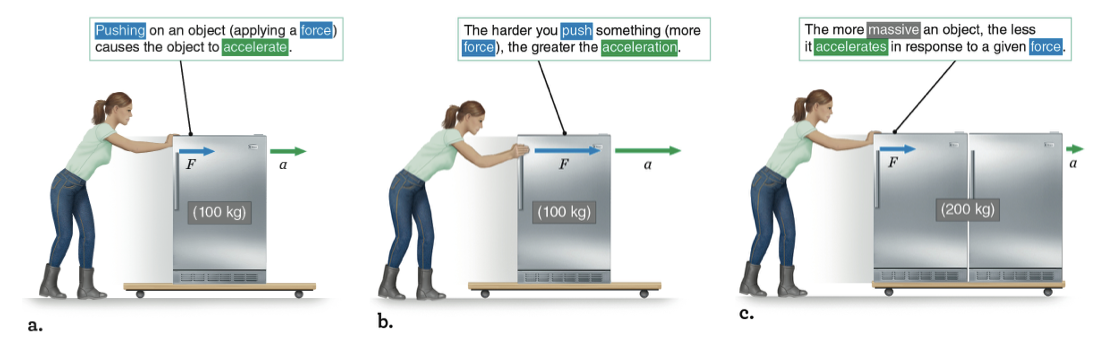
Newton’s Second Law of Motion
F= ma
if a net force acts upon an object, the object’s motion changes
forces causes an acceleration
Acceleration Depends on Force and Mass
Newton’s Third Law of motion
for every action, there is an equal and opposite reaction