1.1 B Kinetic Theory
GOALS
Distinguish between different states of matter ✅
Use state symbols (s), (l), (g), and (aq) in chemical equations ✅
Names of changes of state should be covered: melting, freezing, vaporization (evaporation and boiling, condensation, sublimation, and deposition ✅
KINETIC THEORY
temperature and pressure affect states of matter
states of matter depend on the energy of particles
state of given temperature and pressure determine strength of inter-particle forces
KINETIC ENERGY EK
energy associated with movement/motion
directly related to temperature - the measure of EK of particles in a substance
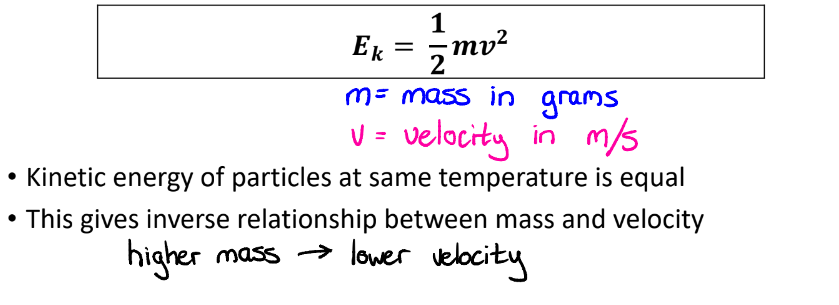
Consider the following when describing states of matter
Packing
Inter-Particle forces
Particle motion
Shape
Volume
Compressibility
 FLUIDS
liquids and gases called fluids - refers to flow ability
DIFFUSION
movement of a substance from an area of high concentration to low concentration
process; particles of substance become more easily distributed - caused by random movement
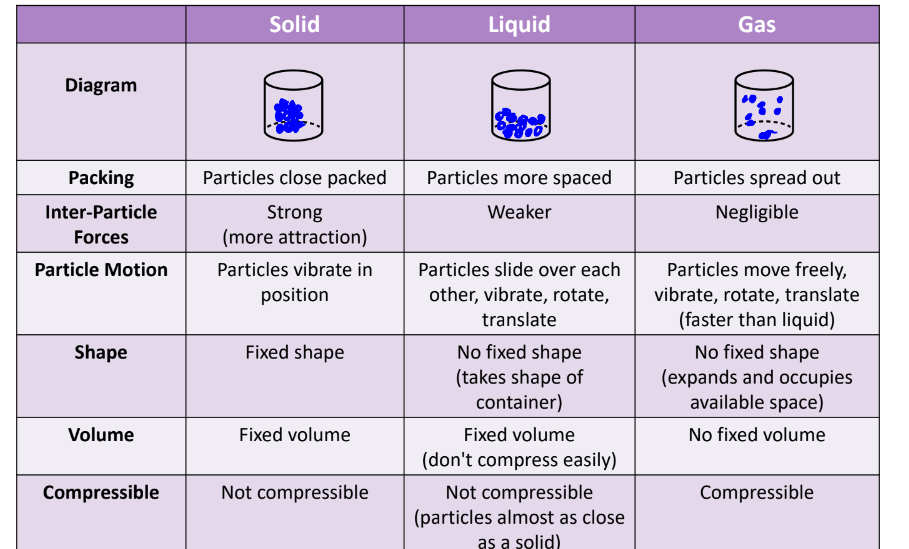
NOTE: due to Ek = ½mv2 , substances with lower mass diffuse faster (inverse relation between mass and velocity)
CHANGES IN STATE
Ek increases with temp
as particles move faster, they overcome inter-particle forces and change state
occur at fixed temp + pressure for each substance
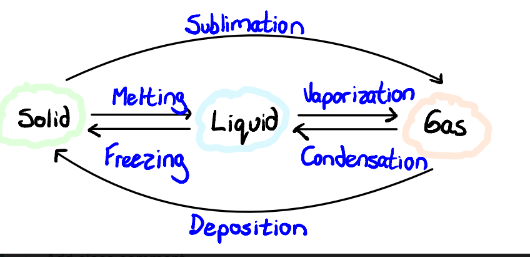 NOTE: if confused between sublimation and deposition - Sublimation = Solid → gas
EXAMPLES OF SUBLIMATION & DEPOSITION
Sublimation - dry ice
Deposition - frosting on windshield
VAPORIZATION
state change from liquid to gas
two kinds - evaporation + boiling
EVAPORATION
surface particles acquire heat from the atmosphere
when enough kinetic energy is acquired, surface particles become gas
occurs below boiling point (temp)
BOILING
throughout liquid - characterized by particles leaving throughout liquid (bubbles)
Boiling point - when all particles in liquid have enough Ek to become gas
VAPOR PRESSURE
pressure exerted by liquid on walls of container
evaporation slow; vapor pressure < atmospheric pressure
Boiling fast; vapor pressure >/= atmospheric pressure
QUESTIONS - p 11 # 6,7