Newton's Laws
🔑 Main Idea
The passage introduces Newton’s laws of motion by using a simple, everyday example (pushing a grocery cart) to show the relationship between force and motion.
📌 Key Points
A force (your push) causes an object (the cart) to move.
When no force is applied, the object can remain at rest.
Sir Isaac Newton studied situations like this to develop his three laws of motion.
These laws were published in Principia (1678), a foundational work in physics.
Newton’s laws:
Work very well for everyday objects and speeds
Do not fully explain motion at atomic scales or near the speed of light
The lesson will focus on Newton’s laws and forces that affect motion.
🧠 Purpose of the Passage
To introduce the topic of Newton’s laws of motion and prepare the reader for learning how forces influence motion.
📘 Types of Forces — Study Notes
🔹 What Is a Force?
A force is a push or a pull exerted on an object.
A force can:
Change an object’s speed
Change an object’s direction
Start or stop motion
Force and Motion
The greater the force, the greater the change in motion.
Objects move in the direction of the applied force.
🔹 Force as a Vector
Force has:
Magnitude (how strong it is)
Direction (where it acts)
Therefore, force is a vector quantity.
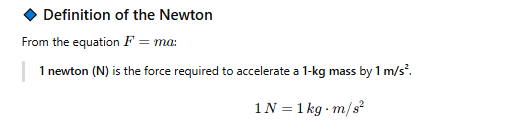
SI unit of force: newton (N)
🔹 Types of Forces
There are two main types of forces:
Contact forces
Field (fundamental) forces
This lesson focuses on contact forces.
🔹 Contact Forces
Contact forces occur only when objects touch.
They result from interactions between molecules on touching surfaces.
Main Types of Contact Forces:
Tension
Normal force
Friction
🔹 Tension
Tension is the pulling force exerted by a rope, string, or cable.
Example:
A block suspended by a rope
Properties of tension:
Acts away from the object
Acts parallel to the rope
Is transmitted through the entire length of the rope
🔹 Normal Force (Support Force)
The normal force is exerted by a surface on an object.
It acts:
Perpendicular to the surface
Away from the surface
Example:
A book resting on a table
Gravity pulls the book downward
The table pushes upward with a normal force
🔹 Weight (Gravity)
Weight is the force of gravity acting on an object.
It is a force, so it is measured in newtons (N).
🔹 Friction
Friction is a contact force that opposes motion.
It occurs when two surfaces:
Are moving against each other
Or trying to move against each other
Friction produces heat energy.
Why Friction Occurs
Even smooth surfaces have microscopic bumps.
At these bumps:
Atoms form weak electrical bonds
These bonds must break for motion to occur
🔹 Types of Friction
1⃣ Static Friction
Acts when an object is at rest
Prevents motion from starting
Increases as force increases, up to a maximum value
2⃣ Kinetic Friction
Acts when an object is already moving
Occurs during:
Sliding
Rolling
Motion through fluids (like air or water)
🔹 Shopping Cart Example
Cart at rest:
Static friction between wheels and floor resists motion
When you push hard enough:
Static friction is overcome
Cart in motion:
Kinetic friction opposes movement
To keep the cart moving:
You must apply a force equal to kinetic friction
🧠 Key Takeaways (Exam-Ready)
Force = push or pull
Force is a vector
Unit of force = newton (N)
Contact forces require physical contact
Main contact forces:
Tension
Normal force
Friction
Friction always opposes motion
📘 Field (Fundamental) Forces — Study Notes
🔹 What Are Field Forces?
Field forces act without physical contact between objects.
Objects interact through a field that exists in space.
There are four fundamental (field) forces in nature.
🔹 Gravitational Force
Gravity is the weakest of the field forces.
It is a force of attraction between any two masses.
Gravity:
Keeps planets in orbit around the Sun
Causes objects to fall toward Earth
Key Facts:
Acts over very large distances
Always attractive (never repulsive)
Near Earth’s surface, objects accelerate downward at:
9.8 m/s²
Example:
A ball thrown upward slows down, stops, then falls back because of Earth’s gravitational field.
🔹 Electromagnetic Force
The electromagnetic force acts between charged particles.
Charges and Interaction:
Like charges repel each other
Opposite charges attract each other
What Electromagnetic Force Does:
Holds electrons and protons together in atoms
Causes electric forces
Causes magnetic forces
Magnetism:
Magnets attract certain metals
Like poles repel, opposite poles attract
🔹 Comparison: Contact vs Field Forces
Contact Forces | Field Forces |
|---|---|
Require touching | Do NOT require touching |
Act through surfaces | Act through fields |
Examples: friction, tension | Examples: gravity, electromagnetism |
🧠 Key Takeaways (Exam-Ready)
Field forces act at a distance
Gravity:
Weakest force
Always attractive
Controls planetary motion
Electromagnetic force:
Acts between charges
Can attract or repel
Holds atoms together
📘 Study Notes: Nuclear Forces
🔹 Nucleus
The nucleus is the center of an atom.
It contains:
Protons (positively charged)
Neutrons (no charge)
Protons + neutrons = nucleons
The nucleus contains most of the atom’s mass.
🔹 Strong Nuclear Force
Acts between:
Proton–proton
Neutron–neutron
Proton–neutron pairs
Strongest force in nature
Acts over very short distances
Overcomes electromagnetic repulsion between protons
Holds the nucleus together
🔹 Weak Nuclear Force
Acts between subatomic particles
Much weaker than the strong nuclear force
Responsible for beta decay
Allows particles to change type
Plays a key role in radioactivity
🔹 Comparison Table
Force | Strength | Main Role | Example |
|---|---|---|---|
Strong Nuclear | Strongest | Holds nucleus together | Protons stay bound |
Weak Nuclear | Very weak | Causes radioactive decay | Beta decay |
🧠 Key Takeaways (Test-Ready)
Strong nuclear force keeps the nucleus stable
Weak nuclear force causes beta decay
Both forces act inside the nucleus
Without the strong force, atoms could not exist
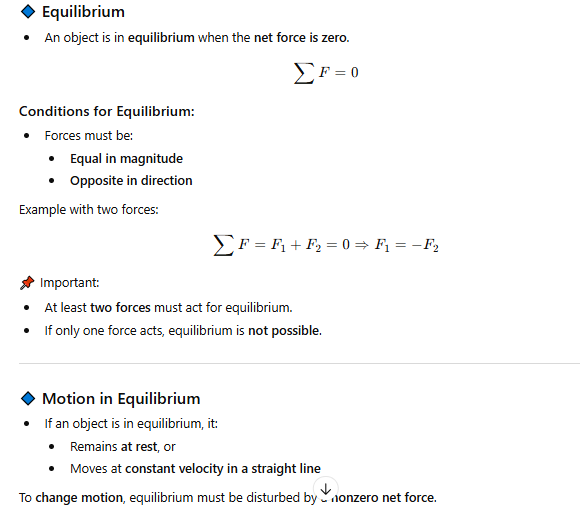
🔹 Motion in Equilibrium
If an object is in equilibrium, it:
Remains at rest, or
Moves at constant velocity in a straight line
To change motion, equilibrium must be disturbed by a nonzero net force.
🔹 Inertia
Inertia is an object’s natural resistance to changes in motion.
Introduced by Galileo.
Objects resist:
Starting to move
Stopping
Changing direction
🔹 Newton’s First Law of Motion (Law of Inertia)
An object remains at rest or continues moving at a constant velocity in a straight line unless acted upon by a nonzero net force.
Key Ideas:
No net force → no change in motion
Motion only changes when forces are unbalanced
🔹 Shopping Cart Example
Cart at rest
Net force = 0
Cart stays still
You push the cart
Net force ≠ 0
Cart accelerates
You let go
Push force disappears
Friction acts between wheels and floor
Net force ≠ 0
Result
Friction opposes motion
Cart slows down and eventually stops
🔹 Friction’s Role
Friction acts opposite the direction of motion
Causes moving objects to:
Slow down
Stop
Without friction, the cart would continue moving forever (ideal physics case)
🧠 Key Takeaways (Exam-Ready)
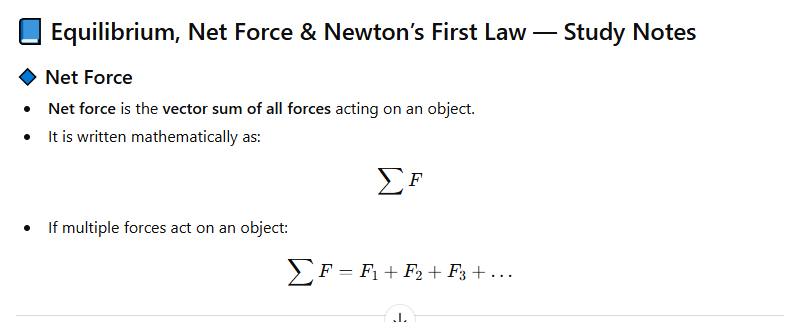
Net force = vector sum of forces
Equilibrium means net force = 0
Equilibrium does not mean no motion
Newton’s First Law explains inertia
Friction creates a nonzero net force that stops motion
📘 Static and Dynamic Equilibrium — Study Notes
🔹 Equilibrium (Newton’s First Law)
An object is in equilibrium when the net force acting on it is zero.
There are two types of equilibrium:
Static equilibrium
Dynamic equilibrium
🔹 Static Equilibrium
Static equilibrium occurs when:
An object is at rest
Net force = 0
Example: Book on a Table
Two forces act on the book:
Gravitational force (weight) → pulls downward
Normal force → pushes upward
These forces are:
Equal in magnitude
Opposite in direction
They cancel each other out, so:
∑F=0\sum F = 0∑F=0
➡ The book remains at rest → static equilibrium
🔹 Dynamic Equilibrium
Dynamic equilibrium occurs when:
An object is moving
Speed is constant
Motion is in a straight line
Net force = 0
Example: Grocery Cart Moving
Two forces act on the cart:
Applied force (your push) → forward
Friction → backward
If these forces are:
Equal in magnitude
Opposite in direction
Then:
∑F=0\sum F = 0∑F=0
➡ The cart moves at constant speed → dynamic equilibrium
🔹 Key Differences
Type of Equilibrium | Motion | Net Force |
|---|---|---|
Static | At rest | 0 |
Dynamic | Constant speed, straight line | 0 |
🧠 Key Takeaways (Test-Ready)
Equilibrium does not mean no forces act
It means forces cancel out
Static equilibrium → object at rest
Dynamic equilibrium → object moving at constant velocity
Both obey Newton’s First Law
📘 Inertia, Mass, and Weight — Study Notes
🔹 Inertia
Inertia is an object’s tendency to resist a change in its state of motion.
Objects with more inertia:
Are harder to start moving
Are harder to stop
Resist changes in motion more strongly
Example: Shopping Cart
Empty cart → moves with a gentle push
Full cart → requires a stronger push
Reason: the full cart has more inertia
🔹 Mass
Mass is the quantity of matter in an object.
Mass is a measure of inertia.
More mass → more inertia
SI unit of mass: kilogram (kg)
📌 Important:
Mass does not change based on location.
🔹 Mass vs. Weight
Although often confused, mass and weight are not the same.
Mass | Weight |
|---|---|
Quantity of matter | Gravitational force on an object |
Measure of inertia | Depends on gravity |
Measured in kilograms (kg) | Measured in newtons (N) |
Constant everywhere | Changes with location |
In the U.S., mass is often expressed in pounds, but pounds are actually a unit of weight, not mass.
🔹 Weight Formula
The weight of an object is calculated using:
weight=mg\text{weight} = mgweight=mg
Where:
m = mass (kg)
g = acceleration due to gravity
On Earth: 9.8 m/s²
🔹 Example Calculation (Earth)
Mass = 1 kg
Gravity = 9.8 m/s²
weight=1×9.8=9.8 N\text{weight} = 1 \times 9.8 = 9.8 \text{ N}weight=1×9.8=9.8 N
A 1 kg object weighs:
9.8 newtons
About 2.2 pounds on Earth
🔹 Weight on the Moon
Gravity on the Moon is much weaker than on Earth.
A 1 kg object on the Moon weighs:
1.6 newtons
📌 Key idea:
Weight changes with gravity
Mass stays the same
🧠 Key Takeaways (Test-Ready)
Inertia depends on mass
Mass measures inertia
Weight = gravitational force
Weight = mg
Mass is constant; weight varies with gravity
SI unit of force = newton (N)
📘 Mass and Acceleration — Study Notes
🔹 Acceleration
Acceleration (a) is the rate of change of velocity.
An object accelerates when:
Its speed changes
Its direction changes
Or both
🔹 Force Causes Acceleration
When you push the shopping cart, you apply a force.
This force causes:
A change in velocity
Therefore, acceleration
🔹 Effect of Mass on Acceleration
If the applied force stays constant:
An empty cart accelerates faster
A loaded cart accelerates more slowly
📌 Reason:
A cart with more groceries has greater mass
Greater mass → greater inertia
Greater inertia → more resistance to acceleration
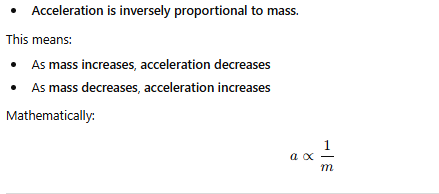
🔹 Relationship Between Mass and Acceleration
🔹 Shopping Cart Example
Same push force:
Empty cart → larger acceleration
Full cart → smaller acceleration
🧠 Key Takeaways (Test-Ready)
Acceleration = change in velocity
Force causes acceleration
Mass resists acceleration
Acceleration decreases as mass increases
Constant force + larger mass = smaller acceleration
📘 Net Force and Acceleration — Study Notes
🔹 Net Force
Net force is the vector sum of all forces acting on an object.
Changes in net force cause changes in motion and acceleration.
🔹 Effect of Net Force on Acceleration
When you push a shopping cart, it accelerates.
If another person helps push in the same direction:
Net force increases
Acceleration increases
Cart moves faster
📌 Conclusion:
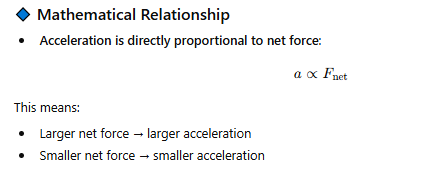
Acceleration increases as net force increases
🔹 Forces in Opposite Directions
If one person pushes while another pulls in the opposite direction:
The forces counteract each other
Net force changes
Possible outcomes:
Smaller net force → slower acceleration
Net force = 0 → cart stops or moves at constant speed
Net force reverses direction → cart changes direction
🔹 Direction of Acceleration
Acceleration always occurs in the same direction as the net force.
If the push is stronger than the pull:
Cart accelerates in the direction of the push
If the pull is stronger:
Cart accelerates in the opposite direction
🔹 Shopping Cart Summary
One push → moderate acceleration
Two pushes (same direction) → greater acceleration
Push + pull (opposite directions) → reduced or reversed acceleration
🧠 Key Takeaways (Test-Ready)
Net force determines acceleration
Acceleration increases with net force
Direction of acceleration = direction of net force
Opposing forces reduce net force
📘 Newton’s Second Law of Motion — Study Notes
🔹 Statement of the Law
Newton’s Second Law explains how force, mass, and acceleration are related.
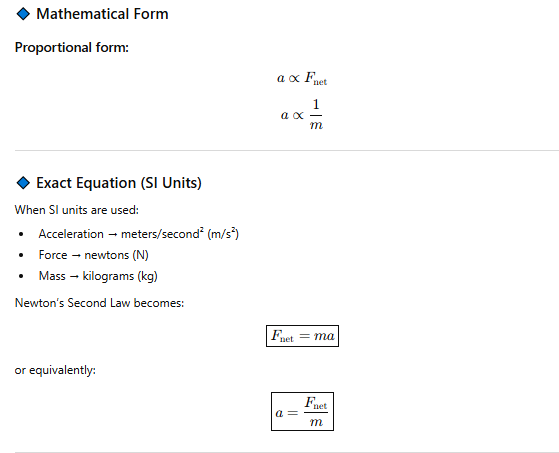
According to the law, an object’s acceleration is:
Directly proportional to the net force acting on it
In the direction of the net force
Inversely proportional to its mass
🔹 Proportional Relationships
More net force → greater acceleration
More mass → smaller acceleration
Acceleration always points in the same direction as the net force
🔹 Vector Nature
Net force and acceleration are vectors
They point in the same direction
If the net force changes direction, acceleration changes direction
🔹 Key Takeaways (Exam-Ready)
Newton’s Second Law links force, mass, and acceleration
Acceleration depends on both force and mass
Doubling force doubles acceleration
Doubling mass halves acceleration
Force causes acceleration, not motion itself
📘 Newton’s Third Law of Motion — Study Notes
🔹 Forces Always Come in Pairs
A force is never exerted alone.
Forces occur due to interactions between two objects.
In every interaction:
Two forces act
They occur at the same time
One force cannot exist without the other
🔹 Everyday Examples
Pushing a shopping cart:
You push the cart forward
The cart pushes back on your hand
Pulling a suitcase:
You pull the suitcase
The suitcase pulls back on you
📌 In both cases, both objects exert forces on each other.
🔹 Newton’s Third Law of Motion
Whenever one object exerts a force on a second object, the second object exerts an equal and opposite force on the first.
🔹 Action–Reaction Pairs
Forces in an interaction are called action–reaction pairs.
Restated form:
To every action, there is an equal and opposite reaction.
Key Properties:
Equal in magnitude
Opposite in direction
Act on different objects
Occur simultaneously
🔹 Important Clarifications
Action and reaction forces do not cancel each other out because:
They act on different objects
You cannot say one object “causes” the force and the other “receives” it.
Both objects apply forces equally.
🔹 Why Objects Move
Motion depends on net force acting on a single object, not on action–reaction pairs.
Example:
You push the cart
The cart moves because of the force on the cart, not because of the force on you
🧠 Key Takeaways (Test-Ready)
Forces always come in pairs
Action–reaction forces are equal and opposite
They act on different objects
Newton’s Third Law explains interactions, not motion itself