CIE IGCSE Biology 14.1 Coordination, Response & Homeostasis
14.1 Coordination, Response & Homeostasis
14.1.1 Mammalian Nervous System
The human nervous system consists of:
The central nervous system (CNS), which includes the brain and spinal cord.
The peripheral nervous system (PNS), comprising all the nerves in the body.
The nervous system allows us to:
Interpret our surroundings and react accordingly.
Coordinate and regulate bodily functions.
Information is transmitted through the nervous system via nerve impulses, which are electrical signals that travel along nerve cells called neurons. A group of neurons is referred to as a nerve.
14.1.2 Types of Neurones
There are three main types of neurons:
Sensory neurons: These neurons transmit impulses from sense organs to the CNS (brain or spinal cord).
Relay neurons: Found within the CNS, these neurons connect sensory and motor neurons.
Motor neurons: These neurons transmit impulses from the CNS to effectors (muscles or glands).
Neurons have a long fiber (axon) which helps in faster transmission of impulse. The axon is insulated by a fatty sheath with small uninsulated sections along it(called nodes). This means that the electrical impulse does not travel down the whole axon, but jumps from one node to the next. Their cell body contains many extensions called dendrites which allows them to connect to many other neurones and receive impulses from them, forming a network for easy communication.
Identifying Neurons
Sensory neurons: Long, with the cell body branching off the middle of the axon.
Relay neurons: Short, with a small cell body at one end and many dendrites branching off it.
Motor neurons: Long, with a large cell body at one end and long dendrites branching off it.
14.1.3 The Reflex Arc
Voluntary Responses
A voluntary response involves a conscious decision to perform a specific action, initiated by the brain. For instance, reaching for a cup of coffee is a voluntary action.
Involuntary (Reflex) Responses
An involuntary or reflex response occurs without conscious thought and doesn't involve the brain as the primary coordinator. Such responses are essential for basic survival and are rapid. An example is quickly pulling your hand away from a hot surface.
A reflex response is an automatic and rapid reaction to a stimulus, like touching something sharp or hot. Since it bypasses the brain, it's quicker than other nervous responses, minimizing potential bodily harm.
The Reflex Pathway
A stimulus (e.g., a pin prick) is detected by a receptor in the skin.
A sensory neuron sends an electrical impulse to the spinal cord (the coordinator).
The electrical impulse is passed to a relay neuron in the spinal cord.
The relay neuron connects to a motor neuron and transmits the impulse.
The motor neuron carries the impulse to a muscle in the leg (the effector).
The muscle contracts, pulling the foot away from the sharp object (the response).
Synapses: Where two neurons meet or join, they do so at a junction called a synapse. Synapses allow junctions between neurones so are important in the nervous system being a connected network of neurones. Nerve impulses can transmit across synapses and be directed along the appropriate route by them eg. to the correct part of the brain
Reflex actions are automatic, fast, and protective.
A common exam question is to be asked to draw arrows on the neurones in the reflex arc diagram to show the direction of movement of the impulse.
14.1.4 The Synapse
The junction between two neurons is known as a synapse.
Synapses & Neurotransmitters
Neurons do not physically touch each other; there are junctions (gaps) in between them called synapses. When an electrical impulse reaches the end of the presynaptic neuron, it triggers the release of chemical messengers called neurotransmitters into the synaptic gap (or cleft). These neurotransmitters diffuse across the gap and bind with receptor molecules on the postsynaptic membrane (the membrane of the second neuron). This binding stimulates the second neuron to generate an electrical impulse that travels down its axon.
After transmitting the signal, the neurotransmitters are either destroyed or reabsorbed to prevent continuous stimulation of the postsynaptic neuron. Synapses ensure that impulses travel in one direction only. Since the synapse is the only part of the nervous system where messages are chemical, it's the only place where drugs can act to affect the nervous system.
14.1.5 Sense Organs
Receptors are specialized cells that detect changes in the environment and generate electrical impulses in response. Sense organs contain groups of receptors that respond to specific stimuli.
When a receptor cell is stimulated, it generates an electrical impulse that is passed to a sensory neuron. The sensory neuron carries the impulse to the central nervous system (CNS). In the CNS, a response is determined and the impulse is passed to a motor neuron (via a relay neuron). The motor neuron carries the impulse to the effector (muscle or gland), which carries out the response.
14.1.6 The Eye
The eye is a sense organ containing receptor cells that are sensitive to light. Key structural features include the cornea, iris, lens, retina, and optic nerve.
Eye Structure and Function
Cornea: A transparent covering at the front of the eye that refracts (bends) light.
Iris: A muscle that controls how much light enters the pupil.
Lens: A transparent disc that changes shape to focus light onto the retina.
Retina: A layer of light-receptor cells that detect light intensity and color.
Optic nerve: A sensory neuron that carries electrical impulses from the eye to the brain.
The Pupil Reflex
The pupil reflex controls the amount of light that enters the eye by adjusting the pupil diameter. In dim light, the pupil dilates to allow more light in, while in bright light, it constricts to prevent too much light from entering and damaging the retina.
Iris Muscles
The iris contains circular and radial muscles that work antagonistically to regulate the pupil size. When light levels are low, the radial muscles contract and the circular muscles relax, causing the pupil to dilate. Conversely, when light levels are high, the radial muscles relax and the circular muscles contract, causing the pupil to constrict.
Eye Accommodation
Accommodation refers to the process by which the eye focuses on near or distant objects by changing the shape of the lens. This change is facilitated by the ciliary muscles and suspensory ligaments.
Near objects: Ciliary muscles contract, suspensory ligaments loosen, lens becomes more rounded, and light is refracted more.
Distant objects: Ciliary muscles relax, suspensory ligaments tighten, lens becomes thinner, and light is refracted less.
Rods & Cones
The retina contains two types of receptor cells: rods and cones.
Rods: Detect light at low levels and are important for night vision. They are found all over the retina, except in the blind spot.
Cones: Detect light at three different wavelengths, enabling color vision. They are concentrated in the fovea, the region of the eye onto which light is focused.
14.1.7 Hormones in Humans
A hormone is a chemical substance produced by a gland and transported in the blood. It alters the activity of specific target organs by binding to target receptors.
The glands that produce hormones are collectively known as the endocrine system. Endocrine glands have a good blood supply which helps them release hormones quickly into the bloodstream so they can travel to target organs.
Hormones only affect cells with target receptors that the hormone can bind to.
The liver regulates levels of hormones in the blood; transforming or breaking down any that are in excess.
Comparison of Nervous & Hormonal Control
Feature | Nervous Control | Hormonal Control |
|---|---|---|
Signal Type | Electrical impulses | Chemical (hormones) |
Transmission | Along neurons | Via the bloodstream |
Speed | Fast | Slower |
Duration | Short-lived | Longer-lasting |
Specificity | Highly specific (localized) | More widespread (generalized) |
Glucagon
Blood glucose levels are controlled by a negative feedback mechanism involving the production of two hormones - insulin and glucagon. Both hormones which control blood glucose concentration are made in the pancreas. Insulin is produced when blood glucose rises and stimulates liver and muscle cells to convert excess glucose into glycogen to be stored. Glucagon is produced when blood glucose falls and stimulates liver and muscle cells to convert stored glycogen into glucose to be released into the blood.
Glucagon is the hormone
Glycogen is the polysaccharide glucose is stored as
Adrenaline
Adrenaline is known as the 'fight or flight' hormone as it is produced in situations where the body may be in danger. It causes a range of different things to happen in the body, all designed to prepare it for movement (i.e., fight or flight). These include:
Increasing blood glucose concentration for increased respiration in muscle cells
Increasing pulse rate and breathing rate so glucose and oxygen can be delivered to muscle cells, and carbon dioxide taken away, from muscles cells more quickly
Diverting blood flow towards muscles and away from non-essential parts of the body such as the alimentary canal, again to ensure the reactants of respiration are as available as possible
Dilating pupils to allow as much light as possible to reach the retina so more information can be sent to the brain
Additional effects of adrenaline include;
Increasing the concentration of glucose in the blood
Increasing heartrate
14.1.8 Homeostasis: Definition
Homeostasis is defined as the maintenance of a constant internal environment. Homeostasis means that internal conditions within the body (such as temperature, blood pressure, water concentration, glucose concentration etc) need to be kept within set limits in order to ensure that reactions in body cells can function and therefore the organism as a whole can live.
Role of Insulin
Insulin is secreted into the blood at times when blood glucose levels are high. Insulin decreases blood glucose concentration.
14.1.9 Homeostasis
The Concept of Negative Feedback
Negative feedback occurs when conditions change from the ideal or set point and returns conditions to this set point. Negative feedback mechanisms are usually a continuous cycle of bringing levels down and then bringing them back up so that overall, they stay within a narrow range of what is considered ‘normal’.
Blood Glucose Control
Blood glucose levels are controlled by a negative feedback mechanism involving the production of two hormones - insulin and glucagon. Both hormones which control blood glucose concentration are made in the pancreas. Insulin is produced when blood glucose rises and stimulates liver and muscle cells to convert excess glucose into glycogen to be stored. Glucagon is produced when blood glucose falls and stimulates liver and muscle cells to convert stored glycogen into glucose to be released into the blood.
Type 1 Diabetes
Type 1 diabetes is a condition where the blood glucose levels are not able to be regulated as the insulin-secreting cells in the pancreas are not able to produce insulin: It can be treated by injecting insulin. Symptoms of diabetes include extreme thirst, weakness or tiredness, blurred vision, weight loss and loss of consciousness in extreme cases.
14.1.10 Homeostasis: Temperature Control
Control of body temperature is a homeostatic mechanism.
The human body maintains the temperature at which enzymes work best, around . If body temperature increases over this temperature, enzymes will denature and become less effective at catalysing reactions such as respiration.
Regulation is controlled by the brain which contains receptors sensitive to the temperature of the blood . The skin also has temperature receptors and sends nervous impulses to the brain via sensory neurones. The brain responds to this information by sending nerve impulses to effectors in the skin to maintain the temperature within a narrow range of the optimum, .
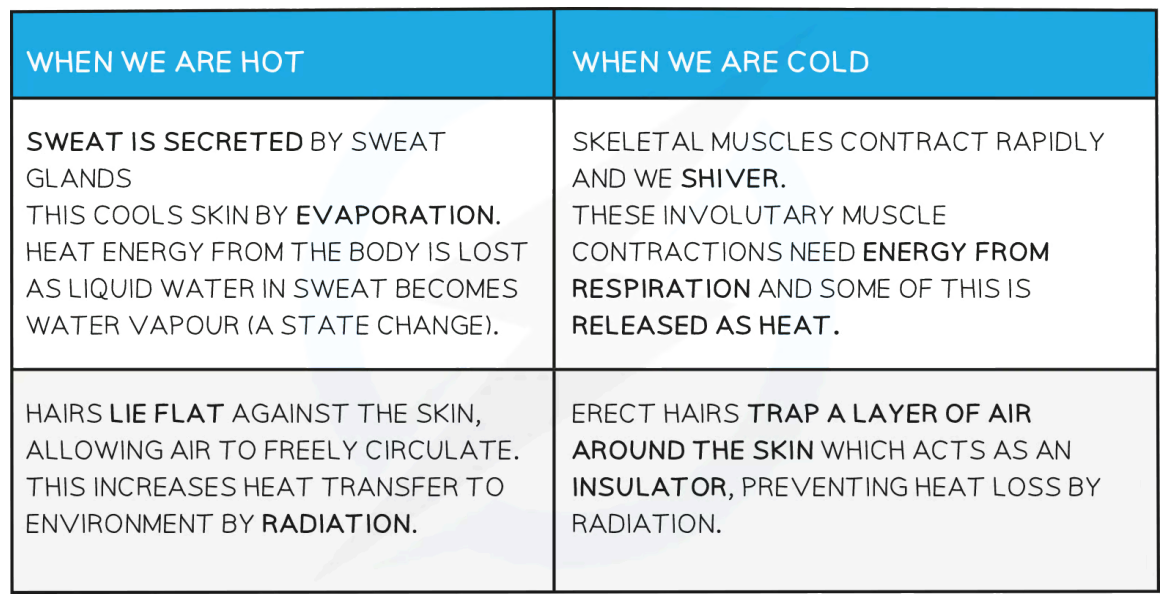
Vasoconstriction & Vasodilation
When we are cold blood flow in capillaries slows down because arterioles leading to the skin capillaries get narrower - this is known as vasoconstriction. When we are hot blood flow in capillaries increases because blood vessels to the skin capillaries get wider - this is known as vasodilation.
14.1.11 Tropisms
Plants can respond to changes in environment (stimuli) for survival, e.g. light, water, gravity. They grow either towards a stimulus (known as a positive response) or away from a stimulus (known as a negative response). The responses are known as tropisms.
Stimulus | Name of response | Definition | Positive response | Negative response |
|---|---|---|---|---|
Gravity | Gravitropism | Growth towards or away from gravity | Growth towards gravity (e.g., roots) | Growth away from gravity (e.g., shoots) |
Light | Phototropism | Growth towards or away from the direction of light | Growth towards light (e.g., shoots) | Growth away from light (e.g., roots) |
Investigating Tropisms
In B the effect of the light only coming from one direction has been cancelled out by using a clinostat (it revolves slowly and repeatedly, so the shoots are evenly exposed to light).
The experiment needs to be done in a lightproof box in order to cancel out the effect of light on the growth of the seedlings.
Auxins: Chemical Control of Tropisms
Plants respond to stimuli by producing a growth hormone called auxin which controls the direction of growth of roots or stems Therefore we say plants control their growth chemically.
Auxin is mostly made in the tips of the growing stems and roots and can diffuse to other parts of the stems or roots; spreading from a high concentration in the shoot tips down the shoot to an area of lower concentration.
If light shines all around the tip, auxin is distributed evenly throughout and the cells in the meristem grow at the same rate - this is what normally happens with plants growing outside.
Different concentrations of auxin affects shoots and roots differently, i.e. higher concentrations of auxin results in a lower rate of cell elongation
When roots grow towards gravity it is known as positive gravitropism. When shoots grow away from gravity it is known as negative gravitropism.