Social Influence
What is Social Influence
Social influence
the many ways people affect one another, including changes in attitudes, beliefs, feelings, and behavior resulting from the comments, actions, or even the mere presence of others
Must come from another person
Examples of social influence
fashion trends, peer pressure, getting a favor, following orders, and so on
Conformity
Changing one’s behavior or beliefs in response to explicit or implicit pressure (real or imagined) from others
This conformity is tame!
Example: fashion trends
Compliance
Responding favorably to an explicit request by another person
Example: agreeing to do someone a favor
Middle level!
Obediance
in an unequal power relationship, submitting to the demands of the person in authority
The most severe level!
Example: following the orders of a police officer
Dr. McKay telling students to throw a piece of paper into a trash can!
Conformity
Some types of social influence are bad.
Going along with a crowd to pull a harmful prank, try a dangerous new drug, or drive a vehicle while intoxicated
Some types of social influence are neither good nor bad.
Millennial women parting their hair on the side and Generation Z parting their hair in the middle
Some types of social influence are beneficial.
Conformity plays a big part, for example, in getting people to suppress anger; to pay taxes; to form lines at the theater, museum, and grocery store; and to stay to the right side of the sidewalk or roadway.
There are different levels of social influence (bad, neutral, and good!)
Nonconcious Conformity: Automatic Mimicry
Some forms of conformity may be automatic.
A study found that participants would unconsciously imitate the behaviors of a confederate.
A confederate is a person who is involved in a research study, but the study participant does not know that!
They don’t even realize that they are mimicing the behavior
Why do we nonconsciously mimic others?
Reasons for Automatic Mimicry
William James (1890) argued that merely thinking about a behavior makes performing it more likely.
When we see others behave in a certain way, we are more likely to act the same way.
We imitate people because we think about it!
William James is working with no technology, he is just spitballing!
Not enough, we need more detail!
Automatic Mimicry and Social Interaction
Preparation for social interactionL
Mimicry is stronger for people with a drive to affiliate with others.
The need to affiliate with others is a spectrum! Those with a high need mimic others more often!
People like individuals who mimic them better than those who don’t.
A form of flattery
People who are mimicked engage in more prosocial (helping) behavior afterward.
It feels good/euphoric when you notice people mimic what you are doing!
Mimicry may build social rapport and lead to pleasant social interactions.
Synchronous mimicry can create particularly powerful feelings of closeness and bonding.
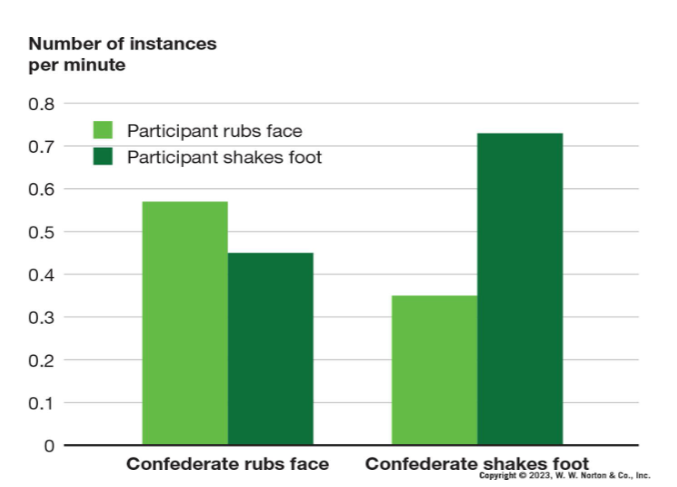
The particpants are not doing what the confederate is not doing! They are not engaging in a behavior that the confederate is not displaying!
Informational Social Influence and Sherif’s Conformity Experiment
Informational Social Influence - The influence of other people that results from taking their comments or actions as a source of information about what is correct, proper, or effective
I will be influenced by Dr. McKay’s talk about the brain because he is a brain psychologists!
Sherif designed his study to examine the circumstances in which other people serve as a social frame of reference.
The Autokinetic Illusion
Sherif’s autokinetic illusion study
The autokinetic illusion is that a stationary point of light will appear to move in a dark room.
The light will look as if it is moving becuase there is nothing else to compare it to!
Asked particpants to rate how much the light is moving.
People’s judgments about the movement of the light converged over time
The estimate began to agree about the same distance the light moved becuase they were using other people as a frame of refrence in order to come to the correct answer
When Informational Social Influence Increases
Informational social influence is more likely when:
the situation is ambiguous or difficult,
Sherif’s study!
we feel low in knowledge or competence about the topic
Important! We are more likely to be influenced by people who have knowledge of a certain topic when we do not have any knowledge about this!

Normative Social Influence and Asch’s Conformity Experiment
Normative social influence
the influence of other people that comes from the desire to avoid their disapproval and other social sanctions (ridicule, barbs, ostracism)
We do not want disaproval!
Norms are perscribed roles of behavior given to us by society!
Judgment of Line Length
Line-judgment study (Asch, 1956):
The task was very easy: judging whether two lines were the same length.
In a group of eight male students, there were seven confederates who gave wrong answers and one true participant.
A full 75 percent of participants conformed at least once
Know this for the exam
Overall, participants conformed 33 percent of the time
Know this for the exam
Desire for Approval Know for exam
Conformity on the line-judgment task had to be due to the desire not to be deviant from the group, since the correct answer was obvious
It is not becuase people are having a brain/eye issue since the test was super easy
There were replcation studies that found the same thing!
Factors Affecting Conformity
Group Size
Conformity rates increase as group size increases, but only up to a point.
Two people may have greater influence than one, but eight people aren’t necessarily more influential than four
The magic number is 4

Group Unanimity
More conformity when the group is unanimous
One person is likely to conform to a group, but if they have at least one ally who breaks the unanimity, then conformity rates decrease dramatically.
If a person aligns with you, then you know it is not the whole majority

Anonymity
Anonymity eliminates normative social influence and therefore should substantially reduce conformity.
This happens becuase if you don’t know what other people are choosing, it does not affect you! It cannot influence you from a normative standpoint
Internalization
private acceptance of a proposition, orientation, or ideology
Informational social influence leads to internalization.
Normative social influence leads to public compliance but not necessarily private acceptance.
People may publicly agree with the group opinion in order to avoid social disapproval but privately believe something different.
In Asch Line study, he had the same set up, but all of the confederates were already in the room, and the particpants came in late (by design). As a part of comming in late, the participant writes down their answer on a piece of paper and gives it anonanously. This is becuase they are not worried about what the confederates think!
Expertise and Status
High status or expert group members have more social influence.
Experts exert more informational social influence. (Professors)
This makes sense becuase experts are more able to sway people based on information!
High status exerts more normative social influence. (Influencers)
I don’t want to make waves becuase I want this person to accept me
Culture
Studies across cultures have found higher rates of conformity in interdependent cultures.
Members of interdependent cultures are more concerned about fitting into social context than members of independent cultures.
Tight vs Loose Cultures
Some cultures are called “tight” because they have very strong norms regarding how people should behave, and members do not tolerate departure from those norms.
Other cultures are “loose” because their norms are not so strong, and their members tolerate more deviance
The USA is a loose culture (overall). If you go by region/state, it would depend (Loose states are California, NorthEast states,) (Tight states are Utah, Deep South)
Critical Thinking About Conformity and Construal (Critical Thinking)
We conform less when we understand the reasons for other people’s behaviors
for instance, when we know they are acting out of bias or self-interest
Since Grace is Bias, we will shy away from her and not conform
We may conform less when we have an obvious explanation for why we may have a deviant opinion; that is, we have relevant group minority status.
People respond to their subjective interpretations, or construals, of situations, not necessarily the objective situations they face.
We are often interacting base upon our particular interpretation of a situation!
We don’t look at things objectivly, but instead our subjective interpretation!
The Influence of Minority Opinion on the Majority
In some cases, a minority opinion can change the majority opinion.
We are not talking about a minority group (race), just the minority opintion/behavior
Minority opinions have the greatest influence when the opinion is consistent.
If there is a deviation from consistancy (inconsistancy), minority opinion is not going to affect the majority opinion
It must be united
Minorities have their effect primarily through informational social influence
happens when there is actual data, statistics, information that the person can give in order to sway the larger opinions
Minority Opinion and Informational Social Influence
Minority opinions may cause other members to reconsider their positions.
If the minority members are not seen as acting out of self-interest, they are believed to have a reason for diverging from majority opinion.
There might be more of an openness to consider their position
“I’m not doing this becuase I’m bias!”
Self-intrest, bias, the majority will not be intrested!
Other group members will reconsider their judgments to understand the divergent opinion.
“I’m doing this becuase I have data, we are consistant, and we are not acting in self-intrest” The majority may reconsider
Compliance
Areeing to the explicit request of another person regardless of that person’s status
If status is taking into consideration, it becomes obediance
No power difference
Examples of compliance
doing a favor, giving to charity, buying a product
Consistency, Commitment, and the Foot-in-the-Door
Technique
Foot-in-the-door technique (Will be on the Exam)
a compliance approach that involves making an initial small request with which nearly everyone complies, followed by a larger request involving the real behavior of interest
Charities often first ask for very small donations, then later ask for bigger donations.
“How about a buck?… How about $20?”
Why it works: Getting someone started on something small often leads to a change in that person’s self-image. That person then has a reason for agreeing to the subsequent, larger request.
“It’s just who I am”
People will think that they actually are a nice, giving person!
Norm-Based Compliance
Effective norm-based appeals
Letting people know what others are doing also can be used to advance the public good.
“All of your neighboors are protecting the enviorment” Wow, I should start protecting the enviorment to!

They had a neighborhood measuring how much energy each house was using.
In Condition 1, we are going to find everyone who is using way too much energy and who is using too litle energy and tell them what their neighboors are doing.
People identified as an above average user became a below average user. People who were a below average user greatly increased their energy.
Condition 2, they did the same examct thing, but put a smiley face or frowny face as a Visual cue to remind them
Resulted in a dramatic cut in above averate users. Below average users (with the smiley face) continued to use a small amount of energy.
Pluralistic Ignorance
Misperception of a group norm that results from observing people who are acting at variance with their private beliefs, which serves to reinforce the erroneous group norm
We observe other people who doing things behaviorally that they might not agree with internally. This reinforces the inacurate norm

Yourself (internal belief) between 5-6 with alcohol. The other graphs are your perceptions of your friends and the average student’s comfortability with alcohol.
These are inconsistant. Your own cofortability is rated at a lower rate than others.
The perception that everyone is confortable with drinking is not true!
It becomes a norm for the group!
Static and Dynamic Norms
Norms can be used to bring about changes by highlighting that they are changing, or that they are dynamic rather than static.
People are influenced not only by what a norm is but also by the trends in how the norm is changing.
Not by a specific data point, but the trends (how things are moving, changing, shifting)
In a study, they asked men if they think they are feminist.
In Condition 1, 30% of men think they are freminist (static data point)
In Condition 2, They changed the wording “so that over 30% of men think that they are feminist” (Dynamic)
In this condition, more people were influenced more because the norm was dynamic!
Descriptive and Prescriptive Norms
Descriptive norms
the behavior exhibited by most people in a given context
“What is” currently happening
Prescriptive norms
the way a person is supposed to behave in a given context; also called injunctive norm
“What should” be happening
We can change people’s behavior and have them comply with these things ONLY IF they do not come into contact with each other
If they start conflicting (I am doing this behavior but I should not be") There will be less compliance
Norm of Reciprocity
A norm dictating that people should provide benefits for those who have provided benefits for them
You did something for me, so I should do something for you
This has been observed in other species (mamals/birds)
Even when given something small, we may feel obligated by a later request.
Why it works: social norms, feeling obligated
“You gave to me, so I give to you.”
Reciprocal Concessions: Door-in-the-Face Technique
Make a large request that is refused, followed by a smaller request
When asked to buy a $5 raffle ticket, the person refuses. Then the person is asked to buy a $1 candy bar and agrees
even though the person doesn’t like chocolate that much. The person complies with the request even if it does not benefit them! They feel bad that they declined the large request
You make a large request, (the point is that you will decline), then make a small request (which you actually wanted)
Reciprocal concessions technique
a compliance approach that involves asking someone for a very large favor that will certainly be refused and then following that request with one for a smaller favor (which tends to be seen as a concession the target feels compelled to honor); also called door-in-the-face technique
Why it works: reciprocal concession
“You compromised with me, so I’ll compromise with you.”
Seizing, or Creating, the Right Mood
Both positive and (some) negative moods can increase rates of compliance.
Positive moods
Our mood colors how we interpret events.
We are more likely to view requests for favors as less intrusive and less threatening when we’re in a good mood.
Mood maintenance
People want to maintain a positive mood, so they agree more easily
It feels good to say yes.

Negative Mood
Guilt
Social psychologists have demonstrated a strong positive association between guilt and compliance.
may feel more obligated to help someone if we feel guilty
better to ask for a donation before someone confesses their sins than afterward
Negative state relief hypothesis
the idea that people engage in certain actions, such as agreeing to a request, to relieve their negative feelings and feel better about themselves
Obediance to Authority
The study of when and why people obey the commands or instructions of someone in authority has been dominated by the most famous set of social psychological experiments ever conducted—those of Stanley Milgram
The Set of of the Milgram Experiment
Milgram’s study showed the power of social influence.
Experimental setup:
described as a “study of learning”
Participants were instructed to shock other participants for any wrong answers.
The other participant is a confederate who never receives any real shocks.
Confederate has scripted wrong answers
Shock level was increased for each wrong answer.
Shock levels ranged from 15 volts (slight shock) to 450 volts (danger: severe shock).
During the experiment, the confederate begins to scream in pain and to demand that the experiment end.
Later, the confederate stops making any sounds, indicating he may possibly be injured or dead
An experimenter in a white lab coat instructs the participant to continue with the experiment
Results of the Milgram Experimetn
Despite potential harm to another person, 62.5 percent of participants completed the experiment.
Originally, it was predicted that less than 1 percent of people would follow instructions until the end.
Participants of different ages and social classes all obeyed.
The same effects were found for women and men.
Opposing Forces
Milgram’s participants were caught in a conflict of opposing forces to both continue and terminate the experiment
Understanding these opposing forces leads to a better understanding of why participants responded the way they did, and what made the experience so stressful.
Would You have Obeyed?
Milgram’s results were surprising
High percentages of Americans showed obedience to authority to the extent that they could have harmed another person.
Many people find it difficult to believe that they would ever personally be capable of doing so.
But there are many historic examples of ordinary people acting in ways they’d never expect.
They tried but failed.
Participants’ attempts to leave the situation were blocked by the authority.
In Milgram’s study, participants called attention to the learner, said they didn’t want to continue, and so on, but most continued anyway
Participants did not wish to harm the learner, so they sought ways to avoid it, but they succumbed to the consistent urging of the experimenter.
Real-world implications
Nazi Germany
recent massacres in Bosnia, Cambodia, Rwanda, and Darfur
Release from Responsibility
Feeling of responsibility for one’s actions is transferred to other people
In the Milgram study, the experimenter stated that he was responsible for everything that happened.
The participants could reduce feelings of distress because the experimenter provided a cover for their actions.
“It was his fault; I was following orders.”
Responsibility was sometimes transferred to the victim.
“Well, he volunteered for this.”
Step - by - Step Involvement
People can get caught on a “slippery slope” because of the step-wise nature of demands.
In the Milgram study, each increment is only 15 volts, so each one seems like a small step, but step by step it gets to an extreme point.
In Nazi Germany, Hitler was democratically elected, and the anti-Jewish laws were introduced a little at a time in a step-by-step progression toward the Holocaust.
Would Milgram Get the Same Results Today?
People seem to react to pressure to obey the same way they did in the 1960s.
Burger (2009) conducted a near-replication of the original Milgram experiments to see if participants stopped or continued after delivering 150 volts (when the learner began to protest).
70 percent of participants were willing to administer the next level of shock (165 volts) after hearing the learner’s protest.
Resisting Social Influence
What enables people to resist being influenced by others?
Reactance theory
the idea that people reassert their prerogatives in response to the unpleasant state of arousal they experience when they believe their freedoms are threatened
What factors increase someone’s ability to stand firm?
practice
having an ally
being wary of potential slippery slopes
putting off responding so you can decide whether to comply based on the merits of an idea, rather than a bad mood or intense emotional state