ch 28 and 31
Chapter 28
1. How far back in time do eukaryotes go? 2.7 billion years (no fossils support this)
2. Describe the endosymbiotic theory. Mitochondria probably evolved from aerobic bacteria that were engulfed by a larger cell
3. What does it mean that “Kingdom Protista is paraphyletic and not a kingdom at all?” Kingdom Protista is not a kingdom because it lumps a bunch of different things together there could be 3-20 different kingdoms made out of just kingdom Protista
4. By what means do protists move? flagella or cilia, pseudopodia, and propulsion
5. What is the range of nutritional strategies among protists? phototrophs, heterotrophs, osmotrophs, phagotrophs, and mixotrophs
6. Campbell’s text identifies four supergroups of eukaryotes. What are they? (pp. 594-595) Supergroup Excavata, SAR clade, Supergroup archaeplastida and Supergroup unikonta
7. What are the basic characteristics of the diplomonads? Give an example of a diplomonad.
- two nuclei
- unicellular
- move with multiple flagella
- modified mitochondria called mitosomes
Ex. Giardia intestinalis: this parasite is found in contaminated water and can pass from human to human. they cause diarrhea
8. What are the basic characteristics of the parabasalids? Give an example or two of a parabasalid.
- have undulating membranes
- move with flagella
- reduced mitochondria called hydrogenosomes
Ex. Trichonympha species: lives in the gut of termites and digests cellulose
Ex. Trichomonas vaginalis: STD in humans
9. What are the basic characteristics of the euglenoids? Give an example of a euglenoid.
- free-living eukaryotes
- pocket at one end with one or two flagella
- have mitochondria
- flexible pellicle can change shape
- one-third of euglenoids have chloroplasts and are fully autotrophic (may become heterotrophic in the dark)
- others lack chloroplasts and are heterotrophic
- reproduction by mitosis
- no sexual reproduction is known
Ex. Euglena: photosynthetic
10. What are the basic characteristics of the kinetoplastids? Give some examples of kinetoplastids and the diseases they cause.
- Second major group in Euglenozoa
- Kinetoplastid refers to unique, single mitochondrion in each cell
- evade immune response with a “bait-and-switch” defense; surface proteins are changed frequently
Trypanosomes: are disease-causing kinetoplastids
African sleeping sickness: transmitted by tsetse fly
Leishmaniasis: transmitted by sand flies
Chagas disease: caused by trypanosoma cruzi (small wild mammals carry the parasite)
11. What are the basic characteristics of the dinoflagellates? What is a “red tide?” What problems do they cause?
- photosynthetic unicells
- have two flagella located into grooves in the cellulose plates
- both marine and freshwater
“red tide”: result from “blooms” of dinoflagellates and are detrimental to fishing industry
12. What are the basic characteristics of the apicomplexans? Give an example of an apicomplexan.
- spore-forming parasites of mammals
- have apical complex of organelles, vacuoles, fibrils, microtubules at one end of cell
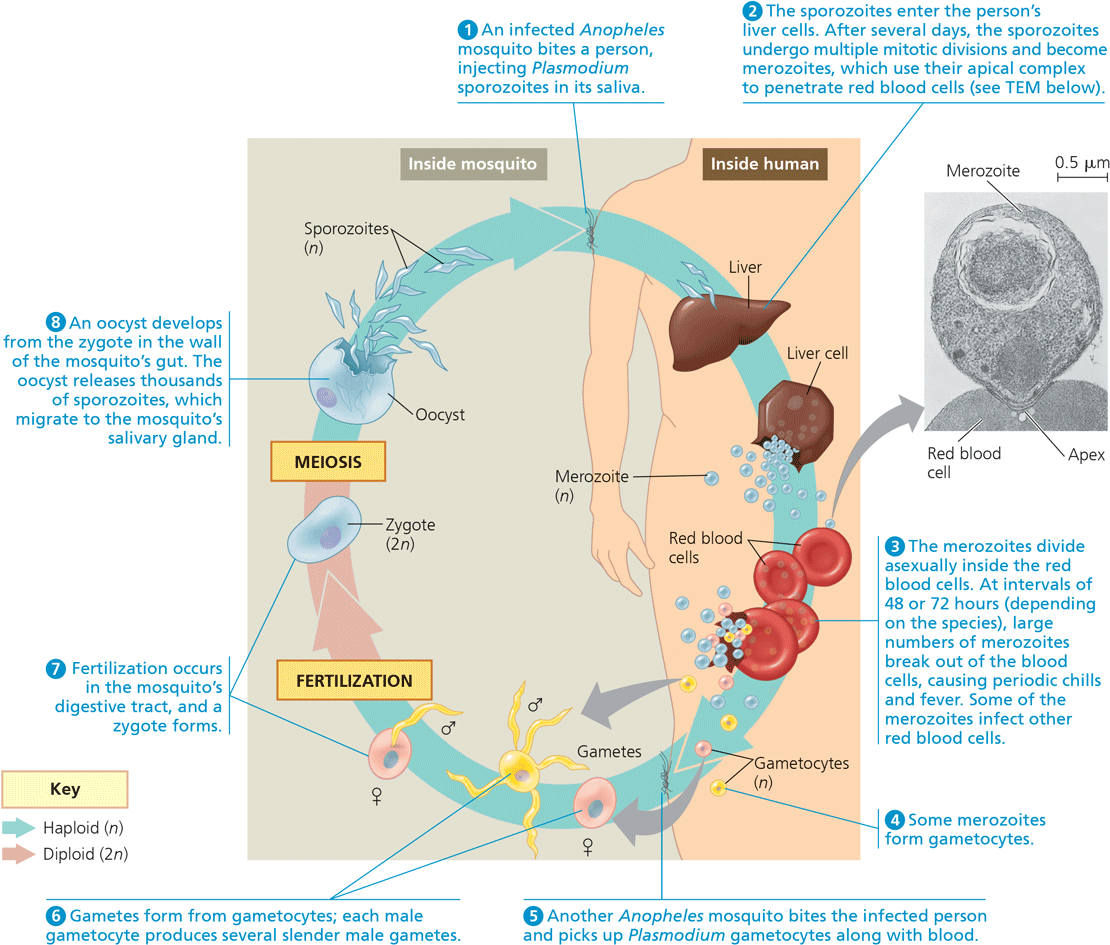
Ex. Plasmodium: causes malaria (the annopheles mosquito is what transmits pathogens for the plasmodium)
13. Describe the life cycle of Plasmodium.
14. What are the basic characteristics of ciliates?
- have large numbers of cilia arranged in longitudinal rows or spirals
- some cilia may be fused into sheets, spikes, or rods that function as mouths, paddles, teeth or feet
- have a pellicle
- unicellular heterotrophs
- micronucleus may only be needed for sexual reproduction
- macronucleus divides by mitosis and is involved with physiological function
- vacuoles for ingesting food and maintaining water balance
- conjugation involves the exchange of micronuclei
15. Describe conjugation in Paramecia.
16. Name and describe four types of stramenopila (brown algae, golden algae, diatoms, oomycetes).
Brown Algae:
- most conspicuous seaweeds in northern regions (kelps)
- thallus = blade, stipe, holdfast
- algin = gel-forming substance used to thicken puddings or salad dressings
- undergoes alternation of generations
Sporophyte: (diploid) goes through meiosis to produce spores
Gametophyte: are smaller, filamentous individuals
Golden Algae:
- biflagellated
- freshwater or marine (plankton)
- all are photosynthetic; some mixotrophic
- most are unicellular; some colonial
- many species can form protective cysts if environmental conditions deteriorate
Diatoms:
- unicellular, photosynthetic organsisms
- phytoplackton
- double shells (look like a box with lid)
- made of opaline silica
- live diatoms can withstand pressures as great as 1.4 million kg/m^2 (equal to the pressure under each leg of a table supporting an elephant)
- Vibrating fibrils line grooves
- diatomaceous earth -filtering medium
Oomycetes: (water molds)
- all are parasites or sabrobes
- used to be categorized as fungi
- have motile spores (zoospores) with two unequal flagella
- sexual reproduction via male and female gametes
- most oomycetes live in water, but terrestrial forms are plant pathogens
17. What is Phytophthora infestans ? What is Saprolegnia ?
phytophthora infestans: cause late blight of potatoes (Irish potato famine)
Saprolegnia: fish pathogen; can infect amphibians and kill amphibian eggs
18. What are the basic characteristics of the radiolarians? For what are they noted?
Radiolarians:
- glassy exoskeleton of silica
- bilateral or radial symmetry pseudopodia extend outward through small openings in exoskeleton
- forms most of the ooze on seafloor
19. What are the basic characteristics of the foraminiferans? For what are they noted?
Foraminiferans:
- heterotrophic freshwater and marine protists
- many can derive nourishment from photosynthesis of symbiotic algae living within their tests
- fossils created limestone deposits (White Cliffs of Dover)
- have tests (shells) of organic substances with grains of calcium carbonate, sand, bits of echinoderm shells or sponge spicules
- have podia (cytoplasmic projections) for gathering food and materials for their tests, and for swimming
20. What are the basic characteristics of the cercozoans?
Cercozoans:
- contains most of the amoeboid and flagellated protists that feed with threadlike pseudopodia
- found in marine and freshwater and in soil
- most are parasites or predators
21. What are the basic characteristics of the red algae (rhodophyta)?
Red algae (Rhodophytes):
- no centrioles; no flagellaa
- reproduce by alternation of generations
- produce pigments that give them a red color
Porphyra = Japanese “nori” used to wrap sushi
22. What are the basic characteristics of the green algae? Compare Chlamydomonas, Volvox, Ulva, and Caulerpa.
Green Algae:
- divided into two groups - the charophytes and the chlorophytes
- charophytes most related to land plants
unicellular cholophytes
- chlorophytes includes 7,000+ species
- most are freshwater, but also marine and terrestrial forms
Chlamydomonas: simple, unicellular, resemble gametes or zoospores of more complex chlorophytes
- Habitats of unicellular chlorophytes include: water (phytoplankton), damp soil, symbiosis inside eukaryotes, and even snow
Colonial and multicellular chlorophytes:
- volvox: colonial as are filamentous forms of algae that form pond scum
- Ulva: forms true multicellular bodies by cell division and differentiation
- Caulerpa: shows repeated division of nuclei with no cytoplasmic division so it is like on big “supercell”
23. Distinguish among the following types of amoeboid organisms: plasmodial slime molds, cellular slime molds, tubulinids (gymnamoebas), entamoebas. Be sure to list any unique features of each group.
Plasmodial slime molds:
- multinucleate, moving mass of cytoplasm
- usually yellow or orange color
- feed on bacteria, yeast, other organic matter
- undergoes synchronous mitosis
- form sporangium under adverse conditions
Cellular slime molds:
- individuals act like amoebas
- eat bacteria
- if food is scarce, they aggregate to form a moving “slug”
Tubulinids (used to be Gymnamoebas)
- large and varied group of amoebas
- free-living
- found in soil, freshwater, saltwater
- heterotrophs that feed on bacteria, other protists, and detritus
Entamoebas:
- parasites of vertebrates and some invertebrates
Ex. E. histolytica: causes amebic dysentery and is spread via contaminated food, water, or eating utensils
- E. histolytica may sometimes get to brain and cause abscesses
24. Describe the choanoflagellida. They may be the common ancestor of what organism?
Chanoflagellida:
- most like the common ancestor of the sponges
- have single flagellum surrounded by collar of shorter filaments
- feed by straining bacteria from water with their collar
\ Chapter 31
25. Fungi are most related to which other kingdom?
- Fungi are more closely related to animals than to plants.
26. What substance is found in the cell walls of fungi? This material is found in which other organisms?
- Cell walls of fungi contain chitin
- the same material found in the exoskeletons of arthropods
27. Define: hyphae, mycelium, monokaryotic (septate), dikaryotic, heterokaryotic, homokaryotic, coenocytic.
Hyphae: the feathery filaments that make up multicellular fungi
Mycelium: a mass of connected hyphae
Monokaryotic: hypha with one nucleus
Dikaryotic: hypha with two nuclei
Heterokaryotic: nuclei from two genetically distinct individuals
Homokaryotic: nuclei from genetically similar individuals
Coenocytic: hypha made up of a continuous cytoplasmic mass with hundreds or thousands of nuclei
28. What is the relevant unit of reproduction in fungi?
- the nucleus
29. How do fungi take in nutrients?
- they are heterotrophic, they excrete enzymes for external digestion and then absorb the digested products
30. Briefly, how does sexual reproduction occur in fungi?
- Sexual reproduction: involves fusion of hyphae from two compatible mating types or hyphae from same fungus
- compatibility is determined by pheromones released by hyphae
31. Define: plasmogamy, karyogamy.
Plasmogamy: union of the cytoplasms of two parent mycelia
Karyogamy: fusion of haploid nuclei from the parent mycelia (produces diploid nucleus)
32. How do fungi reproduce asexually?
- Spores can form asexually or sexually and are most often dispersed by the wind which help fungi reproduce asexually
33. What are the features of the chytridiomycota?
Chytridiomycota: Fungi with flagellated zoospores
34. Chytrids have been implicated in the die-off of what organisms around the world?
- amphibians
35. What are the key characteristics of the Zygomycota?
Zygomycota: fungi that produce zygotes
36. Describe the reproductive cycle of Rhizopus (bread mold), a member of the Zygomycota.
- Rhizopus is commonly found growing on moist bread or fruit
- Rhizopus feeds on simple sugars
- They are named for the diploid zygote nuclei that they produce
37. Describe the characteristics of the Glomeromycota. Where might they be found?
- cannot survive without a host plant.
- Mutualism is involved where the fungus proides minerals (especially phosphorus) to the plant, and the plant provides carbohydrates to the fungus
- Glomeromycete hyphae grow within the root cells of most trees and herbaceous plants.
- These hyphae are called arbuscular mycorrhizae.
38. Describe the characteristics of the Ascomycota. What are some examples?
- Ascomycetes make up about 75% of known fungi
Ex. bread yeasts, common molds, morels, cup fungi, and truffles.
Ex. Genus Penicillium is also found in phylum Ascomycota
- Sexual reproduction occurs within the ascus.
- Asexual reproduction occurs within conidiophores.
- Conidia form at the end of modified hyphae.
- Some ascomycetes have yeast morphology.
39. How do yeasts reproduce?
- They can reproduce asexually by budding or cell fission
40. Describe the characteristics of the Basidiomycota. Give examples. Describe their means of reproduction.
Basidiomycota: the club (basidium) fungi
Basidiocarp: visible reproductive structure
Ex. Mushrooms, toadstools, puffballs, shelf fungi
- Basidiomycetes sexually reproduce within basidia
- gills on the undersurface of the mushroom cap produce tremendous number of spores
What is biggest in this cycle? basidiocarp
What is the next biggest? basidium
What is smaller? basidiospores
41. What two substances are fungi able to break down? What is the importance of this?
- Fungi can break down cellulose and lignin
- Breaking down cellulose and lignin releases carbon, nitrogen, and phosphorus making these elements available to other organisms
42. Define: obligate symbiosis, facultative symbiosis, pathogen, parasite, commensal, mutualist.
Obligate symbiosis: essential to survive
Facultative symbiosis: fungus can survive without the host
Pathogens: cause disease
Parasites: do not cause disease unless it is an extreme case
commensal: one partner benefits, but no harm comes to the other
Mutualistic: both the fungus and the host benefits from the relationship
43. What are endophytes? How are they important?
- Endophytes live inside plants
- they protect plants from parasites
44. What are lichens? Where do they live? How are they important?
- A lichen is composed of a fungus, along with cyanobacteria, green algae, or both
- Lichens live in very harsh habitats, they are usually the first to colonize an area
- Lichens break down rocks and help prepare for invasion of other organisms
- Lichens produce very bright pigments some of which are used as dyes
- lichens are used to indicate air quality since they can absorb substances dissolved in rain and dew
- as pollution decreases, lichen populations increase
45. What are mycorrhizae? How are they important? Distinguish between arbuscular mycorrhizae and ectomycorrhizae.
Mychorrhizae: fungi associated with roots of plants
- fungal hyphae increase amount of contact with soil and increase surface area for absorption
Haustoria: specialized hyphae used to extract nutrients from, or exchange nutrients with their plant hosts
- Mycorrhizae aid in direct transfer of phosphorus, zinc, copper and other minerals from soil into plant roots
Arbuscular mycorrhizae: grow within the outer cells of the plant root
Ectomycorrhizae: surround root cells but do not penetrate them
46. Give some examples of symbioses between fungi and animals.
- Fungi form mutual symbioses with animals
Ex. 1, Ruminant animals have neocallimastigomycete fungi in their gut
Ex. 2, Leaf-cutter ants have domesiticaled a specific fungus that they maintain in an underground garden. Ants provide leaves for the fungi to eat. Ants eat the fungi
47. Briefly identify the following fungal parasites and pathogens: Fusarium, Aspergillus flavus, corn smut, ergot.
Fusarium: grows on spoiled food; produces vomitoxin that can cause brain damage in humans and animals in SW United States
Aspergilus flavus: Produce aflatoxins that are very carcinogenic
corn smut: Damages corn, but is not harmful to animals that consume it
Ergot: fungus associated with rye and other cereal grains
- An alkaloid toxin is produced and if eaten can cause hallucinations, gangrene, nervous spasms, burning sensations
48. Fungal infections are difficult to treat. Explain. difficult to treat in humans and other animals owing to the similarities between the two kingdoms
49. Give some examples of fungal diseases that affect humans.
• ringworm
• athlete’s foot
• nail fungus
• thrush
• oral or vaginal infections caused by Candida
• Pneumocystis jiroveci invades lungs
• mold allergies
• Stachybotris causes “sick” buildings
• chytridiomycosis affects amphibians
\ REVIEW QUIZ:
gameotophyte:
Algin:
saphrolegina: