9.4: Development During Infancy and Childhood
Newly born infants’ behaviors are mostly limited to reflexes that enhance chances for survival
Touching their cheek triggers the rooting reflex
Touching the newborn’s lips evoke the sucking reflex
Putting a finger on the newborn’s palms evokes the grasping reflex
As motor areas of the infant’s brain develop over the first year of life, the reflexes are replaced by voluntary behaviors.
The newborn’s senses — vision, hearing, smell, and touch — are keenly attuned to people
In a classic study, Robert Fantz demonstrated that the image of a human face holds the newborn’s gaze longer than other images
Newborns only 10 minutes old will turn their heads to continue gazing at the image of a human face as it passes in front of them, but they will not visually follow other images
Newborns quickly learn to differentiate between their mothers and strangers
For the first part, mothers become keenly attuned to their infant’s appearance, smell, and even skin texture. Fathers too.
Vision is the least developed sense at birth
A newborn infant is extremely nearsighted
The optimal viewing distance for a newborn is about 6-12 inches
Physical Development
By 7-8 months, their vision will be as clear as the infant’s parents vision
During infancy, their brain will grow to about 75% of its adult weight while their body weight will only reach about 20% of their adult weight
During the prenatal period, the top of the body develops faster than the bottom
Motor skill development tends to follow a “top to bottom” sequence as well
The infant develops control over the lower part of their body
Infants also develop motor control from the center of their bodies outward
The basic sequence of motor skill development is universal, but the average ages can be a little deceptive.
As any parent knows infants vary a great deal in the ages at which they master each skill
Ex.) Virtually all infants are walking well by 15 months, but some walk as early as 10 months
Social and Personality Development
The infant’s individual traits play an important role in the development of the relationship between infant and caregiver
Temperamental Qualities: Babies Are Different!
Temperament: inborn predispositions to consistently behave and react in a certain way
Ex.) Some babies are fussy, and irritable, while others are active and outgoing, while others are shy and wary.
Interest in infant temperament was triggered by a classic longitudinal study launched in the 50s by psychiatrists Alexander Thomas and Stella Chess
The focus on the study was on hoe temperamental qualities influence adjustment throughout life
Chess and Thomas rated infants on activity level, mood, attention span, and sleeping and eating
2/3 of babies could be classified into one of three broad temperamental patterns: easy, difficult, and slow-to-warm-up
The remaining third of the infants were characterized as average because they didn’t fit neatly into one of the 3 categories
Easy babies readily adapt to new experiences, generally displaying positive moods. They have regular sleeping and eating patterns
Difficult babies tend to be intensely emotional, irritable and fussy, and prone to crying with irregular sleeping and eating patterns
Slow-to-warm-upbabies have a low activity level, withdraw from new situations and people, and adapt to new experiences very gradually
Researchers have examined the physiological basis of temperament
Ex.) Jerome Kagan classified temperament in terms of reactivity
High-reactive infants react intensely to new experiences, strangers, and novel objects
Low-reactive infants tend to be calmer, uninhibited, and bolder. They are more likely to show interest than fear when exposed to new things
Virtually all temperament resarchers agree idividual differences in temperament have a genetic and biological basis
However, researchers alsoagree that environmental experiences can modiify a child’s basic temperament
“Temperament is not destiny. Many experiences will affect high and low reactive infants as they grow up. Parents who encourage a more sociable, bold persona and discourage timidity will help their high reactive children develop a less-inhibited profile.”
- Kagan
Temperament can also be affected by cultural beliefs
Ex.) Cross-cultural studies of temperament found that infants who display temperamental characteristics related to shyness are treated with greater maternal approval warmth in eastern asian and latino cultures. The same style is seen less desierable in Western cultures, however is often met with parental disappointment, rejection, and concern
Attatchment: Forming Emotional Bonds
After WWII, psychiatrist Rene Spitz showed the detrimental effects of institutionalization on children depirved of a relationship w/ a loving caregiver.
Harry Harlow showed that it wasn’t just human children who suffered from the lack of care. Infant rhesus monkeys raised in isolation from other monkeys showed severe pathology such as repetive and self-harming behaviors
All primates including humans seek out what Harlow termed contact comfort
Attatchment: the emotional bond that forms between an infant and caregiver(s), especially their parents
Mary Ainsworth and John Bowlby conceputalized that attatchment relationships serve important functions throughout infancy, and the lifespan
Ideally, the caregiver functions as a secure base, providing a sense of comfort and security—a safe haven
When parents are consistently warm, responsive, and sesntitive to their infant’s needs, the infant develops asecure attatchmentto their parents
The infant’s expectation that their needs will be met by their caregivers is the most essential thing to forming a seucre attatchment
Insecure attatchment may develop when an infant’s parents are negelctful, inconsistent, or insensitive to their behaviors or moods
It seems to reflect an ambivalent or detatched emotional relationship between an infant and their parents
Strange Situation: most commonly used procedure to measure attatchment devised by Ainsworth
Typically used with infants between 1-2 years old
The baby and the mother are brought into an unfamiliar room w/ a variety of toys. A stranger enters the room a few mins later. The more stays w/ the baby for a few moments then leaves. After a few mins, the mother returns and repeats this cycle
Psychologists assess attatchment by observing the child’s behavior to their mother during the procedure
When the mother is present, the securely attatched baby will use her as a secure base to explore the new environment and hsow distress when the mother leaves
—
An insecurely attatched baby is less likely to explore the new environment even w/ the mother being present
They appear either anxious or indifferent
Psychologists have focused primarily on the mother in these studies. However, an infant can form multiple attatchments, such as with their dad
The quality of attatchment during infancy is associated w/ a variety of long term effects:
Preschoolers w/ a history of being securely attatched tend to be more prosocial, empathic, and socially competent
Adolescents who were securely attatched tend to have fewer issues, do better in school, and have more successful relationships
Cognititve Development
Children develop increasing sophistication in cognitive processes—thinking, remembering, and processing information.
The most influential theory of cognitive development is of Jean Piaget. Originally trained as a biologist, they combined a boundless curiosity about the nature of the human mind with a gift for scientific observation
Piaget believed that children actively try to make sense of their enironment rather than passively soaking up information about the world.
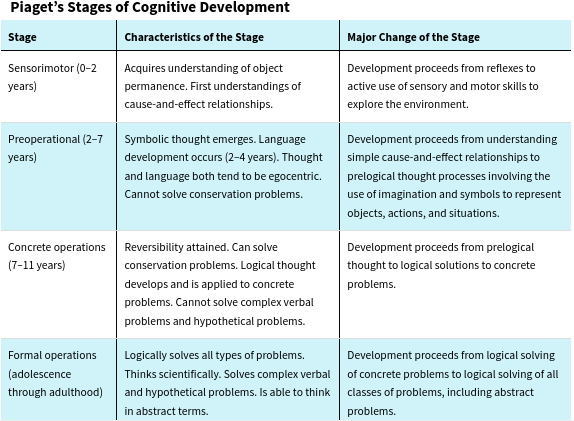
Piaget said that children progress through four distinct cognitive stages: sensorimotor, preoperational, concrete operational, formal operational
As a child advances to a new stage, their thinking is qualitaively different from that of the previous stage. Each new stage represents a fundamental shift in how the child thinks and understands world
Piaget saw cognitive development as more qualitative than quantitative. Meaning that as a child develops and matures, they do not simply acquire more information, but they develop a new understanding of the world in each progressive stage, building on the understandings acquired in the previous stage.
As the child assimilates new information and experiences, meaning that they add on to existing knowledge, they eventually change their way of thinking, meaning they acquire, or accommodate, new knowledge
He believed that these stages were biologically programmed to unfold at their respective ages and that children in every culture progressed through the same sequence
The Sensorimotor Stage
The first stage of cognititve development, from birth to age 2, the period during which infants acquire knowledge about the world through actions that allow them to directly experience and manipulate objects
Infants discover a wealth of practical sensory knowledge, such as taste, feel smell, sound.
They also expand their practical knowledge about motor actions—reaching, pushing, etc. In the process, they gain a basic understanding of the effects their own actions can produce, such as pushing a button to turn on the TV
At the beginning of this stage, their motto is like “out of sight, out of mind.”
An object exists only if they can directly sense it.
By the end of this stage, children acquire a cognitive understanding called:
Object Permanence: the understanding that an object continues to exist even if it can’t be seen
The Preoperational Stage
The second stage of cognitive development, from 2 to age 7 and is characterized by increasing use of symbols and prelogical thought processes
Operations refers to logical mental activites. making this stage a “prelogical” stage
Symbolic thought: the ability to use words, images, and symbols to represent the world
One indication of the expanding capacity for symbolic thought is the child’s impressive gains in language during this stage
The childs increasing capacity for symbolic thought is also apparent in their use of fantasy and imagination whole playing
The preoperational child’s understandinf of symbols still remains immature. For example, a 2 year old shown a picture of a flower may try to smell it
Egocentrism: the inability to take another person’s perspective or point of view
The thinking of preoperational children often displays egocentrism
Ex.) The child thinks that their grandma would want a new Lego set for her birthday because it is what they want
Irreversibility: the inability to take another eprson’s perspective or point of view
Meaning that the child cannot mentally teverse a sequence of events or logical operations back to starting point
Ex.) The child cannot mentally reverse a sequence of events or logical operations back to the starting point.
Centration: the tendency to focus, or center, on only one aspect of a situation and ignore other important aspects of the situation
Conservation: the understanding that two equal quantities remain equal even if the form or appearance os rearranged, as long as nothing is added or subtracted
Because of centration, the child cannot simultaneously consider the height and the width of liquid in a container, for example. Instead they only focus on one aspect of the situation, the height of the liquid. And because of irreversibility, the child cannot cognititvely reverse the series of events, mentally returning the ppured liquid to its original container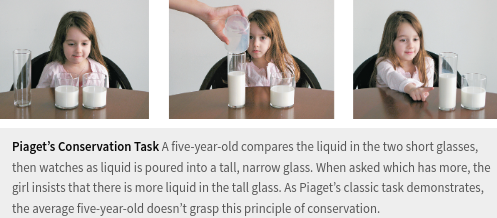
The Concrete Operational Stage
The third stage of cognitive development, lasting from age 7-adolescence and characterized by the ability to think logically about concrete objects and situations
Children are much less egocentric, can reverse mental operations, and focus simultaneously on two aspects of a problem, they understand the principle of conservation
Thinking and use of logic tend to be limited to concrete reality to tangible objects and events
Children in this stage often have difficulty thinking logically about hypothetical situations or abstract idead
Ex.) An 8 year old will explain the concept of friendship in tangible terms “Friendship is when someone places with me.”
The Formal Operational Stage
The fourth stage of cognititve development, lasting from adolescence through adulthood and is characterized by thinking logically about abstract principles and hypothetical situations
Reflects the ability to think logically even dealing w/ abstract concepts or hypothetical situations
In contract to the friendship concept, they explain it emphasizing more global and abstract characteristics such as trust, empathy, loyalty.
Formal operational thinking is often limited to areas in which they have developed expertise or a special interest
Criticisms of Piaget’s Theory
1.) Piaget underestimated the cognititve abilities of infants and young children
2.) Piaget underestimated the impact of the social and cultural environment on cognitive development
3.) Piaget overestimated the degree to which people achieve formal operational thought processes