marine reptiles and mammals test
100 million years ago, reptiles adapted to live on land as well as return to sea. Reptiles include: crocodilians, turtles, lizards, and snakes.
Reptiles and mammals start out as amniotic eggs covered by a protective shell. The amnion is the liquid filled sac where the embryo develops. There is also a yolk sac where food is stored and an additional sac for disposing wastes known as the allantois. The chorion is a membrane lining inside the shell allowing gas exchange.
Because the eggs can be laid in dry places, aquatic predators are avoided.
repitle adaptations include: advanced circulatory system giving more efficient supply of oxygen. Highly efficient kidneys to eliminate waste and conserve water. Scales that decrease water loss
CROCODILES
The Asian saltwater crocodile is the best adapted. (crocodylus porosus) They can grow to be as large as 6-7 m for males.
Crocodiles feed mainly on fish and drink salt water, eliminating the salt through glands on their tongues. They live along the shore where they nest.
Females are sexually mature at 10 while males are at 16. They nest 40-60 eggs and incubation is 90 days. They communicate using calls or barks and can navigate long distances using the sun and magnetic field.
SEA TURTLES!
They have protective shells composed of keratin on the outside and bone on the inside. The dorsal surface is the carapace and the ventral is the plastron. Leatherback do not have a shell, they have a hide.
Gain buoyancy through fatty deposits beneath the skin and their flattened shell that reduces weight and size.
they can stay underwater for 3 hours and sleep under rocks or coral in deep water.
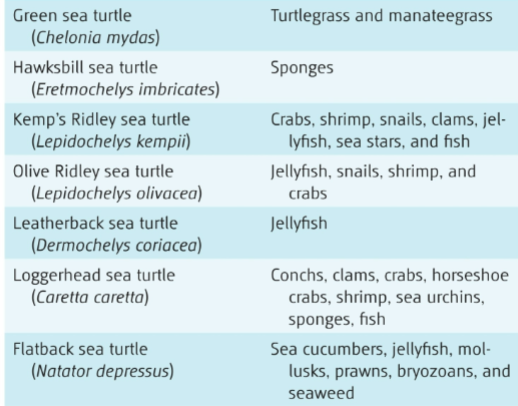
They use a beak like structure to feed and are all carnivorous besides green sea turtles which are herbivorous.
Leatherback turtles eat jellyfish because they have a pharynx that holds slippery prey and can withstand stings.
As sea turtles eat, the salt is eliminated through tears in their salt glands above the eyes.
1 female turtle can mate with many males increasing genetic diversity. The female digs a pit on the beach at night and buries eggs
Things that danger sea turtles are beach erosion, artificial lighting, trapped in fishing nets, hunted, or eaten by dogs or cats.
LIZARDS
The only marine one is the iguana of the galapagos islands off equador. Most lizards are black and some are red and black
They are dark colored to absorb heat energy
very few predators, mainly on dogs and cats
They are herbivores that use their snout to graze seaweed
Excrete salt through tear and nasal glands
Marine iguana are good swimmers and the males occupy a small territory on rocks with 1 or 2 females
SNAKES
descendants of lizards that are limbless. They have no scales to help swimming in the sea and have nostrils high up to avoid water going in
they can exchange gas through skin while in the water to use less oxygen
they mainly eat fish and fish eggs using venomous fangs
excretes salt through gland under their tongue.
some can produce eggs on land while others keep the eggs in their bodies
males have two penises called hemipenes.
SEABIRDS
SHOREBIRDS: Feeds on intertidal marine life. Osryercatchers (haematpodidae) use long flattened bills to slice through molluscs, crush crabs, and pry limpets off rocks. Plovers and turnstones (charadriidae) have short plump bodies with shorter bills. turnstones bills are upturned to turn over stones and sticks. Sandpipers and Curlews (scolopacidae) feed on small crustaceans and molluscs in the sand as tide recedes.