Lecture 13: Hydrostatics
Learning Outcomes
Distinguish between the concepts of ‘fluid’, ‘liquid’ , and ‘gas’
Calculate density
Understand how atmospheric pressure exerts forces on objects
Distinguish between atmospheric and gauge pressures
Work with the hydrostatic equation to calculate pressures at different depths in a liquid
Use the hydrostatic equation to understand pressure measuring devices
Compute buoyancy forces on objects
Terminology
Fluids: Substances that can flow / have free moving particles, including liquids and gases.
Conforms to the shape of a container.
Density

Density, denoted as , relates volume of a solid or fluid to its mass.
Formula:
Rearranged:
Unit of measurement:
Pressure
Definition: Pressure is the force applied per unit area, represented by the formula:
Unit: N/m² or Pascal (Pa)
Example: Calculate the pressure exerted by a student with a mass of 83 kg and a shoe surface area of 0.0290 m².
To find the pressure, we first need to calculate the force (weight) exerted by the student, which is given by the formula: where (g) is the acceleration due to gravity (approximately 9.81 m/s²). Therefore, the force is:
Substituting the force into the pressure formula:
Standard atmospheric pressure:
This is calculated using the pressure formula.
The Hydrostatic Equation
Principle: According to Pascal’s Principle, any pressure applied to a fluid is transmitted undiminished throughout the fluid and to the walls of its container.
Hydrostatic equation: To find the difference in pressure at a depth, use:
Where:
(density of the fluid)
(acceleration due to gravity)
(change in height/depth)
Thus pressure depends on height
Example:
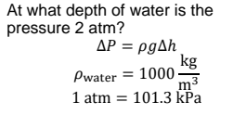
P = P0+ (where is the atmospheric pressure, is the fluid density)
P-P0=
Measuring Pressure
Absolute Pressure: Measured by a barometer.
Historical invention by Torricelli.
Involves mercury and atmospheric conditions.
Calculation:
Absolute pressure can also be calculated using:
Where pressure is P=0$ at the reference point.
Gauge Pressure
Definition: The pressure relative to atmospheric pressure.
Formula:
𝑃gauge = 𝑃 − 𝑃atm
Sphygmomanometer
Used to measure blood pressure.
Cuff should be at the same height as the brachial artery for accurate measurements.
Buoyancy
Archimedes Principle:
The (magnitude of the) buoyancy force, 𝐹𝐵, on a submerged object is equal to the weight of the fluid displaced
𝐹𝐵 = 𝜌𝑔
Where:
= Density of the fluid
= Volume of the displaced fluid
Will the Object Sink or Float?
To determine if an object will sink or float, compare:
Density of the object () to the density of the fluid ( )
Example: Iceberg Proportion Above Water
Density of ice:
Density of sea water:
Calculate the proportion of the iceberg that is submerged based on these densities.