Level 2 music theory
Scale Degrees
In level one you study the alphabetical arrangement of the eight notes that make up a scale. While the order of notes vary per scale, each note is given a degreee.
These degrees are represented by roman numerals ranging one to eight and occurring in the following order.
I Tonic
II Super Tonic
III Mediant
IV Subdominant
V Dominant
VI Sub Mediant
VII Leading note
VIII Octave or Tonic
Important Degrees
Tonic (I): The most important note of any scale, it gives the name to the key signature and is both the highest and lowest not of the scale
Mediant (III) The mediant is the middle note between the Tonic and Dominant, and determines whether a scale is Major or Minor
Dominant (V) The dominant comes from the Latin word “dominus”, meaning master. The chord built around the Dominant is strong enough it masters the key
Leading Note (VII) The seventh degree or the note right before the Octave or Tonic note. It is ALWAYS a semitone below the Tonic and leads directly into it. This note is only ever referred to as the subtonic when the distance is a tone instead of a semi-tone
Italian Terms
Lento Slow
Adagio At ease (not as slow as largo, but slower than Andante)
Andante Moderate tempo; walking speed
Moderato Moderately
Allegretto Slightly slower than Allegro
Allegro Lively or quick
Vivace Fast, vivacious
Presto Quick
Poco Little
Poco a Poco Little by little
Piu More
Piu Mosso More motion (faster)
Relative Minor Scales
The minor scale comes in three forms. Natural Minor, Harmonic Minor, and Melodic minor.
In level two only Natural Minor and Harmonic Minor will be reviewed. Harmonic minor is a level three topic.
All minor scales are named relative minor scales because of their relation to their relative majors. These scales are connected because they share the same key signature, meaning the key signature used in the major scale is identical to the relative minors.
Finding the relative minors
To find the relative minor of a major scale you start on the tonic of the scale (the first note or octave) and move back three semitones. For example;
In the C major scale, going back three semitones from C (C,B,Bb,A) brings us to the note A natural. meaning the relative minor to C major is A minor
Natural minor
The natural minor is the minor with the same key signature as its relative major with no changes to it. Finding the relative minor can be done by either moving three semitones lower than the tonic, or by looking at the sixth degree (sub mediant, 6th note) of the scale.
CDEFGA
Harmonic Minor
The relative harmonic minor is nearly identical to a natural minor, but with the leading tone (seventh degree) raised a semitone. In a key such as C major having a relative minor of A minor, when looking at the notes for the A minor scale the G would be raised to G#

If the seventh degree is flat, then it gets raised to a natural. If it’s natural then it gets raised to a sharp
Triplets
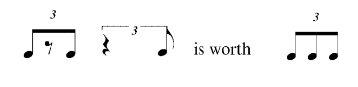
When notes are grouped together with the number 3 written above they become triplets. This means that there are three beats played in the time of two of the same value. For example, a quarter note triplet is equal in value to two quarter notes
Most commonly used for triplets are quarter, eighth, and sixteenth notes

Like notes, can also be found in triplets and work with the same principle, only instead of a sound they represent silence. The value of a triplet rest is worth the note it’s replacing
Regular time signatures
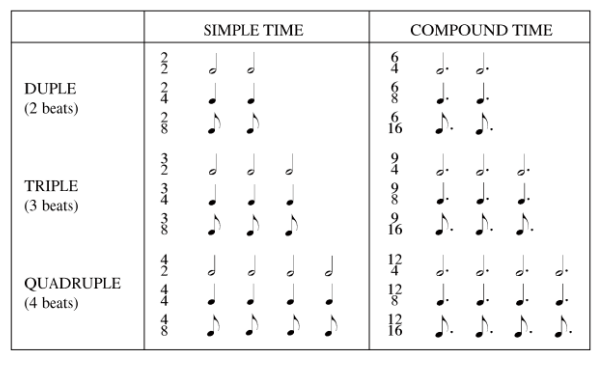
The important thing to understand in simple measures is that the beats are divisible by two, while in compound time they’re divisible by three
Intervals
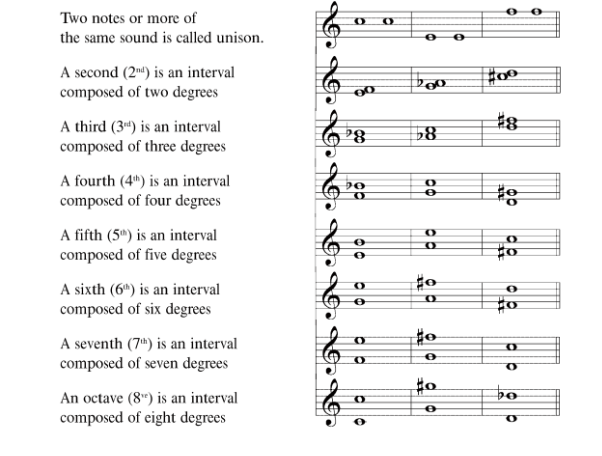
An interval in music the pitch distance between two notes
To count the size of an interval you start at the lower note and count each line and space from it to the upper note (including the line/space the first note sits on). When counting, accidentals do not affect the interval count. Not even en-harmonic notes
Intervals are broken into Major, minor, or perfect, then can be Augmented or Diminished. This is covered in level three.