Chapter 8: Personality
Chapter 8: Personality
Introduction
Personality: An individual’s distinct and relatively enduring pattern of thoughts, feelings, motives, and behaviors.
A. Two Broad Areas of Focus
Understanding individual differences in particular personality characteristics: such as sociability or irritability
Understanding how the various parts of a person come together as a whole:
B. Myers–Briggs Personality Test
Problems associated with the Myers-Briggs Type Indicator (MBTI) personality test:
a. Lack of testability: Jung did not develop his ideas about personality types from experimentation. Jung was a protégé of Freud and, thus, based much of his theories on observations and philosophical exercises
b. Volatility of the “true self: how volatile a person’s true self can be as like it can change from today to tomorrow
C. Big Five Personality Assessment
This assessment meets scientific standards for personality evaluation.
I. Psychoanalysis
A. The Birth of Psychoanalysis
In 1885, Sigmund Freud went to study with Jean Charcot, who was studying hysteria.
Hysteria: a “conversion disorder” in which the patient experiences symptoms such as paralysis of the limbs, blindness, deafness, convulsions, and the like—without an organic basis
a. Charcot found that hysterical disorders often started with a traumatic event in the patient’s childhood and that he could make the symptoms vanish by putting the patient under hypnosis Freud became fascinated with the power of unconscious forces.
Case of Anna O.: An influential case that highlighted the importance of unconscious processes in psychological issues.
Anna O. case → treated by Josef Breuer for hysterical symptoms (paralysis, vision/speech issues) → “talking cure”: recalling traumatic events → symptoms decr. → patient emotionally attached to Breuer; later patient hugged Sigmund Freud unexpectedly → Freud develops transference
Freudian Terms:
a. Transference: The process whereby patients develop feelings for their therapist that are based on past relationships.
b. Free Association: A method in psychoanalysis where patients express their thoughts freely without censorship.
c. Resistance: The tendency of patients to block or refuse to discuss certain topics.
B. Freud's Theory of Personality
Psychoanalysis: Freud’s theory of personality and method of psychotherapy, which assumes that our motives are largely unconscious.
C. The Unconscious
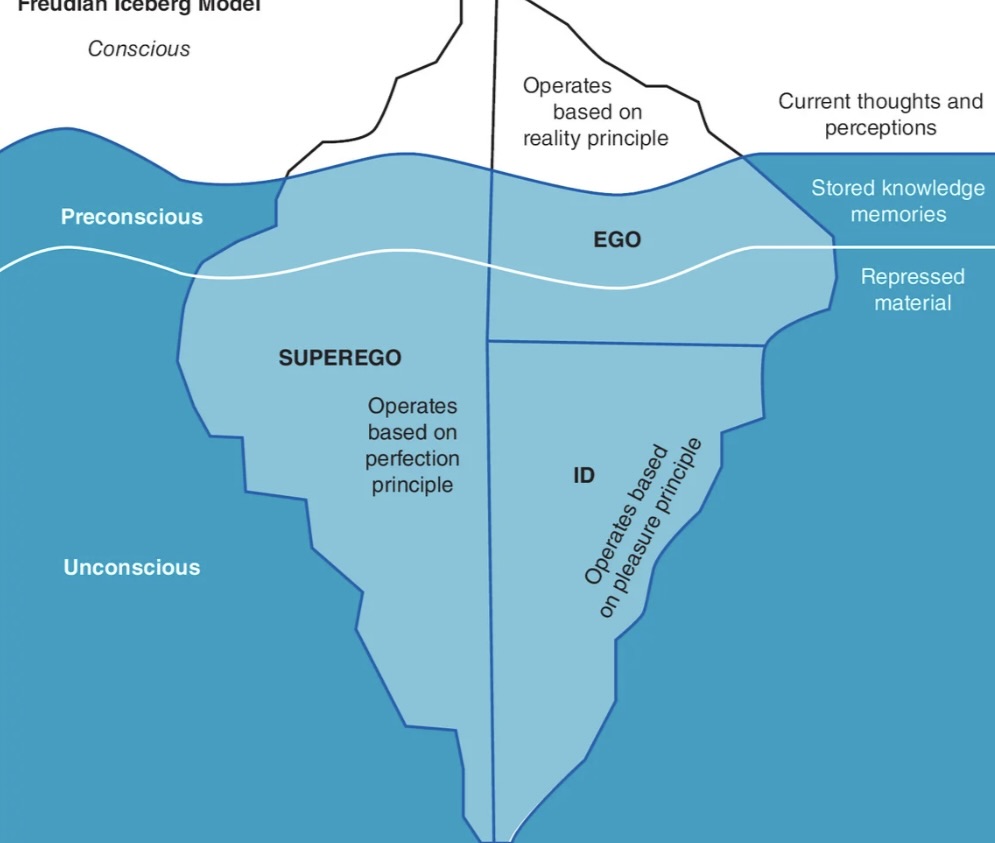
Iceberg Metaphor: The mind is compared to an iceberg, where most thoughts and feelings are beneath the surface (unconscious).
Preconscious: Material that is temporarily out of awareness but can be easily brought to mind.
Unconscious: Contains life instincts (which include the need for food, water, air, and sex) and death instincts (need to reduce all tensions by returning to a calm lifeless state)
D. The Structure of Personality
Freud's belief that people are perpetually driven by inner conflicts.
Id: The primitive and unconscious part of personality that contains basic drives and operates according to the pleasure principle.
i. Pleasure Principle: The id’s boundless drive for immediate gratification.
Superego: The part of personality that consists of moral ideals and conscience.
i. Learned from parents.
ii. Two components: ego ideal (an image of the ideals we should strive for) and conscience (define how we should not behave)
Ego: The part of personality that operates according to the reality principle and mediates the conflict between the id and superego.
The ego is thus a master of compromise, a part of us that tries to satisfy our needs (id) without offending our morals (superego)
i. Reality Principle: The ego’s ability to delay gratification.
E. Psychosexual Development
Freud’s stages of personality development during which pleasure is derived from different parts of the body (oral, anal, phallic, and genital).
Psychosexual Stages: Freud’s stages of personality development, each characterized by the erogenous zones that are the focus of a child's psychosexual energies.
a. Oral Stage: Feeding is crucial, mouth is pleasure seeking center, and weaning (transitioning away from feeding breast) creates significant conflict.
b. Anal Stage: Characterized by tension buildup and release, baby derives pleasure in the sensation of holding in and letting go of feces, along with conflicts between parent and child because of toilet training
c. Phallic Stage: Children exhibit fascination with their bodies, playing with genitals, leading to conflicts with father (love mother, hate father)
1) Oedipus Complex: A child's desire for the opposite-sex parent and rivalry with the same-sex parent.
2) Castration Anxiety: Fear that the father will retaliate by cutting off his son’s prized genitals
3) Identification: The process of internalizing parental values contributing to superego formation.
4) Freud's theories on female development are less clear and less defined.d. Latency Period: Sexual impulses are thought to lie dormant, between 7 and 12
e. Genital Stage: Characterized during puberty where adult sexual urges become dominant.
Fixation: A tendency to become “locked in” at an early, immature stage of psychosexual development; due to too much or too little gratification at earlier stage
Oral stage → weaned too early/late → oral fixation → smoking, drinking, nail biting, chewing pencils, excessive talking → personality: passive, dependent, demanding
Anal stage → harsh/rigid toilet training → anal fixation →
anal-retentive → neat, stubborn, punctual, overcontrolled
anal-expulsive → messy, rebellious, disorganized
Phallic stage → genital frustration or excessive focus → phallic personality → self-centered, vain, arrogant, attention-seeking → example: power-hungry, obsessed with wealth/status, conquering women
F. The Dynamics of Personality
According to Freud, the ego searches for outlets for its needs. Finite amount of “psychic energy”—energy that cannot be created or destroyed, only transformed from one state to another.
Humor serves as outlet, so do dreams
Defense Mechanisms: Unconscious methods that minimize anxiety by distorting or denying reality.
a. Repression: Banning threatening thoughts, memories, and impulses from awareness.
Nicole Kluemper case → treated as child by David Corwin (therapy filmed) → age 17 remembered nothing at first → mention of sexual abuse triggered memory of bathtub incident with mother → matched childhood testimony → example of trauma-induced repression
b. Denial: A primitive form of repression that blocks awareness of anxiety-inducing external events.
c. Projection: Attributing one’s unacceptable impulses onto others.
d. Reaction Formation: Converting an unacceptable feeling into its opposite.
e. Rationalization: Justifying failures and shortcomings with excuses.
f. Sublimation: Channeling repressed urges into socially acceptable substitutes.
G. Freud's Legacy
Neo-Freudian Theorists: Individuals influenced by Freud but who developed their theories around different aspects of personality.
a. Carl Jung: Argued that the unconscious consists of both repressed material and a collective unconscious, which is a memory bank of images and ideas evolved over time.
1) Collective Unconscious: Stores ancestral experiences and cultural elements shared among humans.b. Alfred Adler: Proposed that personality is shaped more by social conflicts than by sexual tensions, known for concepts like inferiority complex and sibling rivalry.
Inferiority Complex: All humans feel small, helpless, and weak in the first few years of life
c. Other theorists like Erich Fromm and Karen Horney emphasized social dimensions of personality.
Erich Fromm - conflict between freedom and unity; abandoning caste system freedom but feeling of isolation; humans constantly seek to “escape from freedom”
Karen Horney - all humans need love and security and become highly anxious when they feel isolated and alone
d. Some theorists focused on expanding the role of ego in personality.
H. Projective Personality Tests
Projective Tests: Psychoanalytic assessments that allow individuals to “project” unconscious needs and conflicts onto ambiguous stimuli.
a. Rorschach Test: Involves interpreting a series of 10 symmetrical inkblots with limited reliability and validity.
b. Thematic Apperception Test (TAT): Proposed by Henry Murrray; Requires subjects to tell stories from ambiguous pictures, based on the idea that individuals identify with heroes in their stories.
I. Current Perspectives on Psychoanalysis
Three major criticisms of psychoanalysis:
a. It presents too bleak a view of human nature.
b. It does not align well with scientific standards.
c. Controlled research often does not support key propositions.
1) Example: Personality development is a lifelong process, not completely formed in first years of life.
Influence of Freud: His concepts, such as the iceberg model of the mind and analysis of defense mechanisms, have been absorbed into mainstream psychology.
II. The Cognitive Social Learning Approach
A. Cognitive Social-Learning Approach
It emphasizes social learning (modeling) along with cognitive factors like expectancies and values, explaining personality through personal interactions and environmental factors.
B. Principles of Learning and Behavior
Behaviorism: Originated in animal laboratories, centered on environmental factors shaping observable behavior.
Five Principles of Learning:
a. Classical Conditioning: Introduced by Ivan Pavlov.
b. Operant Conditioning: Elaborated by Edward Thorndike.
c. Stimulus Generalization: Responding similarly to similar stimuli.
d. Discrimination: Distinguishing between different stimuli.
e. Extinction: The reduction of learned behaviors when not reinforced.
Historical experiment: Watson, Rayner, and Little Albert.
B. F. Skinner: As the most dedicated proponent of behaviorism, he focused on how environment reinforces behaviors.
C. Social Learning Theory
Extensions of behaviorism to account for learning through observation rather than direct experience with reinforcement.
a. Modeling (Albert Bandura): Process through which individuals imitate observed behaviors.
b. Examines cognitive aspects impacting reinforcement effects on behavior.
c. Julian Rotter: Suggested that behavior is determined by the expectancy of reinforcement and its value.
d. Walter Mischel: Created “Cognitive social learning theory” combined with five essential person variables, including competencies and self-regulatory systems.
1) Competencies: Our mental and physical abilities, social skills, and creative talents
2) Encoding strategies: How we process information about other people and situations
3) Expectancies: Our beliefs about the causes of success and failure and other possible consequences of our actions
4) Subjective values: The kinds of outcomes we find more or less rewarding
5) Self-regulatory systems: Our ability to set goals, monitor and evaluate our progress, delay our short-term needs for gratification, and plan for the futuree. Self-Regulation: An adaptive personal variable.
D. Locus of Control
Perceptions about the control of reinforcements in individuals' lives.
a. Locus of Control: Expectancy regarding whether reinforcements are due to internal or external factors.
1) Internal Locus: Belief that control lies within oneself.
2) External Locus: Belief that control lies outside oneself.
To assess these contrasting orientations, Rotter constructed the I-E Scale;
asks about control expectancies for a wide range of domains—including health, academics, career pursuits, friendships, and remote political and social events
b. Two significant qualifications:
i. It’s possible to have a mixture of both orientations in different scenarios.
ii. Individuals have varying levels of desire for control.c. Exceptions to the rule that an internal locus is generally favorable:
i. Internal orientations can lead to problems when control distinction is not clear.
ii. Overcontrolling tendencies can induce stress.
E. Self-Efficacy
Self-Efficacy: One’s belief in their capacity to perform behaviors necessary for achieving specific outcomes.
a. Varies according to tasks and situations.
b. Implications for health: Self-efficacy is required for engaging in healthy behaviors and is linked to stress management and immunity.
F. Perspectives on Cognitive Social Learning Theory
Personality arises from ongoing interactions among individuals, their behaviors, and their environments.
Reciprocal Determinism: Concept indicating that personality results from the mutual influence of individuals, their actions, and their environments.
Methods of personality assessment include:
a. Behavioral observation.
b. Interviews or questionnaires, I-E Scale test
III. The Humanistic Approach
A. Humanistic Theory
Focuses on the self, subjective experience, and the inherent capacity for fulfillment.
Inspired by Carl Rogers and Abraham Maslow
B. Four Basic Principles
The experiencing person is the primary interest.
Focus on human choice, creativity, and self-actualization as key investigation areas.
Emphasis on meaningfulness over objectivity in research topic selection.
The ultimate value placed on the dignity of the individual.
C. Carl Rogers
Recognized as the first self-proclaimed humanist theorist.
Rogers’s Theory:
a. Self-Actualization: The human need to realize and fulfill one’s unique potential.
b. Need for self actualization Unconditional Positive Regard: Acceptance and love received without any conditions self-actualization
c. Need for positive regard Conditional Positive Regard: Acceptance and love contingent upon certain behaviors self-discrepancies, frustration, anxiety
D. Self-Esteem
Self-Schemas: Specific beliefs about the self that guide interpretation of self-relevant information.
Self-Esteem: A personal evaluation that can be positive or negative, influenced by experiences.
a. Varies according to life experiences and is critical to one’s outlook on life.
b. Shows variability across social and cultural contexts.
c. Presence noted in stigmatized minority groups.
d. Differentiates between collectivist and individualist cultures and their influences on self-assessment.
e. Environmental cues significantly affect self-esteem outcomes.
1) Self-Discrepancy Theory: Suggests discrepancies between self-concept and “ideal” or “ought” selves can lead to negative emotional repercussions.

Self varies from ideals sadness
Self varies from “oughts to” shame/guilt
E. Abraham Maslow
Maslow's Theory: Proposed that individuals are motivated by a hierarchy of needs, with a final interest in self-actualization after all physiological and emotional needs are reached.
Self-Actualization State:
a. Personal Orientation Inventory: A tool to assess self-actualization, a lengthy questionnaire designed to assess various aspects of self-actualization
b. Peak Experience: A brief intense moment of self-actualization characterized by happiness and extraordinary capability.
c. Flow: Coined by Mihaly Csikszentmihalyi, referring to deep engagement in activities leading to optimal experience; so fully immersed in an activity that we lose all track of time and all awareness of the self
F. Perspectives on the Humanistic Approach
Praised for recognizing that humans are inherently good and emphasizing the importance of conscious experience.
Criticized for maintaining an overly optimistic view of humanity; taking people’s self-report statements at face value and for painting too rosy a picture of human nature while ignoring our demonstrated capacity for evil.
IV. The Trait Approach
A. Gordon Allport
Suggested an approach that focuses on describing and measuring the basic units of personality.
B. The Building Blocks of Personality
Traits: Stable predispositions to behave in certain ways.
a. Raymond Cattell utilized factor analysis to streamline traits into manageable categories; a statistical technique designed to identify clusters of items that correlate with one another
1) Identified 16 Source Traits & developed the Sixteen Personality Factors Questionnaire (16 PF).
The Five-Factor Model: A modern framework comprising five basic traits—neuroticism, extroversion, openness, agreeableness, and conscientiousness.
Big Five Factor
Key Trait Pairs (for quick notes)
Neuroticism
Anxious ↔ Relaxed • Insecure ↔ Secure • Emotional ↔ Calm • Self-pitying ↔ Content
Extraversion
Sociable ↔ Withdrawn • Fun-loving ↔ Sober • Friendly ↔ Aloof • Adventurous ↔ Cautious
Openness
Original ↔ Conventional • Imaginative ↔ Down-to-earth • Broad interests ↔ Narrow interests • Receptive ↔ Closed to new ideas
Agreeableness
Good-natured ↔ Irritable • Soft-hearted ↔ Ruthless • Courteous ↔ Rude • Sympathetic ↔ Tough-minded
Conscientiousness
Well-organized ↔ Disorganized • Dependable ↔ Undependable • Hardworking ↔ Lazy • Ambitious ↔ Easygoing
b. Extensive empirical support exists for this model;
have discovered genetic variations responsible for personality traits
males had lower scores in agreeableness and neuroticism than females. Males were higher in excitement-seeking and openness to intellect.
environment and personality revealed an average genetic contribution to individual personality at 40 percent.
C. Construction of Multitrait Inventories
Minnesota Multiphasic Personality Inventory (MMPI): A comprehensive test designed to assess a broad array of psychological disorders and personality traits.
a. Most widely administered personality test to date.
Test development method → wrote hundreds of true/false statements → given to normal adults + psychiatric patients → kept only items answered differently by the groups, even if the questions seemed meaningless.
b. Useful in diagnosing psychological disorders for over more than 70 years.
Updated Version: MMPI-2:
a. Includes more inclusive content; To update the test, new items were written and a more diverse cross-section of the United States was sampled. The result was a newer 567-item version known as MMPI-2
b. Contains clinical scales
c. Comprises 15 content scales along with validity scales.
d. Known for reliability and validity, requiring careful interpretation.
D. Introversion and Extroversion
Hans Eysenck (developed extravert/introvert test)
Introverts → more sensitive CNS, easily aroused → avoid high stimulation.
Extroverts → less sensitive CNS, harder to arouse → seek excitement/stimulation.
One of the most critical personality dimensions.
Extravert: A person seeking stimulation who typically exhibits sociability and impulsiveness.
Introvert: A person who tends to avoid stimulation, characterized by a cautious demeanor.
Eysenck's research on biological roots of introversion and extroversion identified differences in probability of stimulation needed for central nervous system arousal.
Developmental behavior observed in predispositions of infants.
Study (Dobbs, Furnham, & McClelland):
In quiet environments, extraverts and introverts had similar test scores.
On the contrary, in noisy environments, extraverts outperformed introverts
Studies have shown that _extroverts_____ tend to receive more working memory benefit from caffeine than __extroverts____.
The rudiments of adult introversion and extraversion can be seen in the predispositions of infants shortly after birth
Not all inhibited infants grow up to become inhibited adults
E. Psychology Applied: Use of Personality Tests and Social Media Sites in Hiring
Personalities are examined through tests for employment suitability.
a. Potential for response faking in tests.
The influence of social media presence on personality analysis within recruitment.
Testing also looks for social desirability in responses.
F. Perspectives: Do Traits Exist?
Mischel's Argument: Traits do not consistently predict behavior, suggesting personality can change with different situations.
Key Conclusions of the Debate:
a. Traits are useful for predicting aggregated behavior across contexts, rather than isolated actions.
b. Behavior arises from complex interactions between individuals and their circumstances.
1) Personality traits are situationally expressed.
2) Traits manifest when behaviors are not externally constrained.
3) Individuals influence the environments they occupy.
4) People tend to select environments that resonate with their personality characteristics.
5) Personalities shape how individuals interpret and react to varied circumstances.
G. Thinking Like a Psychologist About Personality
Psychoanalysis: Focuses on unresolved conflicts, emphasizing sex, aggression, defensive behaviors, anxiety, and formative childhood influences.
Cognitive Social Learning Theory: Personality is viewed as learned through social interactions and shaped by perceptions and interpretations of external reinforcement.
Humanistic View: Posits that humans are inherently good and emphasizes self-awareness, growth, and the drive for potential fulfillment.
Trait Approach: Avoids value judgments and suggests that traits can be measured consistently over time, and are influenced by genetic factors.