W3 L1: Close Relationships I : Getting Closer
when partners meet
signs of rommantic interest: smilling, eye contact, synchrony, mimicking, less distance, oriented towards each other
positive illusions: overlook inevitable imperfections once we’re in love
How do partners meet
from 2017-2025 there is an increase of 4% of couples meeting online
18-29 more commonly find partners - 34%
30-39 - 33%
40-49 - 20%
50-64 less commonly - 14%
why can online dating be disappointing?
may not feel as attracted to others when finding out who they “really” are as opposed to who we thought or wished they are
idealistic qualities are projected into other people before we meet them
mutual liking is hard to predict before two people actually meet
being in a happy relationship
Independence theory
social exchanhge theory - key theory
rewards and costs determine satisfaction and commitment
not necessarily conscious
rewards and costs
we pay more attention to costs - negative experiences - than rewards - positive experiences
costs are particularly influentioal
Gottman & Levenson (1992) - 5-1 ration of rewards to costs when people are satisfied in a relationship
outcome = rewards - costs
what makes people stay in a relationship?
investment model: Commitment
satisfaction - how happy are you in this relationship?
alternatives - how happy would you be in another relationshsip or alone?
investment - what have you put into this relationship that you eould lose if the relationship were to end?
satidfaction + investments + alternatives → commitment → stay or leave
Le & Agnew (2003) - tested the model with meta analysis
investments: pros and cons
high investments - may enable couples to weather the inevitable stormy times
they can also trap people in unhealthy relationships
- eg. women in high investment and poor alternatives are more likely to return to abusive partners (Rusbult & Martz, 1995)
why is commitment important
protects and maintains relationships
- derogate alternatiives: rate other as less attractive than their partners
- accommodate: respond more constructively when dissatisfied (eg. bite tongue during argument, try to work things out)
- make sacrifices when conflicts of interest arise
Attachment
intimate emotional bond to a particular individual who is seen as providing protection, comfort and support
individual differences in attachment
learn in early childhood what to expect from others
develop beliefs and expectations about others and self
these beliefs influence our thoughts, feelings and bhv in relationships
attachment orientations
Fraley et al. 2011
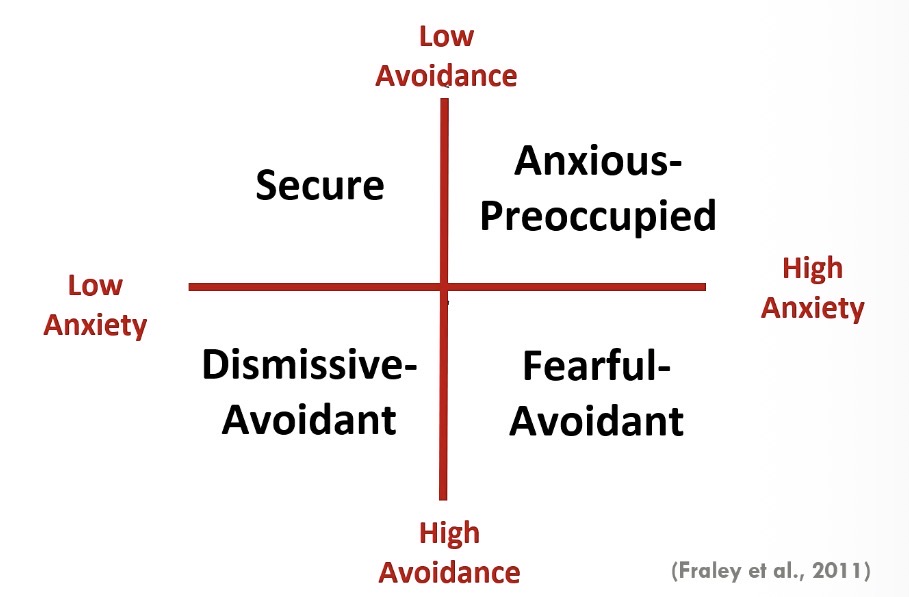
secure attachment
learned that proximity leads to support and protection, relief stress
turn to others when distressed
believe distress is manageable
more stable and satidfying relationships
dismissive-avoidant attachment
value self reliance and independent
Avoid seeking support when distressed
Expect relationship failure, averse to commitment
Relationships lack intimacy, keep partners at a distance
Feel higher levels of attraction when interacting with potential romantic alternatives
report feeling a sense of relief after break ups
anxious-preoccupied attachment
Hypervigilant about loss and rejection
When distressed, excessive reliance on others
Demanding of closeness, attention and approval
Intrusive, demanding, and overly disclosing
Hard time getting over break-ups
fearful-avoidant attachment
High anxiety: hypersensitive to potential hurt and rejection
High avoidance: withdraws when upset; avoid coping
Relatively poor personal and social adjustment
Difficulty expressing feelings
can we change?
more environment changes → more likely to change attachment
attachment style rahter stable over time - Hadiwijaya et al., 2020; Waldinger & Schultz, 2016
BUT new experiences matter for better or for worse
break-ups and new relationships - Fraley, 2019
become more secure with age - Chopik et al., 2019