Module 5 CHEM100
Scientific notation
The number that you put in the indicy spot is determined by how many places we move the decimal point. Eg
93,000,000 → 9.3, we move the decimal point 7 places so the exponent is 7
the scientific notation would be 9.3×10^7
The direction of movement determines whether the exponent of 10 is positive or negative (if its a big number it is positive, if it’s a small number it’s negative)
0.000167 → 1.67×10^-4 (as we moved the decimal point 4 places)
Conversion factor -
1 dozen = 12
how many doughnuts in 2 dozens?
2 dozen doughnuts x 12/1 dozen = 24 doughnuts
1 dozen = 12 doughnuts is equivalence statement
12/1 dozen = conversion factor
The conversion factor is a ratio of the two parts of the definition of a dozen (1 dozen = 12)
You can use this logic to convert any measurements.
1)
Convert 2.85cm to M:
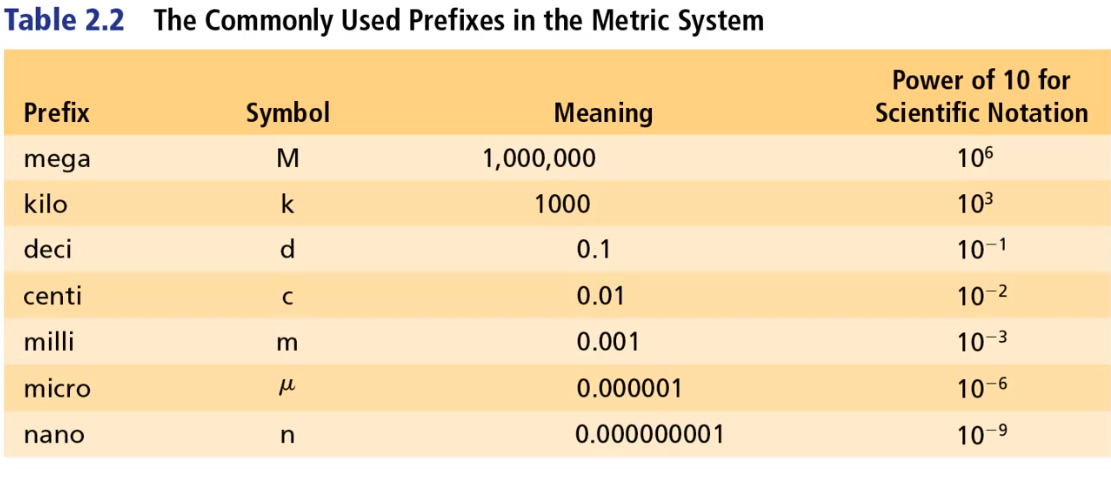
1cm = 0.01m (equivalent statement)
there are 2 conversion factors: 1cm/0.01m or 0.01cm/1m, as we are trying to find meters we need to put the cm in the denominator to get rid of it, so we will use 0.01cm/1m.
0.01m/1cm (conversion factor)
2.85cm×0.01m/1cm = 0.0285m (the cm cancel each other out)
2)
convert 285mg to kilograms
this is a 2 step conversion as there is no direct relation between mg and kg in the table above.
We want to convert mg to g first, and then g to kg.
1mg=0.001g (equivalent statement)
0.001g/1mg (conversion factor)
285mgx0.001g/1mg=0.285g
1g=0.001kg (equivalent statement)
0.001kg/1g (conversion factor)
0.285g×0.001kg/1g=0.000285kg
therefore 285mg = 0.000285kg
or 285mg is 2.85×10^-4 kg
3)
How long is 3215km in miles?
1 mile=1.609344km (equivalent statement)
1mile/1.609344km (conversion factor)
3215kmx1mile/1.609344km=1997.7
therefore 3215km is 1997.7miles
The Atomic Mass Unit (Amu)
Is a smaller unit of mass used for counting atoms.
Individual atoms are far too small to see and have very tiny masses so scientists created a unit to avoid using very small numbers.
The mass of a single carbon atom is 1.99×10^-23g(0.0000000000000000000000199g). The normal units of mass (g, kg) are too large to be convenient. We must learn to count atoms be weighing samples containing large numbers of them. A much smaller unit of mass is therefore defined as the atomic mass unit (amu).
1 atomic mass unit (amu) = 1.66×10^-24 g
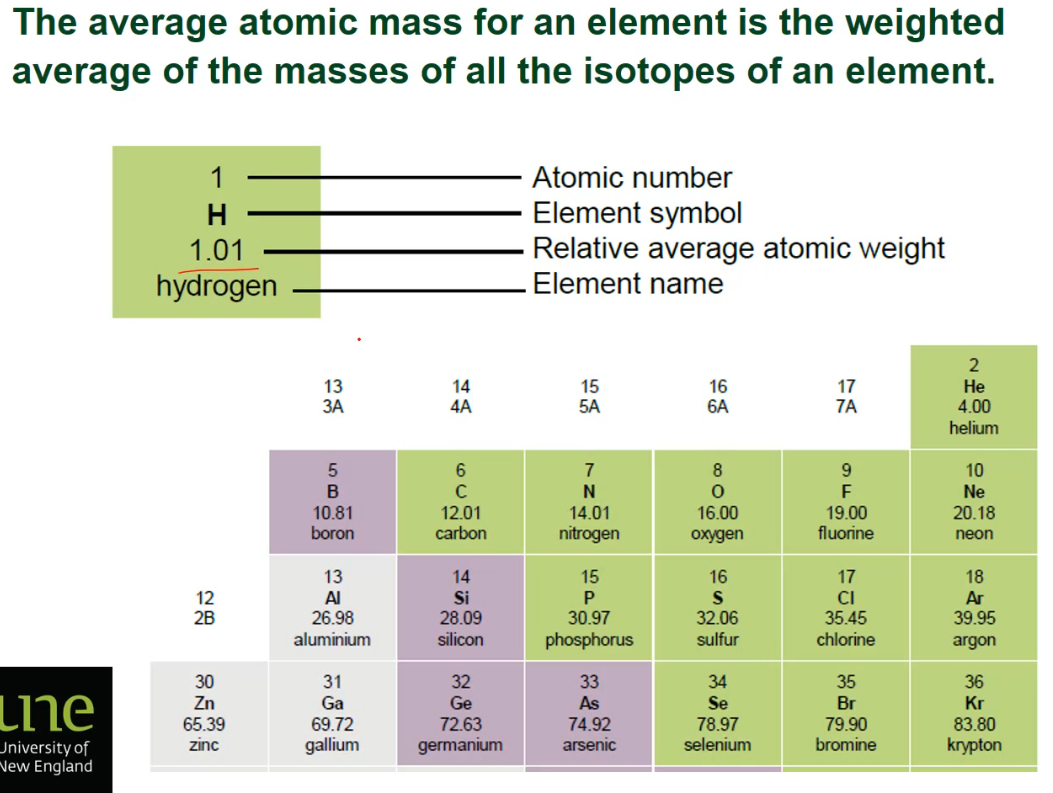
The average atomic mass for an element is the weighted average of the masses of all the isotopes of an element. Each isotope has a slightly different mass.
Even though natural carbon does not contain a single atom with mass 12.01 amu, for our purposes we can treat carbon as though it is composed of only one type of atom with a mass of 12.01 amu.
This enables us to count atoms of natural carbon by weighing a sample of carbon.
Taking into account the relative abundance of all of the different weights of the carbon isotopes, the average weight is 12.01 displayed on the periodic table.
The average atomic mass for an element is the weighted average of the masses of all the isotopes of an element.
All the elements as found in nature typically consist of a mixture of various isotopes. So to count the atoms in a sample of a given element by weighing, we must know the mass of the sample and the average mass for that element.
Worked examples using atomic mass units:
Calculate the mass (in amu) of 431 atoms of carbon.
1 carbon atom = 12.01 amu (equivalent statement)
431 C atoms x 12.01amu/1 C atom = 5176 amu
Calculate the number of carbon atoms present in a sample of natural carbon weighing 3.00×10^20 amu.
3.00×10^20 amu x 1 C atom/12.01 amu = 2.5×10^19 carbon atoms
Samples in which the ratio of the masses is the same as the ratio of the masses of the individual atoms always contain the same number of atoms.

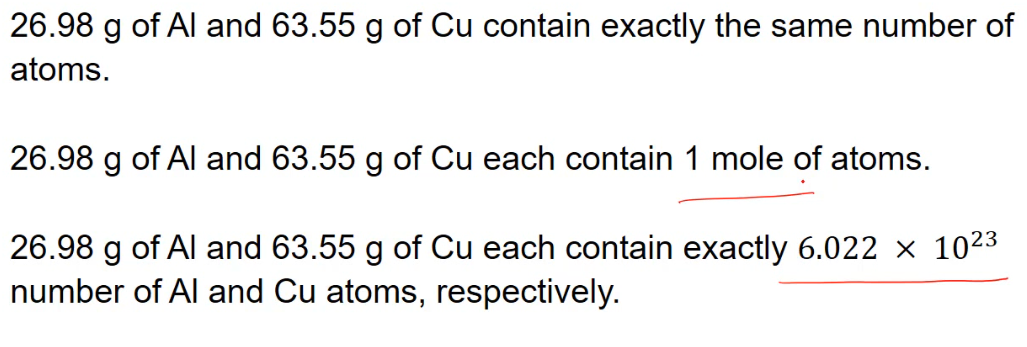
The ratio of Al:Cu, is 26.98:63.55. To get the same number of copper atoms as aluminium, you would need 63.55g.

Samples in which the ratio of the masses is the same as the ratio of the masses of the individual atoms always contain the same number of atoms.

This number (described above) is called the mole.
The mole is the unit all chemists use in describing numbers of atoms. The mole is defined as the number equal to the number of carbon atoms in 12.01 grams of carbon.
In 12.01 grams of carbon, there are 6.022×10^23 atoms. This number is called Avogadro’s number.
One mole of anything consists of 6.022×10^23 units of that substance.
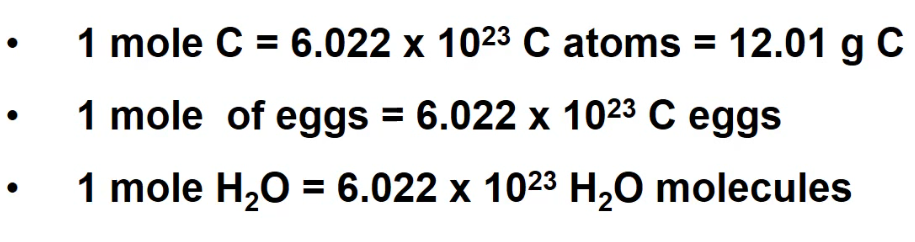

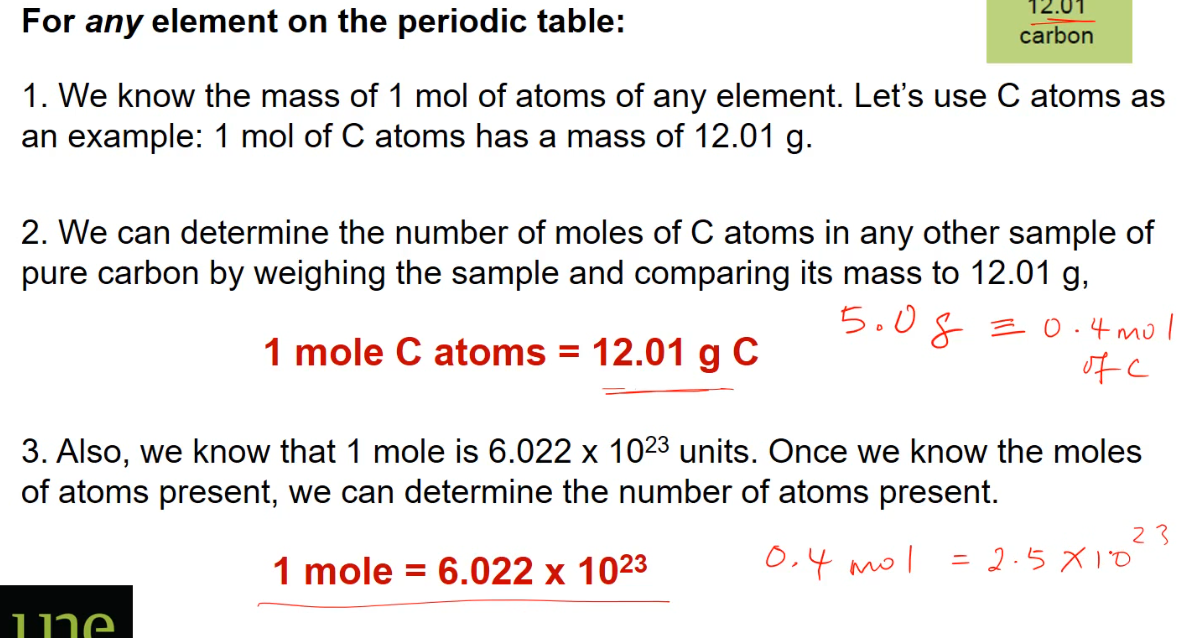
Using the mole, we can calculate many things about molecules including:
Mol<→atoms
Mol<→mass
1)
Determine the number of nitrogen atoms in a 14.01g sample of nitrogen.
=6.022×10^23 atoms
Or 1 mole of nitrogen atoms.
2)
Calculate the number of moles of atoms and the number of atoms in a 10.0g sample of aluminium.
a) number of moles
10/26.98 = 0.371
0.371 moles
b) number of atoms
0.371 x (6.022×10^23) = 2.23×10^23 atoms
3)
A silicon chip used in an integrated circuit of a microcomputer has a mass of 5.68mg. How many silicon atoms are present in this chip? The average atomic mass for silicon is 28.09.
1g=1000mg
0.00568
0.00568/28.09= 0.000202
0.000202x(6.022×10^23) = 1.22×10^20 atoms
Molar mass -
A chemical compound is fundamentally a collection of atoms. Most elements are too reactive to be found in the uncombined from in nature. They often exist as bi-molecular molecules or compounds.
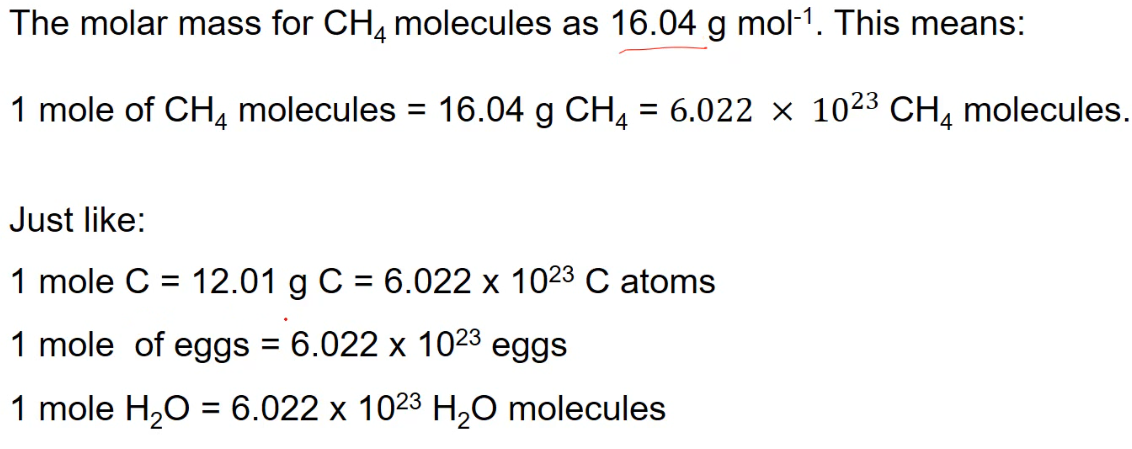
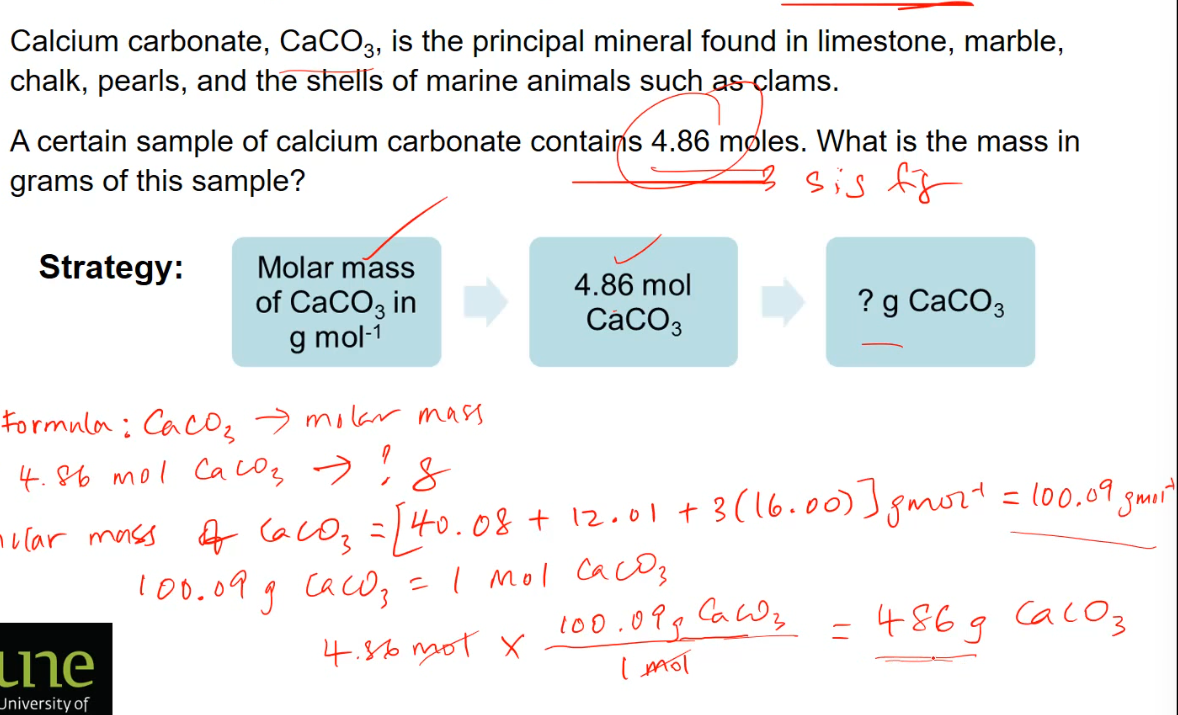
The mass of 1 mole of a compound is the molar mass of that compound. The molar mass of any substance is the mass (in grams) of 1 mole of the substance. The unit is g mol^-1 (g/mol).
Lets consider the methane, CH4, the major component of natural gas. Each methane molecule consists of 1 carbon atom and 4 hydrogen atoms.


(in the example above the amu for hydrogen is 1.008 which is why it’s displayed as that in the example, know that in our periodic table it is displayed as 1.01)
Find the molar mass of sulfur dioxide.
Sulfur dioxide = SO2
S = 32.065
O = 15.999
Molar mass = 32.065 + (2×15.999) = 64.063 g/mol, or 64.063 g mol^-1

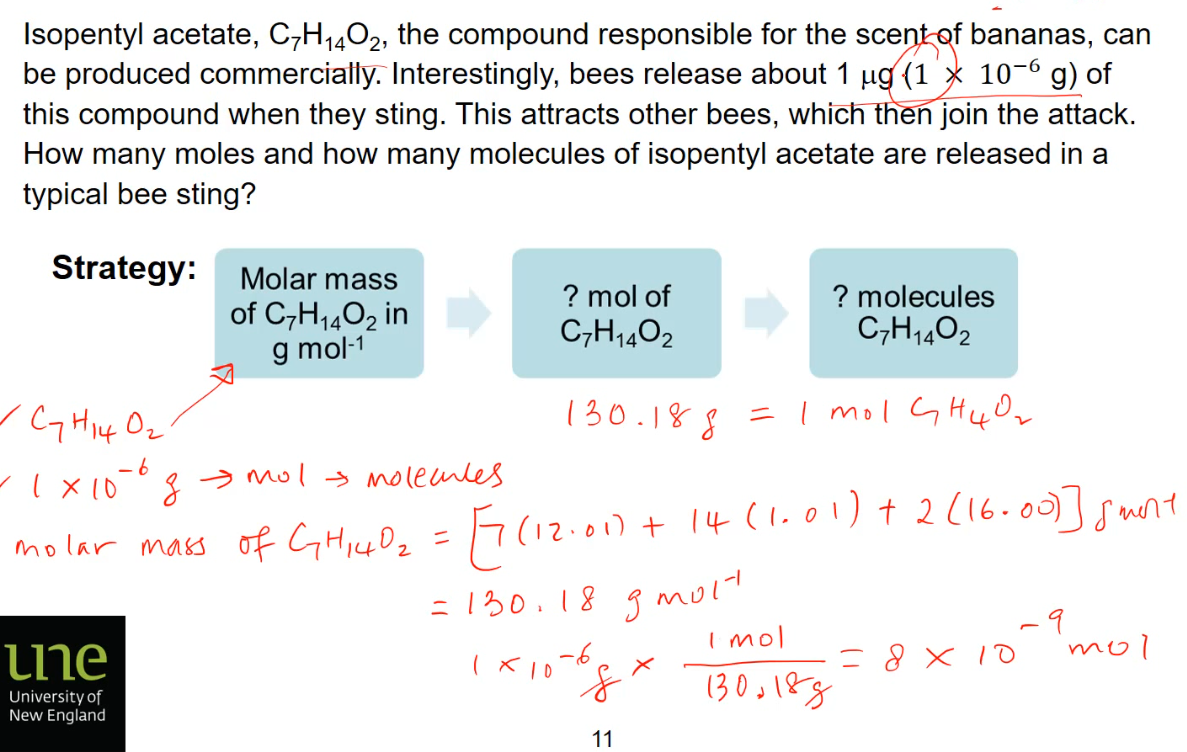
Answer displayed in 1 sig fig as the question displays the grams as 1×10^-6g

In the first slide we are figuring out how much Isopentyl acetate is being released, but the question is asking for how many molecules. So we need to multiply the moles by Avogadro’s number to find the exact number of molecules being released (slide 2).
Percentage composition of Compounds-
When calculating the percentage composition of each element in a compound, you must use the actual mass of each element not just the subscript amount in the chemical formula. Eg.
Calculate the percentage composition of each element in CH4.
Wrong way)
C = 20%
H - 80%
This is wrong as each element weighs a different amount, we are not calculating the ratio of carbon to hydrogen atoms, we are calculating the overall percentage.
Correct way)
C = 12.01
H = 1.01 = 4×1.01 =4.04
12.01 + 4.04 = 16.05
C = 12.01/16.05 = 0.75 = 75%
H = 4.04/16.05 = 0.25 = 25%
When finding the percentage composition of compounds with polyatomic ions present, you must split the polyatomic ions into their elements. eg.
Calculate the percentage composition of each element in Ethanol (C2H5OH).
C = 2×12.01 = 24.02g
H = 6×1.01 = 6.06g
O = 1×16 = 16g
24.02+6.06+16 = 46.07 = molar mass.
C = 24.02/46.07 = 0.5214 = 52.14%
H = 6.06/46.07 = 0.1315 = 13.15%
O = 16/46.07 = 0.3473 = 34.73%
Information given by chemical equations -
Chemical changes are actually rearrangements of atoms groupings that can be described by chemical equations.
The coefficients in a balanced equation give us the relative numbers of molecules.
A balanced chemical equation tells us:
-the identities (formulas) of the reactants and products
-how much of each reactant and product particles in the reaction
We are interested in the ratio of the coefficients, not individual coefficients.
C2H8(g) + 5O2(g) → 3CO2(g) + 4H2O(g)
In terms of molecules: 1 molecule of C3H8 reacts with 5 molecules of O2 to give 3 molecules of CO2 and 4 molecules of H2O.
In terms of number of moles (of molecules): 1 moles of C3H8 reacts with 5 moles of O2 to give 3 moles of CO2 and 4 moles of H2O.
As 1 mole = 6.022×10^23.
6.022×10^23 C3H8 molecules reacts with 5(6.02×10^23) O2 molecules to give 3(6.02×10^23) CO2 molecules and 4(6.02×10^23) H2O molecules.
A balanced equation can predict the moles of product that a given number of moles of reactants will yield.

Above we found out by how much we need to multiply the water to get 4 moles of it and multiplied the entire equation by that much to find how many products we will get.
We can use balanced equation toi:
Determine the mole ratio - predict the number of moles of products that a given number of moles of reactants will yield.
Using mole ratios in calculations - determine the number of moles of reactants required to react to produce a given number of moles of products.

Above, the 1mol O2/2mol H2O is the mole ratio


Stoichiometry is the process of using a balanced chemical equation to calculate the relative masses of reactants and products involved in a reaction.
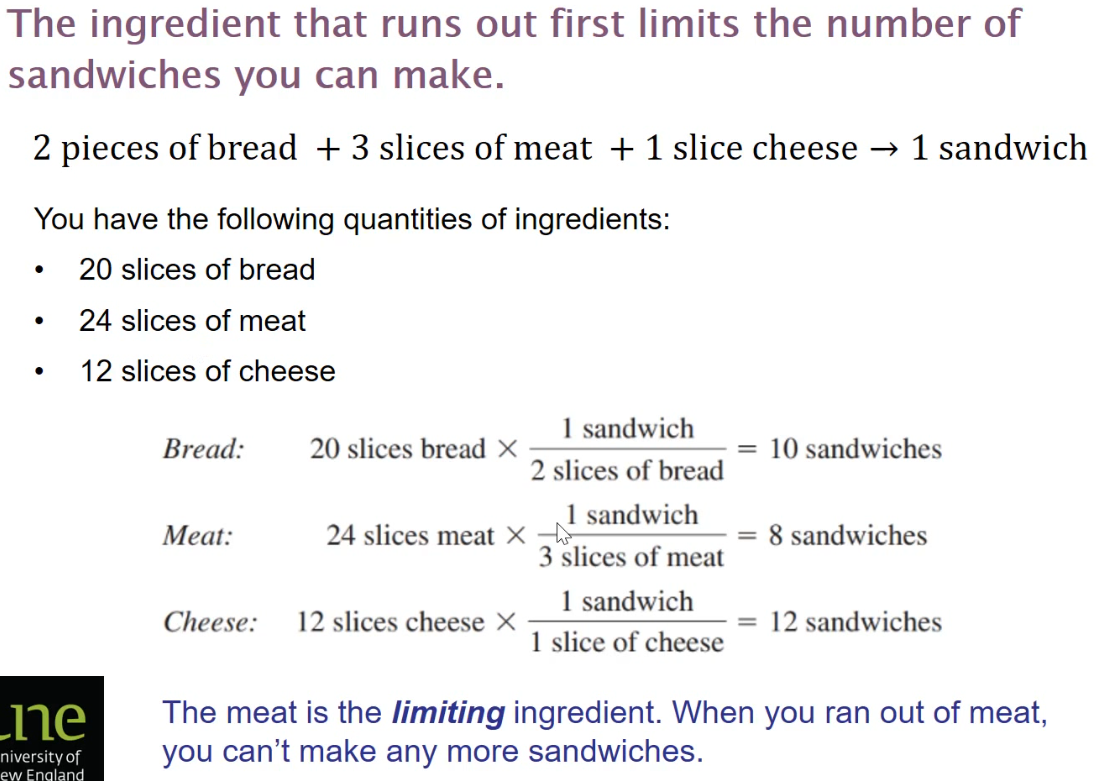


To determine how much product can be formed from a given mixture of reactants, we have to look for the reactant that is limiting - the one that runs out first and thus limits the amount of product that can form.


Use the ratio of moles to calculate the amount of products are created from all reactants.
Whichever produces the lower amount of products is the limiting reactant.
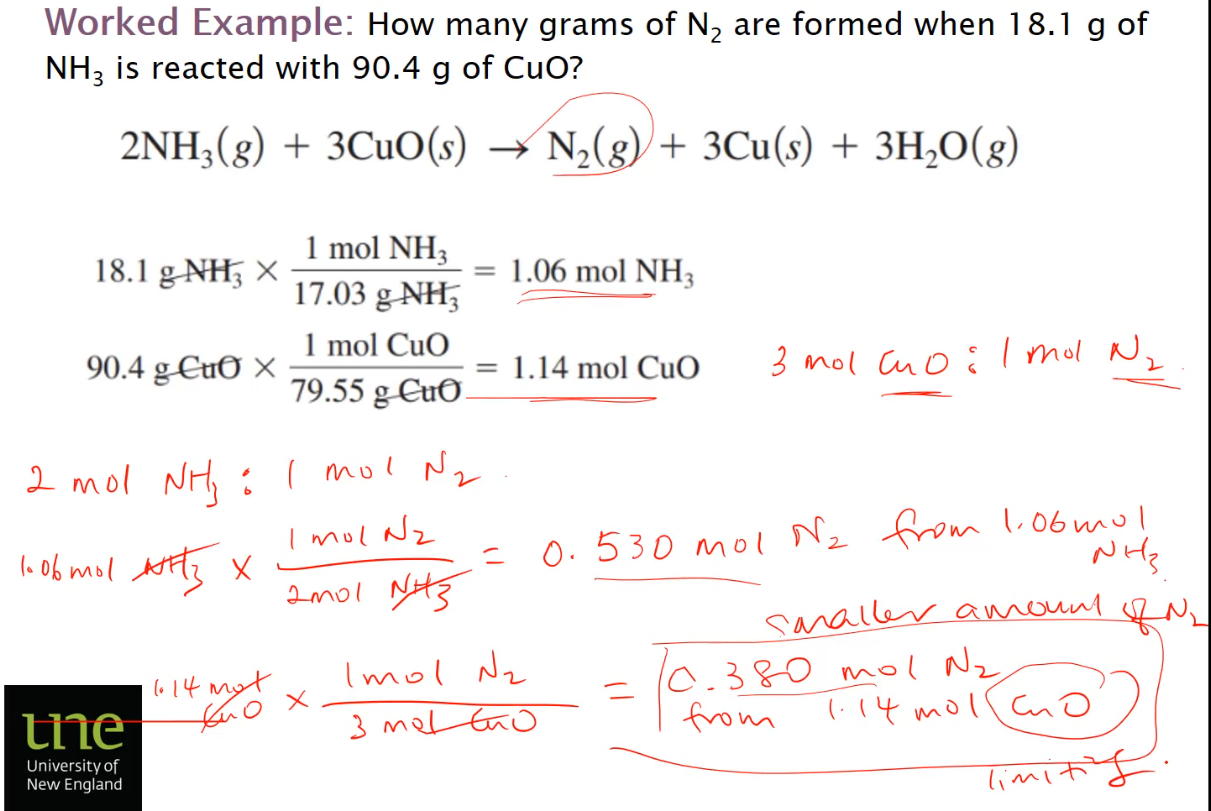

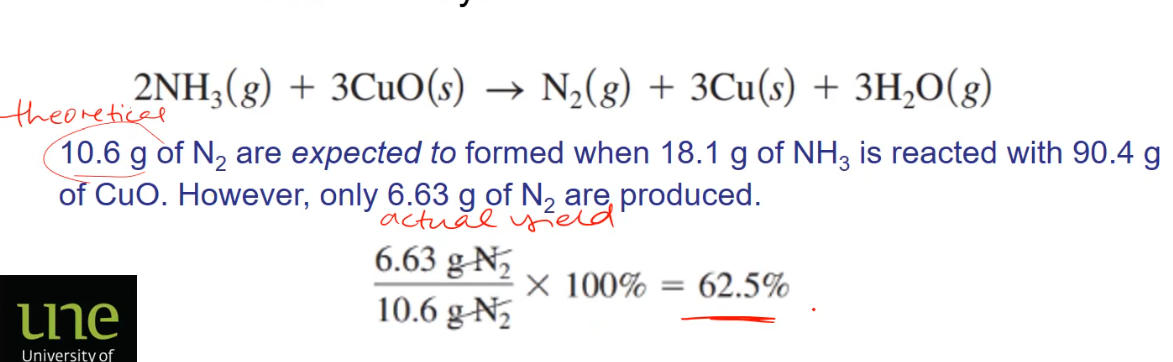
Percentage yield - an important indicator of the efficiency of a particular laboratory or industrial reaction.
Theoretical yield - the maximum amount of a given product that can be formed when the limiting agent is completely consumed.
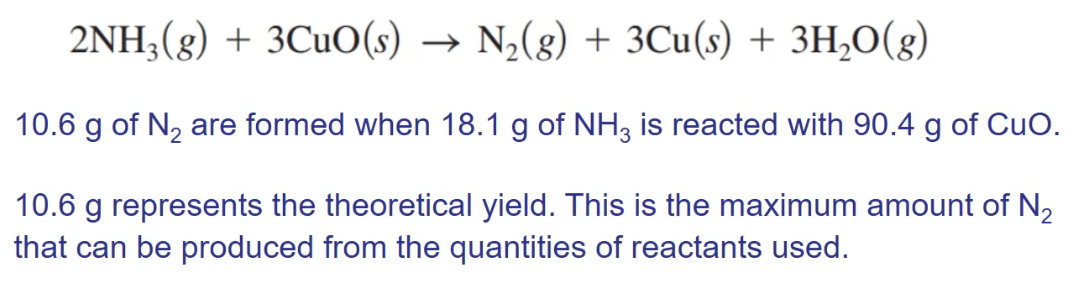
Actual yield - the amount actually produced from a reaction is usually less than the maximum expected (theoretical yield)
Percentage
yield - the actual amount of a given product as the percentage of the theoretical yield