energy transfer during long duration/ lower intensity exercise
exercising for long periods of time = uses aerobic energy system
this is because at low intensity exercise, the demand for oxygen can be easily met and glucose can be easily broken down much more efficiently when oxygen is present
FATS are used for energy at low intensity, but as intensity increases usage becomes limited because they require more oxygen than glucose in their breakdown, as soon as oxygen supplies become limited, fat use for energy drops
OXYGEN CONSUMPTION DURING EXERCISE (MAXIMAL AND SUB-MAXIMAL OXYGEN DEFICIT)
when we exercise the body uses oxygen to produce energy (resynthesises ATP)
oxygen consumption = the amount of oxygen we use to produce ATP and is usually referred to as VO2.
At rest we consume oxygen at a rate of 0.3/4 litres per minute
during the start of exercise we require more oxygen to provide more ATP so our oxygen consumption increases
intensity increases = so does oxygen consumption until a performer reaches maximal oxygen consumption which can be 3-6 litres per minute
THIS IS OUR VO2 MAX!!! which is the maximum volume of oxygen that can be taken up and used by the muscles per minute
when we start exercise, insufficient oxygen is distributed to the tissues for all energy to be provided aerobically, this is because it takes time for the circulatory system to respond to the increase in demand for oxygen and it can also take time for the mitochondria to adjust to the rate of aerobic respiration needed
As a result, energy is provided anaerobically to satisfy the increase in demand for energy until the circulatory system and mitochondria can cope
this is referred to as SUB-MAXIMAL OXYGEN DEFICIT
Maximal oxygen deficit is often referred to as maximal accumulated oxygen deficit of MAOD
gives an indication for anaerobic capacity
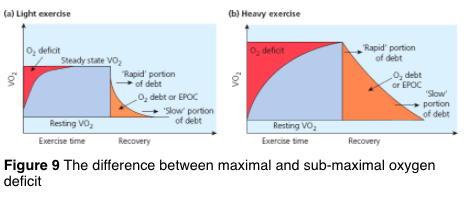
oxygen deficit is bigger during maximal exercise as the performer is short of more oxygen at the start as they have to work more anaerobically, hence the idea of maximal accumulated oxygen deficit
OXYGEN CONSUMPTION DURING RECOVERY (EXCESS POST-EXERCISE OXYGEN CONSUMPTION - EPOC)
recovery involves returning the body to its pre existing state
when a performer finishes exercise, the oxygen consmuption will still remain relatively high in comparison to it at rest
this is becasue extra oxygen needs to be taken in to pay of the oxygen debt that has built up and help the peroformer recover (EPOC)
there are TWO main components of EPOC
Fast component
Slow component
Fast component - fast replenishment stage uses the extra oxygen that is taken in to restore ATP and phosphocreatine, alongside to resaturate myoglobin with oxygen
complete restoration of ATP takes about 3 minutes but 50% of stores can be replenished after only 30 seconds, during which approx 3 litres of oxygen is ocnsumed
myoglobin has a high affinity for oxygen (degree to which a substance binds to oxygen), it stores oxygen in the sarcosplasm that has diffused from the haemoglobin in the blood, after exercise, oxygen stores in the myoglobin are limited.
Surplus of O2 given by EPOC helps replenish these stores, taking up to 2 minutes and using 0.5 litres of oxygen
Slow component
The oxygen consumed during the slow component (slow replenishment stage) sometimes referred to as the lactacid component has SEVERAL FUNCTIONS
removal of lactic acid
maintenance of breathing and heart rates
glycogen replenishment
increase in body temperature
removal of lactic acid
Lactic acid accumulates during exercise, needs to be removed in recovery
full recovery may take up to an hour or longer, depending on the intenisty and duration. Lactic acid can be removed in these ways:
when o2 present, lactic acid can be converted to pyruvate and oxidised into carbon dioxide and water in the inactive muscles and organs, this can then be used by the muscles as an energy source.
Transported into the blood to the liver where it is converted to blood glucose and glycogen (the cori cycle)
converted into protein
removed in sweat and urine
The majority of lactic acid can be oxidised in mitochondria so performing a cool down can accelerate its performance
this is because the metabolic rate of the muscles are kept high and capillaries dilated from exercise, which means the oxygen can be flushed through