Intro to Seed Plants : Gymnosperms and Seed Plants
Kingdom Plantae: Seed Plants Overview
Introduction to Seed Plants
Major Groups: Gymnosperms and Angiosperms (Coniferophyta and Anthophyta)
Characteristics: Seed plants are vascular plants that are heterosporous and have developed pollen and seeds as adaptations for life on land.
Classification of Seed Plants
Phylogenetic Organization:
Land plants (Embryophyta) include:
Vascular tissue
Dominant sporophyte generation
Development of seeds, pollen, and flowers.
Non-vascular plants like mosses and ferns are less evolved than seed plants.
Gymnosperms / Conifers
Characteristics:
Photosynthesis: autotrophic, reliant on sunlight.
Adapted to dry environments with water stress adaptations.
Growth: Woody structure, can grow larger than Pterophyta; examples include:
Old Tjikko (Norway Spruce): 9,500 years old.
Alerce Milenario, Chile: over 5,000 years old.
Reproductive Adaptations of Gymnosperms
Heterosporous: Meiosis produces two types of spores:
Megaspores (female)
Microspores (male)
Endosporous: Male gametophyte (pollen) develops inside microspore, female gametophyte develops within the ovule on the sporophyte (parent).
Pollen Grains: Contain microgametophyte; crucial for fertilization.
Seeds: Mature ovule contains the next generation's embryonic plant (sporophyte).
Essential reproductive transitions with minimal developmental changes following fertilization:
Zygote Mature sporophytes.
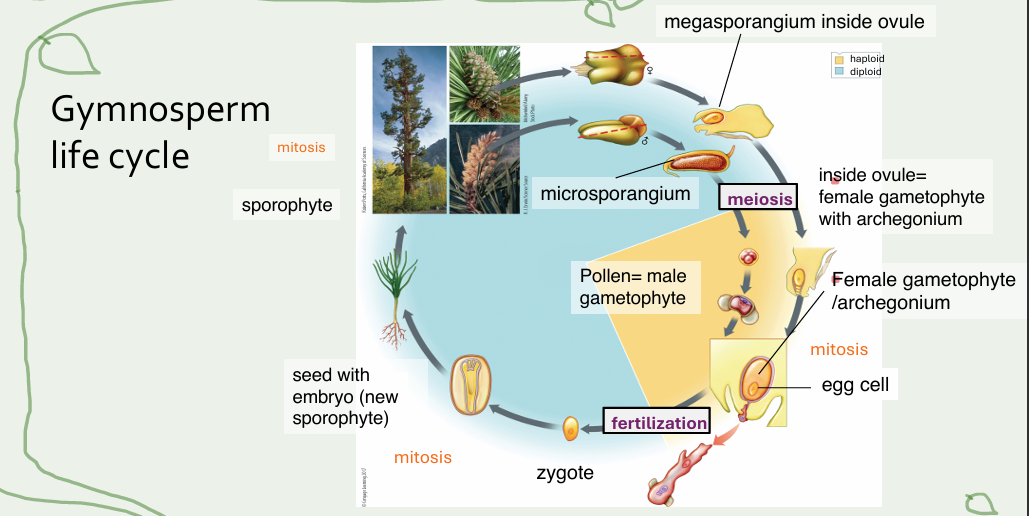
Life Cycle of Gymnosperms
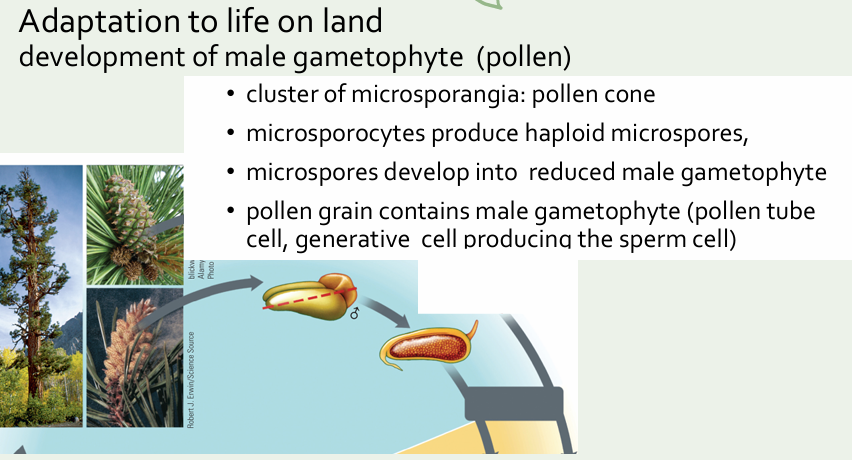
Male Gametophyte Development:
Formed from microsporocytes in clusters known as pollen cones:
Microsporocytes undergo meiosis, producing haploid microspores.
Microspores develop into reduced male gametophytes within pollen grains that consist of:
Pollen tube cell
Generative cell (generates sperm).
Female Gametophyte Development:
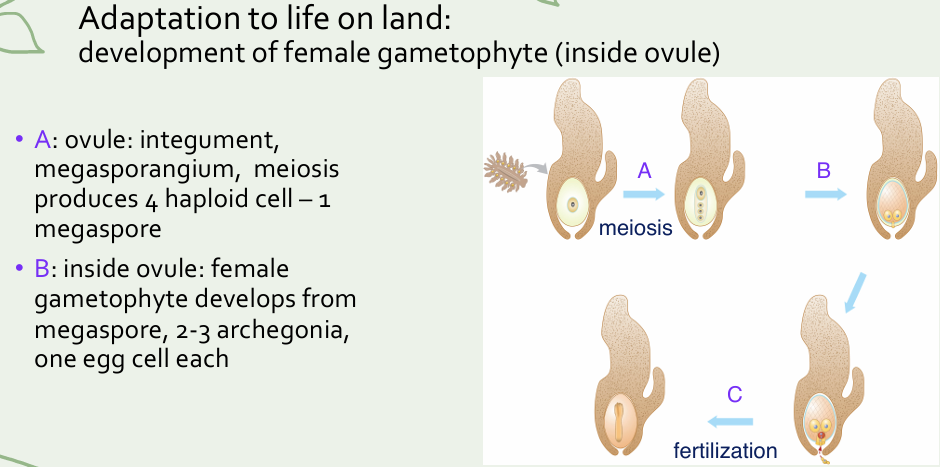
Involves the following steps:
Ovules consist of integument and megasporangium, where meiosis produces 4 haploid cells, of which 1 becomes the megaspore.
In the ovule, female gametophyte emerges from the megaspore, resulting in 2-3 archegonia (structures where egg cells develop).
Pollination and Fertilization Process:
Megasporocyte (2n) divides into 4 haploid cells; 1 megaspore develops into female gametophyte.
Archegonia: Eggs are fertilized by two sperm cells from the pollen tube:
Pollination occurs when pollen reaches the ovule, germinates, and forms a pollen tube that penetrates the megasporangium.
Gymnosperm Diversity
Key Groups: Four phyla classified as gymnosperms, characterized by 'naked seeds':
Cycadophyta
Ginkgophyta
Gnetophyta
Coniferophyta
Economic Importance: Coniferophytes significantly impact forestry, with species such as Lodgepole Pine, Jack Pine, and White Spruce being essential economically.
Summary of Gymnosperms
Gymnosperms possess adaptations critical for terrestrial life: pollen and seeds.
Pollen is defined as a reduced male gametophyte containing a tube cell and two sperm nuclei.
Seeds represent a mature ovule housing a dependent gametophyte featuring an integument that includes the embryo from fertilized eggs (female gametophyte tissue).
Within the Coniferophyta, economically important species predominantly exhibit woody structures; softwoods such as pine and spruce are prevalent in cooler, drier climates.