B1.01 Characteristics of living organisms
Movement:
Respiration:
Sensitivity: the ability to detect and respond to changes in the internal or external environment
Growth: a permanent increase in size and dry mass
Reproduction: the processes that make more of the same species of organism
Excretion: the removal of waste products of metabolism and substances over requirements
Nutrition: the taking in of materials for energy, growth, and development
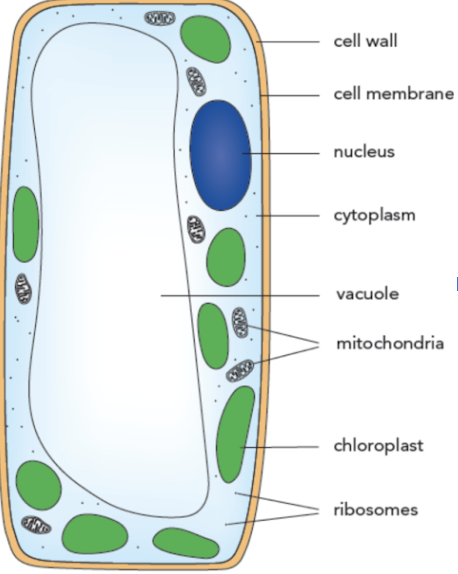
B1.02 Cell structure
Cell | Function | Animal/plant/bacteria |
Cell membrane | controls what going in and out of the cell, partially permeable, and holds cell components together | all |
Cell wall | protect and support the cell, made of cellulose, permeable | plant, bacteria |
Cytoplasm | take place metabolic reactions, clear jelly, mostly made of water | all |
Vacuole | keep the cell shape, surrounded by membrane, contains a solution of sugars and cell sap | plants/animals (vesicles)
|
Nucleus | contains genetic material and controls the cell activities | plant/animal |
Chloroplasts | contain chlorophyll, photosynthesis takes place in | plant |
Mitochondria | aerobic respiration takes place, the main way in which cells get the energy they need to stay alive | plant/animal |
Ribosome | where the cell makes proteins/protein synthesis | all |
Plasmid | small rings of DNA | bacteria |
DNA strand | single circular strand of free-floating DNA | bacteria |

B1.03 Specialised cells
Specialized cells
specialised cells | where it is found | function | adaptation |
root hair cell | tip of the roots of flowering plants | absorption of water/mineral ions | root hair cells greatly increase the surface area of the roots => increase the movement of water into the cell.
the presence of a permanent vacuole in these cells increases the speed of osmosis
have many mitochondria to increase the energy available for the active transport of mineral ions
|
palisade cell | leaves of flowering plants | photosynthesis | Chloroplasts: photosynthesis
A tall shape: large surface area exposed to absorbing Carbon Dioxide
A thin shape: many cells can be fitted at the top of the leaf => nearer the light. |
red blood cell | in blood | carry/transport hemoglobin/oxygen | No nucleus: more room for the cell to carry more oxygen
Biconcave Disc Shape: larger surface area over which oxygen is absorbed
Haemoglobin: red pigment in the cell /component that binds and carries oxygen |
ciliated cell | lining trachea/bronchi | moves mucus upwards | Hair-like structures called cilia: move substances along surfaces. |
neurone | nervous system | conduct electrical impulses | Axon: Long thin cytoplasm fibres stretching the length of the cell
Dendrites: Short fibers that allow it to pass the signal to other neurons. |
sperm cell | testes | male gamete in reproduction | Long tail: helps it swim through the female reproductive system.
Mitochondria: provide energy for the cell to move
Acrosome: release enzymes to pierce/digest the jelly coat of the egg cell |
egg cell | ovary | female gamete in reproduction | Cell membrane: after fertilization, it changes to prevent more sperm from entering |
Bacterial cells
=> Bacterial cells: unicellular organisms whose cells do not contain a nucleus
Always have a cell wall (the cell wall is not made of cellulose like plant cells)
Have cell membranes, cytoplasm, and ribosomes but do not have mitochondria and chloroplasts.
AKA prokaryotic cells, inside a nucleus, bacteria have a circle of DNA or bacterial chromosomes. The DNA provides instructions for making proteins.
B1.04 Sizes of specimens
Sizes of specimens
I = AM
Size of image = size of actual object * magnification
1000 micrometer = 1 millimeter