Complete Dominance
Quick Review on Mendel:
^^Key Person:^^
Gregor Mendel: Austrian monk who bred thousands of pea plants and collected evidence on inheritance and how traits are passed down through generations.
- ^^cross-fertilized^^ pea plants and collected seeds of offspring
- kept records of what traits ^^were present in offspring^^
- concluded that genetic info is passed down in ^^small units of hereditary information,^^ called genes.
Complete Dominance:
Complete dominance is when a gene's dominant allele ^^fully masks^^ the recessive allele's effects.
What are alleles?
Alleles are ^^different^^ forms of a gene found on the ^^same locus^^ on two chromosomes, usually represented by letters (ex: AA, Aa, aa).
→ Locus: location of a gene on a chromosome
Dominant? Recessive?
Dominant genes in Mendelian genetics are the genes that prevail in a ^^heterozygous^^ situation (ex: Aa)
→ usually represented by a capital letter (A)
Recessive genes are the genes that only have their effects shown when in a ^^homozygous^^ form (ex: aa)
→ shown by lowercase letters (a)
Back to complete dominance…
Here’s an example to understand…
In flowers, having purple flowers is a dominant trait, while having white flowers is recessive.
Crossing a purple flower breeding true for the trait with a white flower that breeds true has offspring that?
→ Breeding true: all offspring will present the ^^same trait as the parent^^ (white flower breeding true means that all their offspring will be white (think of it as a ^^purebred^^, with a homozygous form like aa))
<<Result:<<
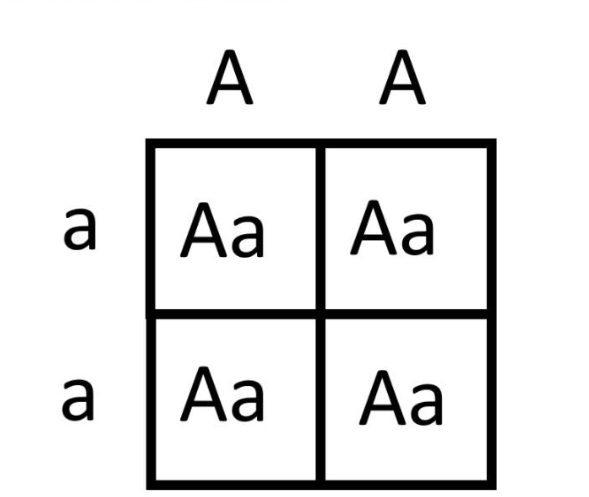
The offspring’s phenotype is their purple flowers, but their genotype is Aa (heterozygous).
Genotype? Phenotype?
Genotype: the ^^set of alleles^^ an organism has (ex: AA, Aa, or aa)
Phenotype: ^^physical trait^^ presented in an organism (purple or white flowers)
Punnett Square:
Practice Problems!
#1: Having brown eyes is a dominant trait (represented with a big B), and having blue eyes is recessive (b). If a mom heterozygous for eye color has a kid with a man with blue eyes, what are the chances that their baby will have blue eyes?
→scroll down for answers, don’t peek :)
ANSWER: There is a 50% chance that their baby will have blue eyes.
WORK:
If mom is heterozygous for eye color, then her genotype is Bb (that’s brown eyes!)
If dad has blue eyes, his genotype is bb.
CROSS THEM WITH A PUNNETT SQUARE:
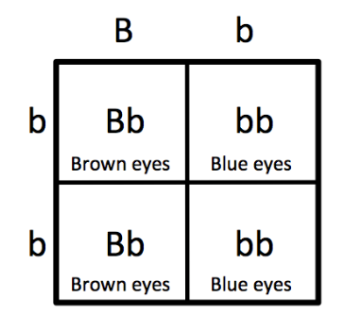
Now, we are looking for the chances for the baby to have blue eyes.
This means we look for the genotype bb. In the Punnett square, we see two out of the 4 squares have this genotype. This means there is a 2/4 chance the baby will have blue eyes, or 50%!
#2: True or False: If a homozygous brown-eyed man had a baby with a blue-eyed woman, all of their babies would have brown eyes. (use B or b for alleles like before)
→scroll down for answers, don’t peek :)
ANSWER: TRUE, all offspring would have brown eyes.
WORK:
A woman homozygous for brown eyes has a genotype of BB, and a man with blue eyes has bb.
PUNNETT SQUARE:
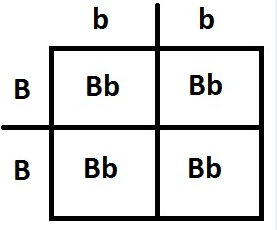
Due to complete dominance, that one big B allele masks the effects of the blue-eyed allele (b). This means all babies will have brown eyes.
#3 (last one!): Now that you know all the babies in the problem above have brown eyes, cross one of those offspring with a homozygous brown-eyed person. Will they ever have a kid with blue eyes?
→scroll down for answers, don’t peek :)
ANSWER: No! They will never have a blue-eyed child.
WORK:
The offspring has a genotype of Bb.
A homozygous brown-eyed person has a genotype of BB.
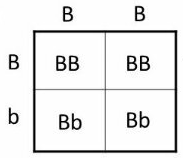
We have to look for a bb to see if they will have blue-eyed kids in a Punnett Square.