The eye
Human eye structure:
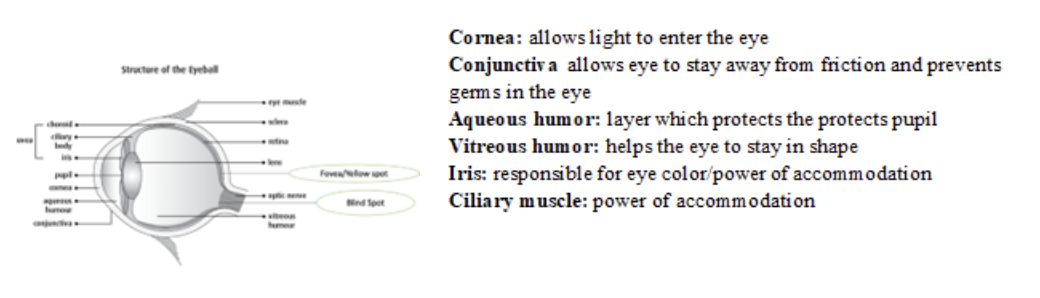 Cornea: allows light to enter the eye
Conjunctiva : allows eye to stay away from friction and prevents germs in the eye
Aqueous humor: layer which protects the protects pupil
Vitreous humor: helps the eye to stay in shape
Iris: responsible for eye color/power of accommodation
Ciliary muscle: power of accomodation
Fovea/yellow spot à cone cells identifies colors, wavelength of light
Retina à red cells: intensity of light
Retina: picture (actually sees)
Black spot/blind spot: if the light enters the blind spot and not the retina, then the person will not be able to see
Blind spot has optic nerve which connects to the retina by electric signal which connects to the occipital lobe of the brain
Power of accommodation:
how our eyes adjust and accommodate to the light
ability of the eye to change its focus from objects which are far away to objects which are closer
the adjustment is possible due to the ciliary muscles which changes the shape of the eye
when the object is close by, the ciliary muscles stretch apart (pupil has less diameter)
when the object is far away the muscles relax and the pupil size increases (pupil has more diameter)
Photoreception: The mechanism when the eye detects the light around the eye. The image is later interpreted by the brain. Rods and cones are photoreceptors are located in the retina.
Photoreception is the mechanism of light detection (by the eyes) that leads to vision when interpreted by the brain
Rods and cones are photoreceptors located in the retina
Light is absorbed by specialized photoreceptor cells in the retina, which convert the light stimulus into nerve impulses
There are two different types of photoreceptors located within the retina – rod cells and cones cells
These cells differ in both their morphology (shape) and function
Rods and cones differ in their sensitivities to light intensities and wavelengths