Membrane Potential
MEMBRANE POTENTIAL: the difference in the electrical potential between the inside and outside of the cell
SEPARATION OF CHARGES: difference of positive and negative ions in ECF and ICF
separation of positive and negative charges has the potential to generate energy/do work
extracellular fluid (ECF: outside cell) and intracellular fluid (ICF: inside cell) are separated by the plasma membrane
3 main ions set up resting membrane potential
sodium (Na+)
potassium (K+)
anionic protein (A-)
Na is more concentrated in the ECF (outside of the cell) than ICF
K is more concentrated in the ICF (inside of cell) than ECF
This is maintained by sodium potassium pumps as well as the membrane’s permeability to respective Na and K ions
Concentration and Permeability of Ions Responsible for Membrane Potential in a Resting Nerve Cell (millimoles/litre)
Ion | Extracellular | Intracellular | Relative Permeability |
Na+ | 150 | 15 | 1 |
K+ | 5 | 150 | 50-75 |
A- | 0 | 65 | 0 |
higher elative permeability shows that it is easier for K+ to move into the cell, than for Na+ to move out of the cell
less sodium leak channels, therefore less relative permeability. more potassium leak channels, therefore more relative permeability
anionic protein is mainly concentrated in cellular fluid, it has no relative permeability because of its large size and negative charge
therefore no movement, as it is impermeable to the plasma membrane
Effect of K+ Only on Membrane Potential
concentration gradient for potassium moves it OUT of the cell (positive charge attracted to negative)
when K+ moves, the outside of cell becomes more positive (gaining positive charge), while inside more negative (losing positive charge)
electrical gradient as a result of this will tend to move K+ back into the cells
only when the inward electrical gradient exactly counters the outward concentration gradient will K+ movement stop
equilibrium potential for K = -90 mV
Effect of Na+ Only on Membrane Potential
concentration gradient for sodium moves it INTO the cell (positive charge attracted to negative)
when Na+ moves, the cell becomes more positive (gaining positive charge), while the ECF will become more negative (losing positive charge)
electrical gradient as a result of this will move Na+ back out of the cell
only when outward electrical gradient exactly counters the inward concentration gradient will Na+ movement stop
equilibrium potential for Na = +60 mV
Resting Membrane Potential
in reality, movement of both Na+ and K+ at the same time will determine membrane potential
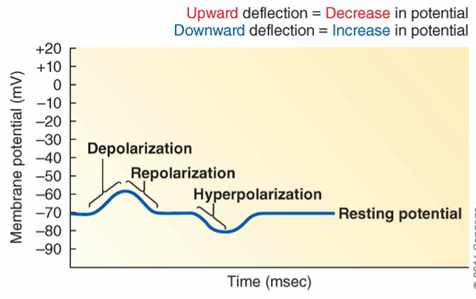
resting membrane potential = -70 mV
EP K+ -90 mV + EP Na+ 60 mV = -30, so why -70 mV?
due to ion/leak channels; elements permeability to membrane differ
anionic proteins are also trapped inside the cell, keeping its negative charge inside
Changes in Membrane Potential
Polarization: has charge different than 0 mV, whether positive or negative, has any charge
Depolarization: taking on more positive charges, membrane potential will get closer to 0
Repolarization: returning to resting membrane potential, becoming more negative after depolarization
Hyperpolarization: membrane potential becomes more negative than resting membrane potential