Lecture 14: Periodicity of the elements (Ionization energy and electron affinity)
Ionization Energy
Minimum energy needed to remove an electron from a gaseous atom.
Endothermic process.
Valence electron is the easiest to remove.
First ionization energy () = energy to remove an electron from a neutral atom.
Second ionization energy () = energy to remove an electron from a +1 ion; and so on.
General Trends in First Ionization Energy
The larger the effective nuclear charge on the electron, the more energy it takes to remove it.
The farther the most probable distance the electron is from the nucleus, the less energy it takes to remove it.
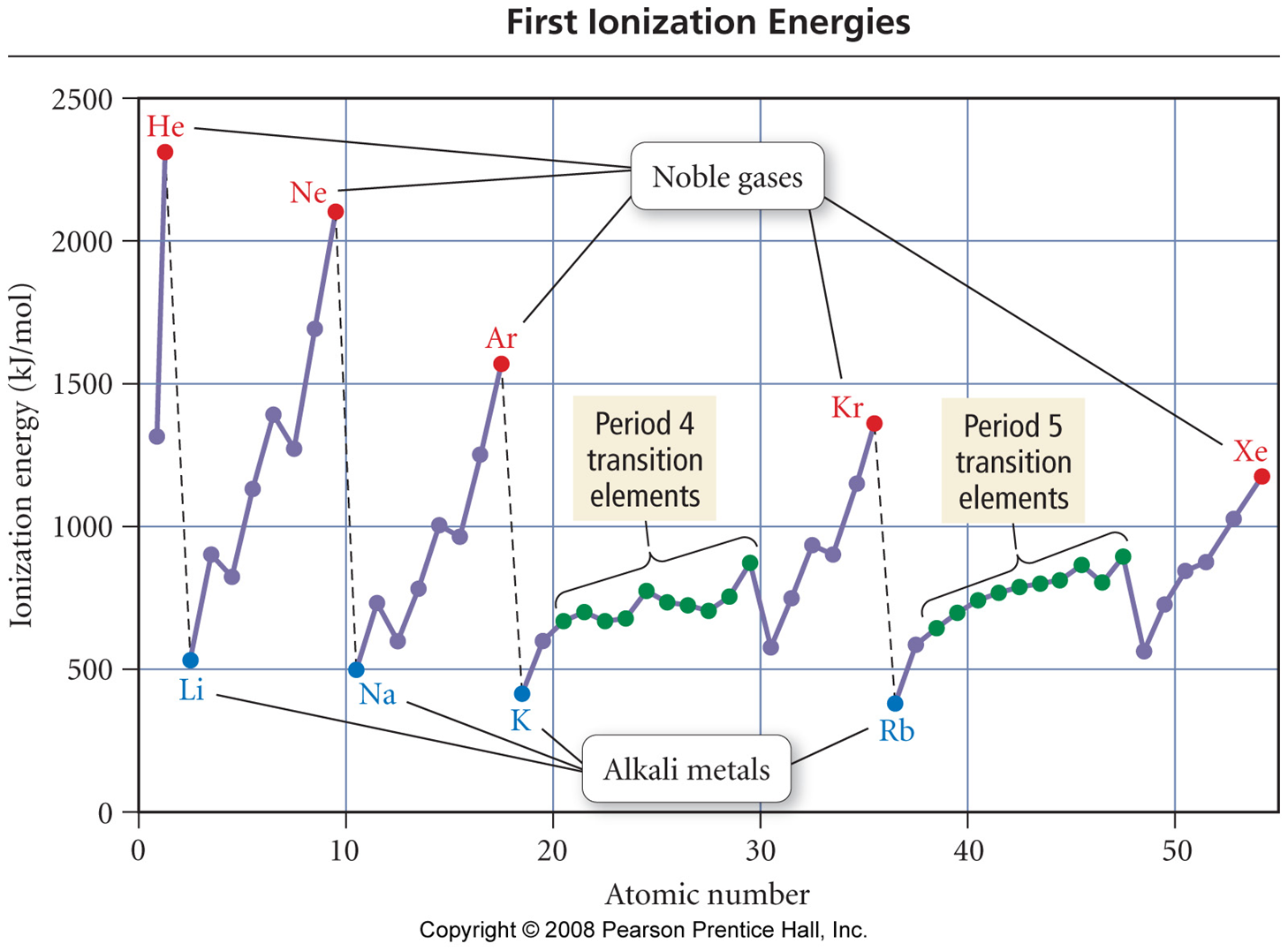
First ionization energy () decreases down the group.
Valence electron is farther from the nucleus.
First ionization energy () generally increases across the period.
Effective nuclear charge increases.
Trends in First Ionization Energy
Decreasing ionization energy down a group and increasing ionization energy across a period. Specific values (kJ/mol) are given for elements in periods 1-6.
Group 1A (Alkali metals) show the lowest ionization energies, while Group 8A (Noble gases) show the highest.
Values are given for H (1312), Li (520), Na (496), K (419), Rb (403), Cs (376) in Group 1A.
Values are given for He (2372), Ne (2081), Ar (1521), Kr (1351), Xe (1170), Rn (1037) in Group 8A.
Other values are given for elements in Groups 2A through 7A, illustrating the general increasing trend across the period.
There are some irregularities in the trend, which are explained later.
Example 2 – Choosing the Atom with Higher First Ionization Energy
Al or S: S has a higher first ionization energy because it is further to the right on the periodic table.
As or Sb: As has a higher first ionization energy because it is further up on the periodic table.
N or Si: N has a higher first ionization energy because it is further up and to the right on the periodic table.
O or Cl? This example involves opposing trends, and requires more nuanced consideration.
Irregularities in the Trend
Ionization Energy generally increases from left to right across a Period EXCEPT from Group 2A to 3A, and from Group 5A to 6A.
Examples used to illustrate the irregularities in the trend:
Be:
B:
N:
O:
It is easier to remove an electron from B than from Be because B loses an electron from the 2p subshell, while Be loses an electron from the full 2s subshell.
It is easier to remove an electron from O than from N because O gains a half-full 2p subshell configuration upon ionization.
Irregularities in First Ionization Energy Trends
Be:
B:
To ionize Be, you must break up a full sublevel, which costs extra energy.
When you ionize B, you get a full sublevel, which costs less energy.
Irregularities in First Ionization Energy Trends
N:
O:
To ionize N, you must break up a half-full sublevel, which costs extra energy.
When you ionize O, you get a half-full sublevel, which costs less energy.
Trends in Successive Ionization Energies
Removal of each successive electron costs more energy.
Shrinkage in size due to having more protons than electrons.
Outer electrons closer to the nucleus, therefore harder to remove.
Regular increase in energy for each successive valence electron.
Large increase in energy when starting to remove core electrons.
Successive Values of Ionization Energies for the Elements Sodium through Argon (kJ/mol)
Table showing ionization energies (IE1 through IE7) for elements Na through Ar.
For Na:
For Mg:
For Al:
For Si:
For P:
For S:
For Cl:
For Ar:
The data shows a regular increase in energy for each successive valence electron and a large increase in energy when starting to remove core electrons.
Trends in Electron Affinity
Energy released when a gaseous neutral atom gains an electron.
Defined as exothermic (-), but may actually be endothermic (+).
Alkaline earth metals & noble gases are endothermic.
The more energy released (more negative), the larger the EA.
Generally increases across a period.
Becomes more negative from left to right.
Lowest EA in group = alkaline earth metal or noble gas.
Highest EA in group = halogen.
Electron Affinities (kJ/mol)
Values are provided for elements in periods 1-6. Note that >0 indicates an endothermic process.
Group 1A values are negative, indicating exothermic processes, while Group 2A values are positive.
Specific values include:
H: -73
Li: -60
Na: -53
K: -48
Rb: -47
Halogens (Group 7A) have high negative electron affinities:
F: -328
Cl: -349
Br: -325
I: -295
Noble Gases (Group 8A) have positive electron affinities (>0).