4.2: Phylogenetic trees and Speciation
%%Phylogenetic tree:%% shows the evolutionary relationship between different species with specific reference to the amount of time that has passed since the species shared a common ancestor.
The information presented in phylogenetic trees has been determined through fossil record evidence, feature (physical or chemical) similarity and modern comparative genomic data.
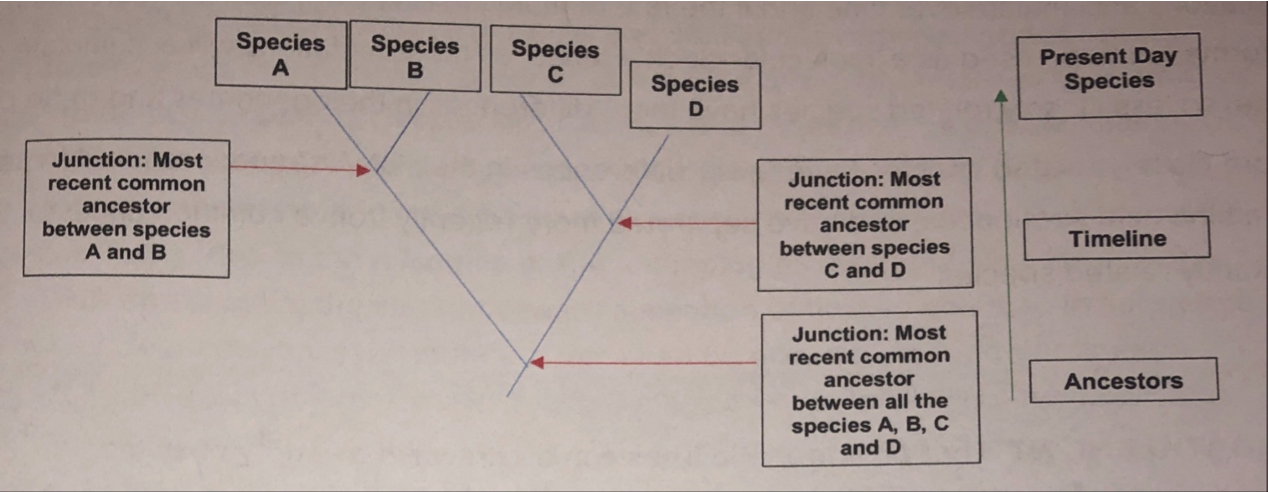 ==Explanation:== The phylogenetic tree above shows a particualar evolutionary pathway. the present day species are at the top and decsend down to the ancestors. Every Junction (branch point) is where a common ancestor existed. the length of each branch can be drawn to scale to represent the amount of time since the species shared their common ancestor.
==The timelines== from when species shared a common ancestor will correlate to the data used to generate the phylogenetic tree.
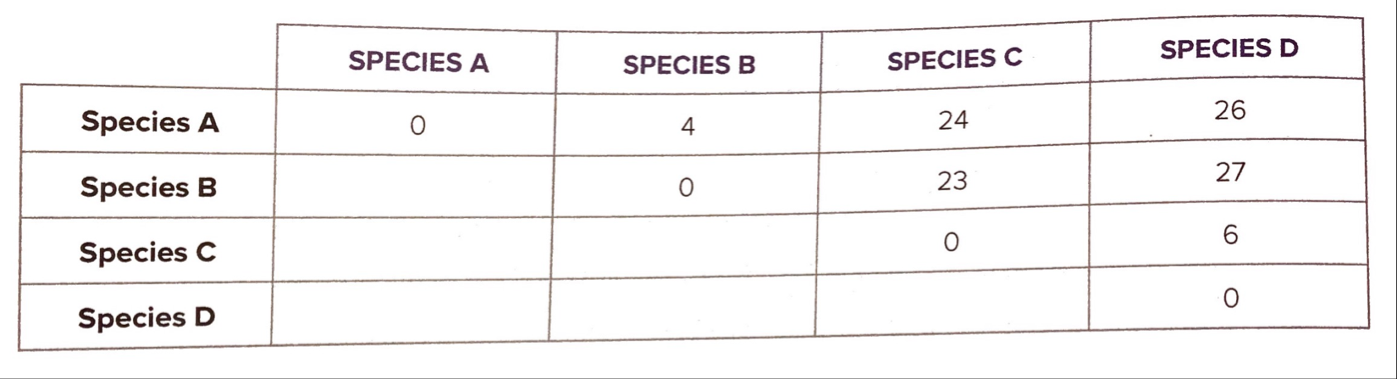 The table above shows the number of changes in DNA base sequences of the species.
==Species:== a group of organisms that are more or less alike and can produce offspring in their natural environment; the members of a species share a common gene pool.
%%Speciation:%% the formation of two or more species from one. It typically occurs when there is an event that forms a geographical barrier (valley, river, desert, ocean etc.). This is known as ^^allopatric speciation.^^
If the environmental conditions for the separated populations were different, then different features would be selected for best chance of survival. if these populations remained geographically separated with no gene flow between them, they could become so genetically diverse they wouldn’t not be able to produce fertile offspring anymore. This is known as ^^reproductive isolation.^^
Reproductive isolation can involve one of two mechanisms:
- ==Pre-zygotic:== barriers that prevent fertilisation or mating
these can include temporal isolation (flowing or mating occurs at different times), behavioural isolation (no sexual attraction between males and females), mechanical isolation (reproductive structures are different/incompatible) and Gamete isolation (process that prevents fertilisation due to inappropriate conditions or non-recognition of fertilising gamete).
- ==Post-zygotic:== barriers that operate after fertilisation and prevent the development of fertile adults
these can include hybrid inviability (fertilisation takes place but the zygote fails to develop as the genes from the parents are too different) and hybrid sterility (in which the hybrid formed reaches maturity but is sterile and cannot have offspring of its own)