Chapter 5: Democracy and Dictatorship: Conceptualization and Measurement
Foundations of Democracy: Early vs. Modern Democratic Systems
Historical Origins and Misconceptions:
A common assertion is that Europeans invented democracy. However, if the "consent of the people" is taken as the defining feature of democratic rule, democracy is a relatively common system of governance across human history that emerged independently in diverse geographic regions and cultures.
Early democracy arose whenever rulers were structurally compelled to seek the consent of those they ruled.
David Stasavage's Definition: Early democracy is defined as a "system in which a ruler governed jointly with a council or assembly composed of members of society who were themselves independent from the ruler and not subject to [their] whim."
Key Characteristics of Early Democracy:
Consent Requirement: The ruler requires the consent of assembly members in order to govern.
Limited Participation: Franchise and participation were restricted to specific elite or independent groups, rather than open to the entire population.
Direct Democracy: Governance functioned primarily through direct decision-making rather than representative institutions.
Binding Local Mandates: Representatives or delegates were bound by strict instructions from their local communities.
Non-Binding Assembly Decisions: Decisions reached at the aggregate assembly level were often not binding on all constituent groups or regions.
Ruler Strategies and Structural Conditions:
Rulers possessed two main strategies to access revenue and power:
Centralized Predation: Where conditions allowed, rulers built powerful, centralized state institutions capable of predate on society to extract resources.
Governance by Consent: Where conditions prevented centralization, rulers were forced to restrain their predatory impulses and seek consent through councils and assemblies.
Early democracy typically developed in environments where building a monitoring and coercive state apparatus was difficult—such as hunter-gatherer societies or geographically dispersed, highly mobile populations.
The primary structural driver of early democracy was the ruler's dependence on populations equipped with credible exit options.
Decline of Early Democracy:
Early democratic systems tended to erode or disappear due to three main factors:
Societal Scale: Growth in population and geographic size rendered direct democracy logistically impractical.
State Capacity: Rulers developed enhanced capacity to monitor, control, and coerce citizens, reducing their reliance on voluntary consent.
Diminished Exit Options: Economic or political shifts reduced the viability or value of citizens' exit options.
Key Characteristics of Modern Democracy:
Modern democracy is defined as a political system in which representatives of the people are regularly chosen through competitive elections under universal suffrage.
Representative Architecture: Governance is representative rather than direct.
Broad Political Inclusion: Universal suffrage and political inclusion encompass virtually the entire adult population.
Episodic Participation: Citizen participation is largely restricted to periodic elections.
Absence of Binding Local Mandates: Elected representatives operate with discretionary authority rather than local mandates.
Binding Assembly Decisions: Decisions made by assemblies (typically via majority rule) are legally binding across the entire polity.
Bureaucratic Administration: A formal state bureaucracy manages day-to-day administration.
The Underlying Mechanism of Consent:
Both early and modern democracies share a common core feature: rulers are forced to seek the consent of the governed.
Rulers submit to this constraint not due to constitutional texts alone, but because they depend on populations possessing credible exit options.
Modern democracy is significantly more inclusive than early democracy because economic and social developments have expanded the set of actors who hold credible exit options.
The Strategic Rationale and Function of Elections
Functions of Elections:
Elections serve to authorize governments and hold political leaders accountable.
Crucially, elections provide a mechanism to process societal conflicts peacefully, avoiding political violence.
Przeworski's Coin-Toss Model of Peaceful Order:
Adam Przeworski illustrates the logic of democratic compliance by imagining political office determined by a simple coin toss.
The mere possibility of an alternation in power in future tosses can induce competing political factions to comply with current outcomes rather than seek power through force.
Calculus of the Loser: Defeated factions evaluate three variables:
The probability of prevailing in future iterations ().
The explicit costs of fighting ().
The policy loss suffered under the winner's rule ().
If the future chance of winning is high enough, the cost of fighting is sufficiently steep, and the policy loss is tolerable, defeated factions prefer compliance over violence.
Calculus of the Winner: Although victors would prefer to eliminate future uncertainty, they accept future coin tosses because provoking violence by seizing permanent control is more costly. To maintain this stability, the winner has two strategic imperatives:
Policy Moderation: Keep policy outcomes moderate so the loser's policy loss () does not trigger armed resistance.
Institutional Fairness: Refrain from abusing incumbent power to manipulate future rules (tampering with the "coin"), ensuring the loser's future winning prospects remain viable.
Why Elections Outperform Pure Randomization:
Unlike a random coin toss, elections generate critical information regarding the relative strength of competing political forces.
Election results inform losers of the exact magnitude of their support if they consider armed rebellion.
Election results signal to winners the scale of opposition they would encounter if they chose to cancel future contests or subvert the regime.
Przeworski's Democratic Miracle: "The miracle of democracy is that conflicting political forces obey the results of voting. People who have guns obey those without them. Incumbents risk their control of governmental offices by holding elections. Losers wait for their chance to win office. Conflicts are regulated, processed according to rules, and thus limited."
Historical Development and Waves of Modern Democracy
Critical Institutional Transitions:
Two main historical developments drove the transition from early to modern democracy:
The Glorious Revolution of 1688 (England): Established a powerful parliament and created a new model of parliamentary governance and executive restraint.
The American Colonial Experience: Encouraged broad political inclusion and popularized representative republican institutional design.
Huntington's Three Waves of Democracy:
First Wave (): Initiated in the early century and extending through the aftermath of World War I. Primarily concentrated in Western Europe and North America (e.g., France, Britain, Iceland, Ireland, Italy, Switzerland).
Second Wave (): Sparked by Allied victory in World War II and decolonization, lasting until the early (e.g., Austria, Brazil, Costa Rica, India, Israel, Italy, Japan, Malaysia, Nigeria, Sri Lanka, Turkey, Uruguay, West Germany).
Third Wave (): Beginning with the Carnation Revolution in Portugal (mid-) and spreading globally across Africa, Asia, Latin America, Southern Europe, and Eastern Europe.
Democracy as an Evolutionary By-Product:
Modern democracy is not the final endpoint of political evolution.
Political institutions are frequently the by-products of rulers attempting to survive in power against internal and external rivals.
Rulers continually experiment with institutional arrangements to maintain a competitive survival advantage. Current democratic forms represent institutions that survived historical competition, but ongoing experimentation can produce either more democratic or more autocratic political systems.
Conceptualizing Democracy and Dictatorship
Theoretical Concepts and Operationalization:
Concept: An abstract mental category or construct that captures the meaning of objects, events, or ideas (e.g., "Democracy"). Theoretical concepts are unobservable abstract constructs.
Measure / Indicator: A concrete quantification of the concept under study.
Operationalization: The formal process of translating an abstract theoretical concept into a measurable, observable indicator.
Minimalist vs. Substantive Views:
Minimalist (Procedural) View: Classifies political regimes strictly according to their institutional rules, procedures, and mechanisms (e.g., competitive elections).
Substantive View: Classifies political regimes based on the substantive outcomes they produce (e.g., economic equality, social justice, administrative efficiency, human rights).
Dahl's Framework: Contestation and Inclusion:
Robert Dahl formulated a minimalist, procedural framework defining regime space along two distinct continuous dimensions:
Contestation: The extent to which citizens are free to organize themselves into competing blocs to press for desired policies and offices.
Inclusion: The extent to which adult citizens are legally permitted to participate in the political process.

* *Historical Regimes in Dahl's Conceptual Space*:
* *High Contestation, Low Inclusion*: Apartheid South Africa; United States prior to (restricted franchise).
* *High Contestation, Moderate/High Inclusion*: Liechtenstein (pre- women's suffrage); Switzerland (pre- women's suffrage); France (pre- women's suffrage).
* *High Contestation, Full Inclusion*: United States today.
* *Low Contestation, Moderate Inclusion*: Contemporary China.
* *Low Contestation, High Inclusion*: Soviet Union (universal voting without competitive political choice).
Major Measures of Democracy and Dictatorship
1. Democracy-Dictatorship (DD) Measure:
Conceptual Focus: Minimalist and procedural; heavily emphasizes contestation.
Classification Type: Strictly dichotomous (regimes are categorized exclusively as either a Democracy or a Dictatorship).
Operational Rules: A regime is coded as a democracy only if all four of the following conditions are met:
The chief executive is elected.
The legislature is elected.
There is more than one political party competing in elections.
An alternation in executive power under identical electoral rules has occurred.
The DD measure builds on Dahl’s insights in two ways:
1. Minimalist view of democracy.
2. Emphasis on contestation.
The main difference with Dahl is that the DD measure treats
regime type as a dichotomy.
• A dichotomous measure has only two discrete categories or
values, such as ‘tall’ and ‘short’.
• A continuous measure can take on any intermediate value
within a given range, such as ‘height in centimeters’.
Figure 5.2 Comparing DD’s and Dahl’s Conceptualization of Regime Type

2. Freedom House (FH) Measure:
Conceptual Focus: Substantive view; incorporates broader concepts of freedom, rights, and governmental performance.
Classification Structure: Generates continuous scores resulting in three categorical classifications: Free, Partly Free, and Not Free.
Two Sub-Dimensions:
Political Rights: Evaluated via questions (each scored , maximum score ), categorized into:
Electoral Process
Political Pluralism and Participation
Functioning of Government
(Total score out of is converted to a scale).
Civil Liberties: Evaluated via questions (each scored , maximum score ), categorized into:
Freedom of Expression and Belief
Associational and Organizational Rights
Rule of Law
Personal Autonomy and Individual Rights
(Total score out of is converted to a scale).
Final Score: Calculated as the simple average of the Political Rights and Civil Liberties scores.
Comparing democracy and dictatorship scores in 2021


3. Varieties of Democracy (V-Dem) Measure:
Conceptual Focus: Minimalist, procedural, continuous measure ( to scale).
Core Architecture: Aggregates five foundational sub-components:
Freedom of Expression
Freedom of Association
Clean Elections
Percentage of Population with Suffrage
Elected Officials
Statistical Features: Each indicator includes explicit standard error measurements to capture coding uncertainty, aggregated statistically to produce a continuous index from to .
Comparing democracy and dictatorship scores in 2021
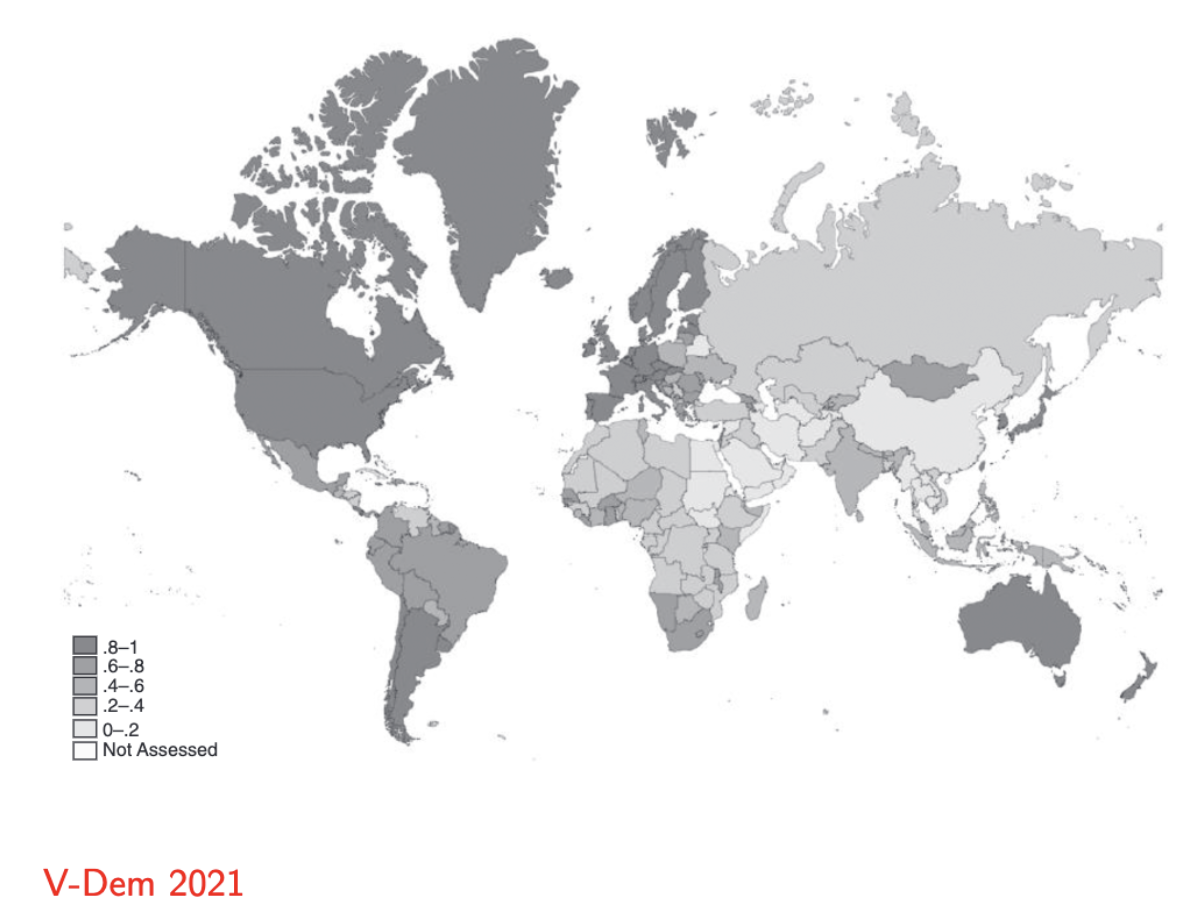
V-Dem Scores for 60 countries around the world

Comparative Global Trends Across Measures:
Tracking the global proportion of democracies from to across DD, V-Dem, and Freedom House reveals divergent empirical trends depending on operational definitions.
While DD shows stark step-function changes due to its dichotomous nature, V-Dem and Freedom House depict smoother, continuous shifts over time.
Proportion of Democracies Globally

Comparative Evaluation of Regime Measures
Four Methodological Criteria:
Conceptualization
Validity
Reliability
Replicability
Conceptualization Challenges:
Substantive vs. Minimalist: Substantive measures risk circular reasoning when used to study causal outcomes. For example, if low socioeconomic inequality is included in the substantive definition of democracy, researchers cannot use that measure to test whether democracy reduces inequality.
Isolation of Causes: Minimalist measures make identifying causal mechanisms easier. If Freedom House uses distinct attributes, isolating which specific attribute drives an observed empirical relationship with economic development is difficult.
Dichotomous vs. Continuous: Dichotomous views (DD) assume regimes belong to discrete categories, whereas continuous views (Dahl, V-Dem, FH) view regime type as a spectrum. The choice depends on the research question (e.g., studying political transitions vs. measuring incremental democratic erosion).

* *Case Study (Bolivia )*:
* During political instability, DD codes Bolivia as Dictatorship in , Democracy in , Dictatorship in , and Democracy from .
* Freedom House codes Bolivia as Mixed (), Dictatorship (), Mixed (), and Free ().
* V-Dem classifies Bolivia as Dictatorship continuously from until , moving to Democracy only in .
Validity:
Refers to the extent to which a operationalized measure accurately reflects the intended theoretical concept.
Attributes: Including too many attributes reduces conceptual clarity and empirical utility.
Aggregation Rules: Combining attributes requires clear logic. DD uses a multiplicative rule (if any single democratic requirement fails, the country score becomes ), whereas Freedom House uses an additive rule (scores are summed across attributes).
Reliability:
Refers to the extent to which a measurement process repeatedly and consistently produces the identical score for a given case under identical conditions.
Reliability increases when measures rely on observable objective facts rather than subjective expert judgments.
Comparing the Reliability and Validity of Three Measures

*   *Target Conceptualization*:
    1.  *Reliable, but not Valid*: Tight cluster of measurement points located far from the true center target.
    2.  *Valid, but not Reliable*: Measurement points widely scattered across the target, but centered around the true middle on average.
    3.  *Valid and Reliable*: Tight cluster of measurement points located directly inside the center target.
Replicability:
Refers to the ability of independent, third-party scholars to fully reproduce the measurement process.
Requires researchers to provide explicit coding rules, clear operational standards, and fully accessible disaggregated data.
Levels of Measurement in Regime Classification
Nominal Measures:
Classifies observations into discrete, mutually exclusive, and collectively exhaustive categories.
No mathematical order or magnitude exists between categories (e.g., DD regime classification: Democracy vs. Dictatorship).
Ordinal Measures:
Rank-orders observations along an underlying dimension.
Indicates whether a case has more or less of an attribute than another case, but lacks standardized units, meaning distance between ranks cannot be quantitatively interpreted.
Interval Measures:
Rank-orders observations along a standardized numerical scale with equal units of distance.
Allows exact calculation of distances between cases, but lacks a natural or absolute zero point (e.g., standard temperature scales).
Ratio Measures:
Includes all features of an interval scale, with the addition of a natural or absolute zero point.
An absolute zero signifies the complete absence of the measured phenomenon.
Enables precise multiplicative statements (e.g., a state possessing twice as much of an attribute as another).