Technology
What is engineering?
➢ Engineering is the use of science in inventing many new things like robots, kitchen appliances and much more which is used in modern life; also innovating
➢ Scientists ask questions about the nature of the universe, while engineers use these facts to solve problems
Different types of engineering
● Military
● Civil
● Mechanical
● Electrical
● Chemical
● Aerospace
● Nuclear
● Biomedial
● Industrial
Engineering comes from the Latin word meaning ‘cleverness’ or ‘to design or devise’.
● Military Engineering – involves designing and building military works, along with ways of communicating and transporting people and things
● Civil Engineering – focus on building structures of all kinds, along with highways, sanitation systems and even entire cities
● Mechanical Engineering – focus on machinery and mechanical systems, from robots to engines
● Electrical engineering – focus on the production of microchips and cell phones to the giant power station generators that help supply energy to big cities
● Chemical engineering – has quite a wide focus, not only designing and operating chemical plants that do things like refine old and distill alcohol. They also deal with food, medicine, the environment and much more
● Other branches of engineers
○ Aerospace engineers – focus on development and operation of space operations
○ Nuclear engineers – focus on the use of nuclear elements for multiple purposes
○ Biomedical engineers – focus on the creation of solutions for health problems for humans
● Types of engineers and their projects
○ Creating a spaceship
○ Creating a new type of car
○ Creating prosthetic arms for someone who lost their arms
○ Creating a new type of medicine
● How do engineers improve our daily lives?
○ Help with transport and long distance travel (e.g. cars, trucks, transport etc.)
○ Help keep food fresh and safe to eat (fridges, freezers, etc.)
○ Help keep people healthy and safe (Medicine, helmets, car airbags, etc.)
● What is a prototype?
○ A prototype is an early version of a product that is built for testing and evaluation.
○ Prototypes allow engineers:
■ Test ideas full production
■ Identify weaknesses
■ Gather feedback
■ Improve performance
○ Prototypes do not need to be perfect. Their purpose is to help engineers learn and improve
○ Examples
■ Model bridge
■ Model house
■ Rubber band racer
■ Scale model vehicle
○ An initial model that allows engineers to test ideas and identify improvements needed before producing a final solution
Design process
1. Identify the problem a. Describe the challenge to be solved, including limits and constraints
2. Explore a. Research what others have done. Discover what materials are available
3. Design a. Use your knowledge and creativity to come up with many solutions. Choose one idea and draw or make a model of it
4. Create a. Make your solution
5. Try it out a. Test your solution
6. Make it better a. Evaluate how the solution worked and think of how to improve your design When you finish step 6, circle back to step 4 and repeat this process as many times as needed
Identify the problem The first step is identifying exactly what needs to be solved. Design situation (What is the problem?): A paragraph describing the circumstances of your project and the problems you are trying to solve Design brief
(What will you do?): A paragraph describing in detail the actions taken to solve the problems mentioned in the design's solution.
What is Design Thinking? Design thinking is the process that helps engineers solve problems by focusing on the needs of users and generating creative solutions. Instead of choosing the first idea that comes to mind, engineers explore many possibilities before selecting the best option
How do Engineers choose the best idea? Engineers rarely use the first idea they create. Instead, they evaluate ideas using design criteria. Common criteria include:
● Safety
● Cost
● Performance
● Reliability
● Durability
● Sustainability
● Appearance Each design is assessed against these criteria Example: An engineer designing a car may compare and different body shapes to determine which provides the best balance of speed, stability and safety.
○ Real world example
■ Designing an electric car
● Identify the problem
○ Design an affordable electric vehicle for families
● Explore
○ Research existing electric vehicles
● Design
○ Sketch possible solutions
● Create
○ Build a prototype
● Try it out
○ Test based on criteria
● Make it better
○ Improve weaknesses discovered during testing
Cars
● What makes a car modern?
○ Advanced technology such as touchscreens, GPS and smartphone connectivity
○ Electric or hybrid engines that reduce fuel consumption and emissions
○ Advanced safety features
○ Self-driving/semi-autonomous driving abilities
○ Improved fuel efficiency and eco-friendly design
○ Internet connectivity and over-the-air software updates
○ Uses technology to improve safety, comfort and efficiency. Many modern vehicles are electric or hybrid, have smart driving assistance systems and can connect to mobile devices. Some can even drive themselves in certain situations

● Electrical Vehicles (EVs)
○ Powered entirely by electricity
○ Use rechargeable
○ Produce no tailpipe
● Hybrid Vehicles Lower Higher Quiet
○ Use both a gasoline engine and an electrical motor
○ Improve fuel economy
○ Reduce environmental impact compared to traditional cars
● Self-driving vehicles ○ Use sensors, cameras and AI
○ Can perform some or all driving tasks automatically
○ Aim to improve safety and convenience
● Vehicle automation technology
○ Adaptive cruise-control
○ Automatic parking
Parts of an EV
● Door post
● Battery
● Wing mirror
● Water pumping and hose
● Front fender
● Bumper
● Grill
● Radiator and cooling bars
● Oil pumping and filter
All electric vehicles have a traction battery pack
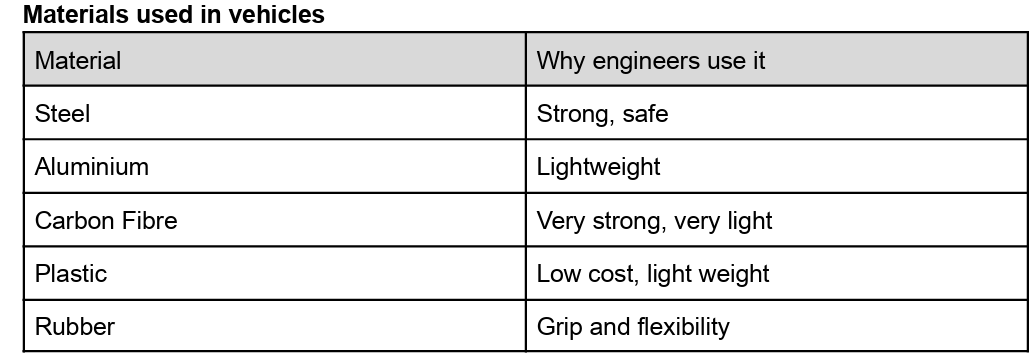
● Lightweight materials
○ Aliminium
○ Carbon Fibre
○ Lightweight alloys Benefits:
● Reduced vehicle mass
● Better fuel efficiency
● Faster application
● Improved performance
Newton’s 1st Law: Inertia Inertia
● Newton’s first law of motion
● Every object at rest wants to stay at rest and every object at motion wants to stay in motion
● Gravitational forces are external
● Friction and gravity affects objects
● Objects move at a steady pace with no acceleration
How seat belts work
● When a car is moving, both the car and its passengers are moving at the same sped
● The car stops almost immediately
● The passenger continue moving forward because of inertia
● Without a seatbelt:
○ Hit the dashboard
○ Strike the windshield
○ Be thrown from the vehicle
○ Injury or death
Functions of seat belt
1. Prevent forward motion a. Seat belts provide a restraining force that prevents passengers from continuing to move forward during a sudden stop
2. Distribute impact force a. Seat belts spread forces across stronger parts of the body including:
i. Chest, shoulder, pelvis b. This reduces the risk of severe injuries
● Example
○ A bus driver suddenly applies the brakes
■ What happens?
● The bus slows down
● The passenger leans forward
■ Why?
● They continue moving due to inertia
Mathematical equations Deceleration Formula:
a = (v-u)/t a = acceleration
-a = deceleration
u = initial velocity
v = final velocity
t = time
Example A car is travelling at an initial velocity of 10 m/s. After 5 seconds, its velocity increases to 25 m/s. What is the car’s acceleration?
Given:
● u=10 m/s = 10 m/s
● v=25 m/s = 25m/s
● t=5 s = 5 s
Equation (25-10)/5
Answer: 3 m/s^2
Newton’s 2nd Law: Force vs Acceleration
● Newton’s Second Law explains how a force affects an object's acceleration.
● The formula: F = ma
○ F = net force, measured in newtons (N)
○ m = mass, measured in kilograms (kg)
○ a = acceleration, measured in m/s²
● Basically:
● More force → more acceleration. More mass → less acceleration (if the force stays the same). ●
Example
○ A 5kg box is pushed with a net force of 20N
■ a= F/m = 20/5 = 4 m/s
● The acceleration of an object depends on:
○ The force applied to it
○ Its mass Formula – F = ma
F: Force (Newtons)
m: mass (kg)
a: acceleration (m/s)
● Real word e.g.
○ Engine performance
● Examples
○ A car with a mass of 1000kg accelerates at 2 m/s^2
■ F = ma
■ F = 1000 x 2
■ F = 2000 N
■ And : 2000 N
○ A force of 3000 N acts on a car with a mass of 1500kg. Calculate the accelerate
■ F = ma
■ a = F/m
■ a = 3000 ÷ 1500
■ a = 2 m/s^2
● When working with gravity, remember that gravitational value is basically just acceleration
Newton’s 3rd Law: For every force, there is an opposite force
➢ Whenever one object exerts a force on a second object, the second object exerts an equal and opposite force on the first
➢ E.g. ○ The motion of a lift from an airfoil, the air is deflected downward by the airfoil’s action, and in reaction, the wing is pushed upward
○ The motion of a spinning ball, the air is deflected to one side, and the ball reacts by moving in the opposite direction
○ The motion of a jet engine produces thrust and hot exhaust gases flow out the back of the engine, and a thrusting force is produced in the opposite direction
○ Car tires and the road ■ Tires push backward on the road
■ The road pushes forward on the tires
■ This forward reaction force the car forward
○ Balloon propulsion ■ Air rushes out of the balloon backward
■ The escaping air pushes on the balloon
■ The balloon moves forward
● Example questions
○ A car tire pushes backward on the road with a force of 500N. What force does the road exert on the tire?
■ Due to Newton’s third law, the road exerts 500N forward
○ A balloon pushes air backward with a force of 8N. What force does the air exert on the balloon?
■ Due to Newton’s third law, the air exerts 8N forward
Energy
● What is Energy Transformation
○ Energy transformation occurs when changes from one form to another. Energy cannot be created or destroyed, but it can be transferred or transformed
● Potential Energy (PE)
○ Stored energy due to an object’s position or condition
○ E.g.
■ A toy car at the top of a ramp
■ Water stored behind a dam
■ A stretched rubber band
○ Formula
■ PE = mgh
● PE = potential energy
● m = mass
● g = gravitational acceleration
● h = height
● Kinetic energy
○ The energy of motion
○ Formula:
■ KE = ½ mv^2
● KE = kinetic energy (J)
● m = mass (kg)
● v = velocity or speed (ms)
Lever ➢ Simple machines make work easier by changing the size or direction of a force. The six simple machines are: the lever, the wheel and axle, pulley, inclined plane and the wedge
● Lever
○ A rigid bar that rotates around a fixed point called a fulcrum. It helps us move loads using less effort

● 3 levels of classes
○ 1st class: Fulcrum is in the middle
■ Seesaw, scissors, shears
○ 2nd class: Load is in the middle
■ E.g. wheelbarrow, can opener, canoe
○ 3rd class: Effort is in the middle ■ E.g. shovel, tweezers, fishing rod


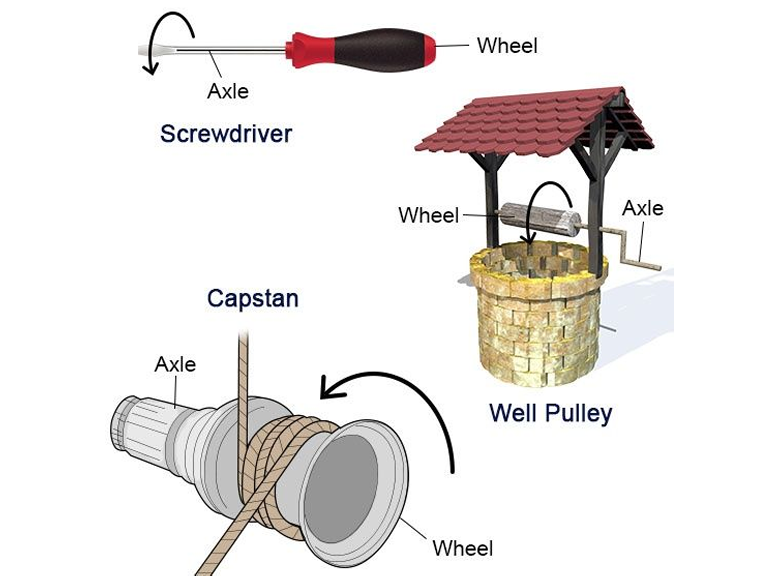
Wheel and axle
● Wheel and axle
○ A wheel and axle is a simple machine made of a large wheel fixed to a smaller axle. When one turns, the other turns with it. It helps change the size of a force and makes work easier
○ How it works
■ A force applied to the wheel causes the axle to turn. The bigger the wheel compared to the axle, the easier it is to work
■ E.g. bicycle wheel
Pulley
➢ A wheel with a grooved rim that changes the direction of a force and helps lift heavy loads
➢ Fixed pulleys ○ Changes the directions of force

➢ Moveable pulley
○ Helps lift the load with less effort

Inclined Plane
➢ A sloped surface that makes it easier to lift objects to a higher level by applying a force over a long distance

● Real lids example
○ Loading ramps for trucks
○ Wheelchair ramps
○ Accessibility ramps and walkways Wedge
➢ 2 inclined planes
➢ E.g. splitting wood, axe, knife, nail, chisel

Screw
➢ An inclined plane wrapped around a cylinder or cone. It converts rotational motion into linear motion and provides a mechanical advantage to hold or lift object
Mechanism (Pulleys and CAMs): knowledge
● Linear →
● Reciprocating ↔
● Rotary ↻
● Oscillating
○ E.g. wheel and axle fixed