2.5 - interest rate risk management
[2.4 - not examinable]
aim
to critically evaluate the issues and decisions that firms face regarding interest rate risk and its management
learning outcomes
by the end of this unit:
interest rates
definition - the price of money; the most important price in the world
determination - the rate at which demand for loanable funds [borrowing] equates to the supply of loanable funds [savings]
why are interest rates important?
interest rates influence key macroeconomic decisions:
consumption vs. saving - should individuals spend or save?
borrowing now vs. later - should firms/individuals borrow now or defer borrowing?
capital allocation - should firms hold cash, invest in CapEx, or allocate resources elsewhere?
duration decision - should firms borrow or lend short term or long term?
interest rates lie at the core of major financial economic decisions
corporate finance perspective
interest rates impact:
financing decisions:
debt vs. equity [long term financing]
loan, hire purchase, leasing [medium term financing]
cash vs. liquid assets [short term financing]
other financial topics:
investment appraisal - used as discount rates in NPV calculations
capital structure - determines cost of capital and opportunity cost
portfolio theory - defines the risk free rate of return
option pricing - used in calculating risk free return
interest rate risk
a firms financing rate is determined by:
BOE base rate + bank premium + term premium + credit risk premium
BOE base rate - the rate at which banks borrow from the bank of England
bank premium [or discount] - reflects interbank lending conditions, often referenced using SONIA [BOE base rate + bank premium]
term premium - the additional return required for lending over a longer duration, influenced by time value of money, inflation, and uncertainty over future base rates
credit risk premium - compensation for borrower default risk, which is firm-specific
fluctuations in components affect interest rate risk
assets - returns decrease if interest rates fall
liabilities - interest costs increase if rates rise
floating rate assets/liabilities - explicit exposure to interest rate changes
fixed rate asset/liabilities - no explicit risk but implicit risk arises when assets/liabilities are rolled over
short vs. long term borrowing:
short term borrowing = frequent rollovers
long term borrowing = higher term premiums and credit risks
interest rate risk management
interest rate risk management depends on:
forecasts of future interest rates
risk aversion of the firm
balance sheet structure and duration of liabilities
long term rate management = managed through capital structure decisions
short/medium term borrowers:
objective - remove uncertainty
approaches:
fixed rate loans
floating rate loans with hedges [using derivatives]
hedging instruments
forward-forward loans
forward rate agreements [FRA]
interest rate futures [RIF]
interest rate guarantees [IRG]
caps, floors, and collars
interest rate options
interest rate swaps
forward-forward loans
example
taren ltd. needs to borrow 5 mil. in 1 month for 3 months
expectations - interest rates will rise
strategy:
borrow 5 mil. today for 4 months at a lower rate
reinvest excess funds for 1 month
outcome - saves costs by borrowing at a cheaper rate
taren ltd. faces:
borrowing rates:
2.5% = 1 month
2.75% = 3 months
2.75% = 4 months
lending rate = 2% = 1 month
calculations:
interest payable = 5 mil. x 2.75% x 4/12 = 45, 833
interest received = 5 mil. x 2% x 1/12 = 8,333
net interest cost = 45,833 - 8,333 = 37,500
annualised rate = [37,500/5 mil.] x 12/3 = 3%

forward rate agreement [FRA]
definition - a forward contract fixing an interest rate on a specified principal for future period
nature:
both parties agree on a fixed rate
notional principal - no actual money exchange
cash settlement - the difference between the FRA rate and actual rate is settled at maturity
traded over the counter [OTC]
example:
taren ltd. wants to borrow 5mil. in 1 month for 3 months
they expect borrowing rates to rise from 3% to 3.5%
solution:
borrow 5mil. at 3.5% from Bank A
buy an FRA from Bank B at 3%
calculations:
interest payable to bank A = 5mil. x 3.5% x 3/12 = 43,750
FRA payoff from bank B = 5mil. x [3.5% - 3%] x 3/12 = 6,250
net interest cost = 43,750 - 6,250 = 37,500
annualised interest rate on strategy:
[37,500/5mil.] x [12/3] = 3% — fixed no matter what happens
additional cost = [3.5% - 3%] x [3/12] x 5mil. = 6,250
rate index future [RIF] / short term interest rate future [STIR]
3 mont interest rate futures
for the UK “Short Sterling Contracts“ [ST3]
mechanism:
buying the future - right to lend at a set rate for 3 months
selling the future - right to borrow at a set rate for 3 months
exchange traded - standardised, transparent, and highly liquid
example:
contract size and maturity
size - each futures contract represents 1mil. in notional value
maturity - the contract always has a 3 month duration
expiration dates - contracts expire in march, june, september, and december
quotation format
the futures price [F] is calculated using the formula:

therefore, if SONIA = 4.25%, then:
F = 100 - 4.25 = 95.75
this means if you buy a december contract at 95.75, you are effectively agreeing to lend at 4.255 for 3 months [april to june]
tick size and value
tick size - the smallest price movement is 0.005
value of one tick - 0.005 basis points [bps] = £12.50 per contract
notional value x bps = 1mil. x [0.005/100] = 50
must put bps out of percentage
contract = 3 months so its quarterly = 50/4 = 12.5
therefore:
a single tick [0.005] movement = £12.50 per contract
each contract has a notional value of 1,000,000
tick movement of 0.005 = 0.5 bps
so, 1 basis point = £25, and 0.5 bps = £12.50 per contract
example: buying a december 3M SONIA Futures contract
you buy a december contract at 95.75 [implying SONIA = 4.25%]
this means you have agreed to lend 1mil. at 4.25% for 3 months [april - june]
the contract expires in march
if interest rates rise:
assume that by expiration in march, SONIA has inc. to 5%
the new futures price is:
F = 100 - 5 = 95
since you bought at 95.75, and the price dropped to 95, you profit from this price movement
calculating profit:
change in price = 95.75 - 95 = 0.75 [which is 25 bps]
multiply out of percentage = 0.75 × 100 = 75
divide for 3 month contract = 75/4 = 25 bps
since 1 bps = £25, the profit is = £25 × 25 = £625
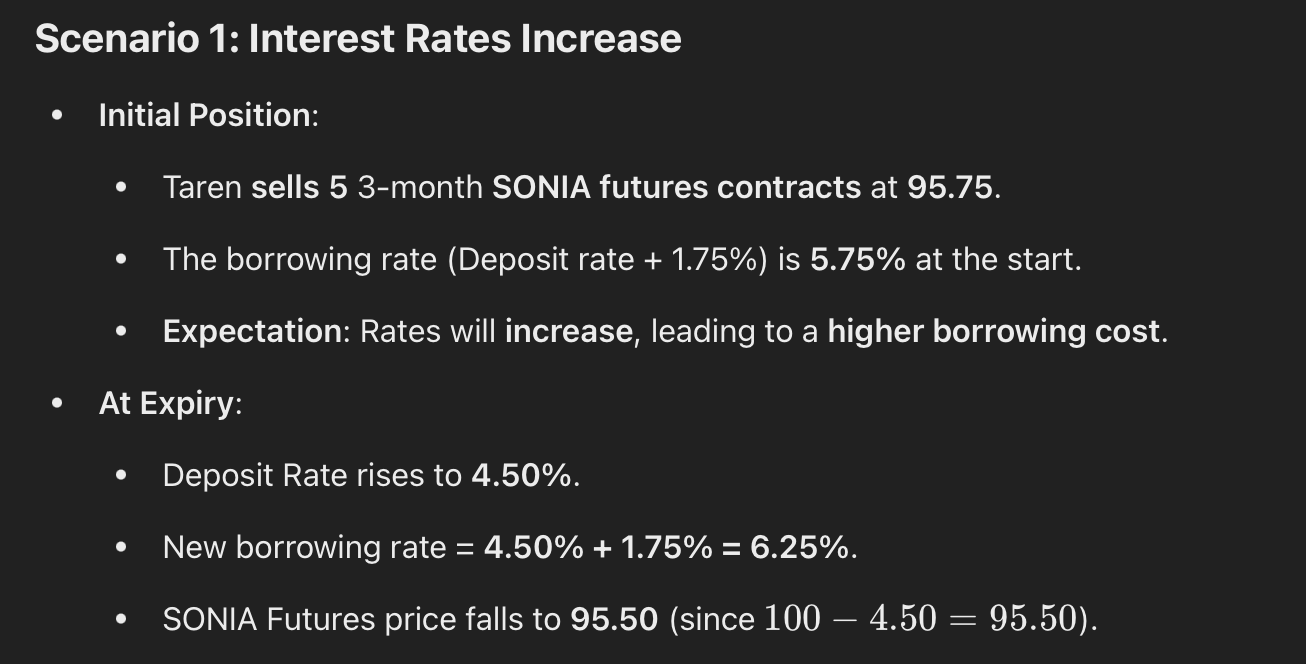
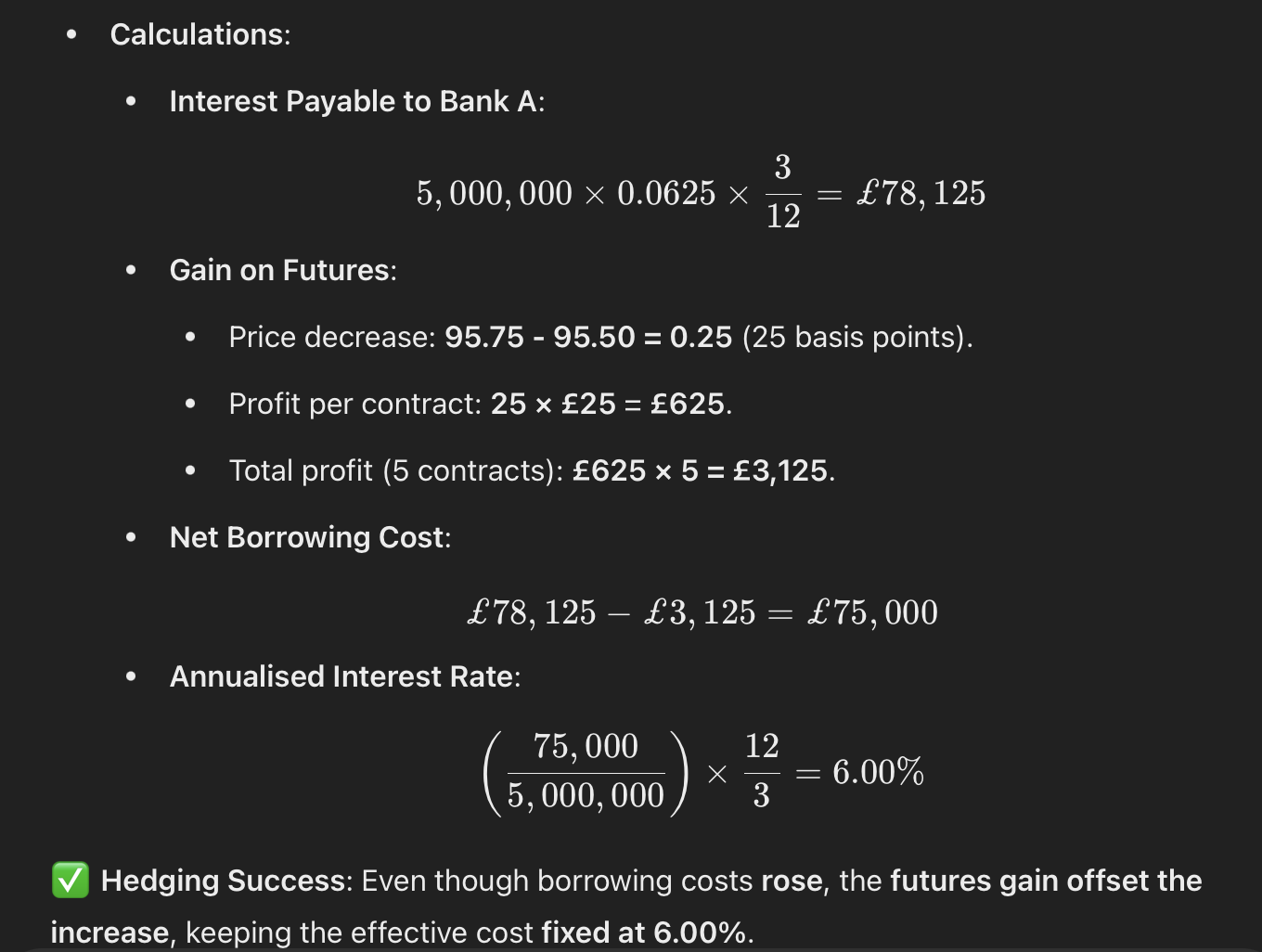
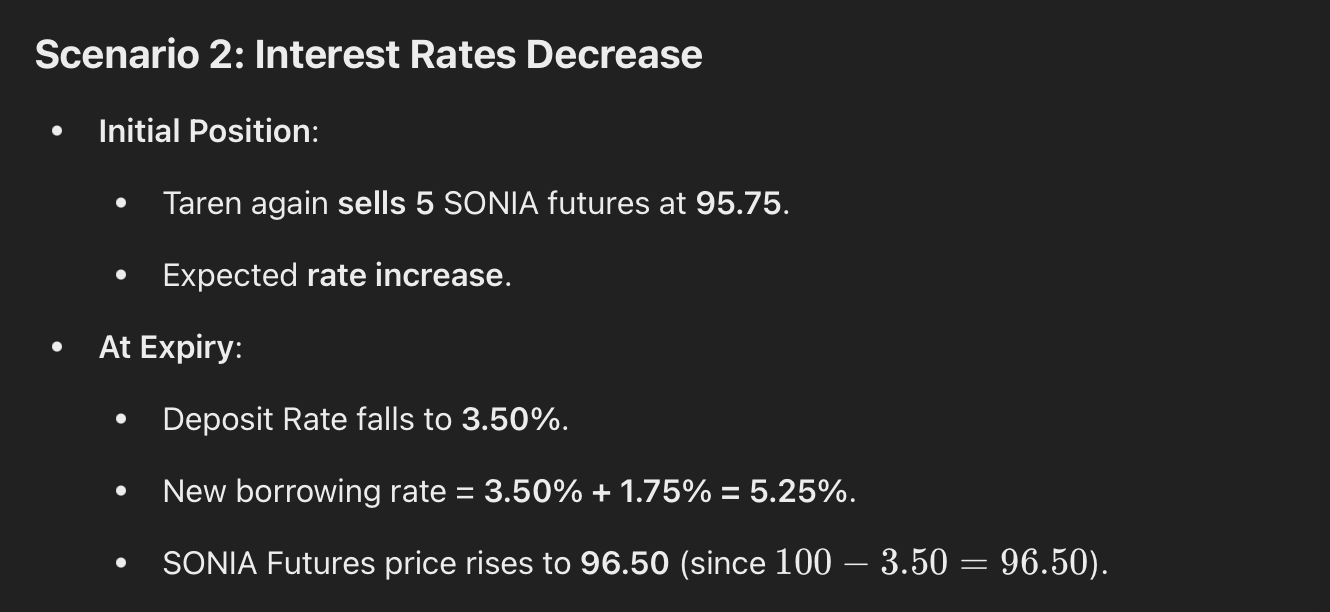
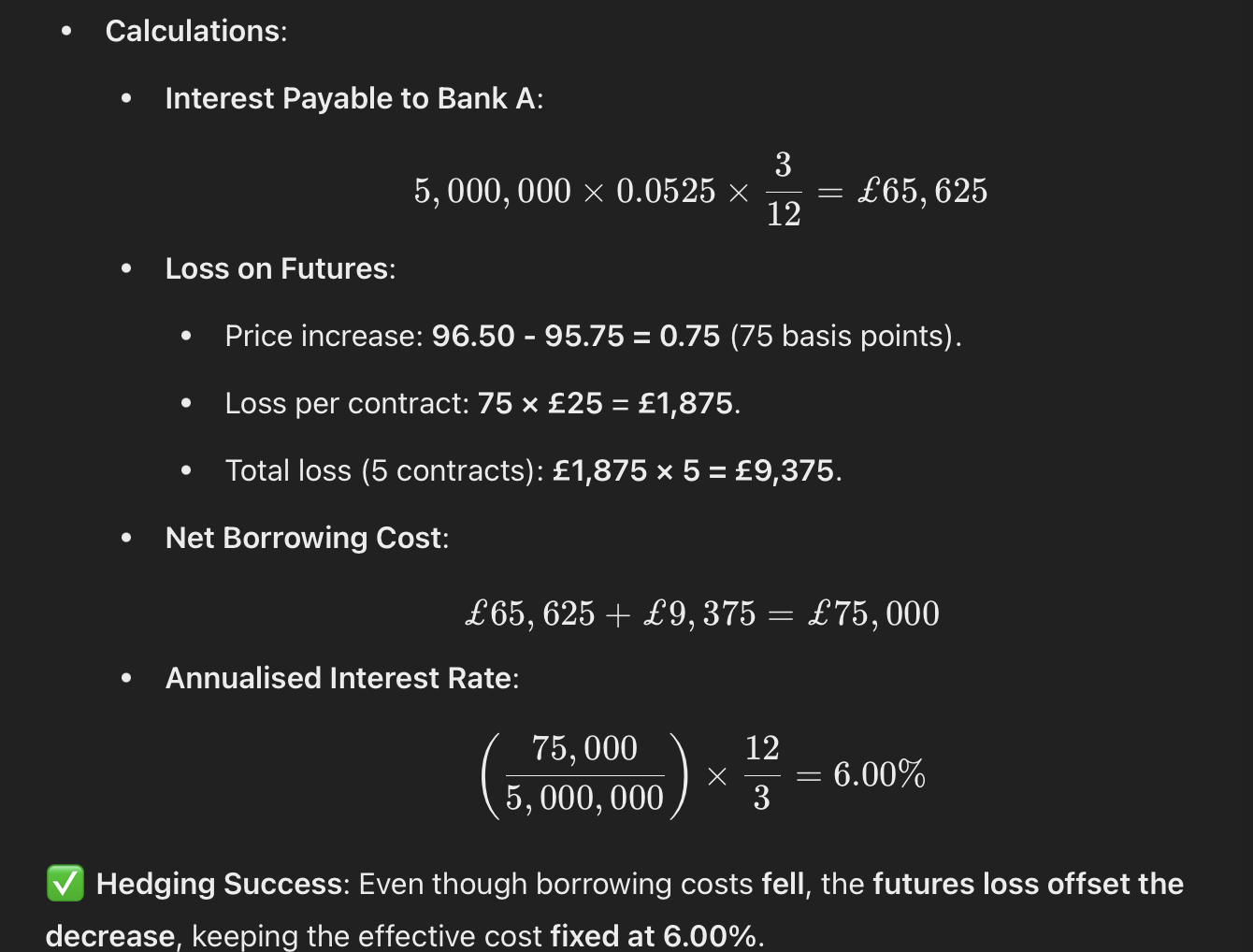
differences between FRA and IRF
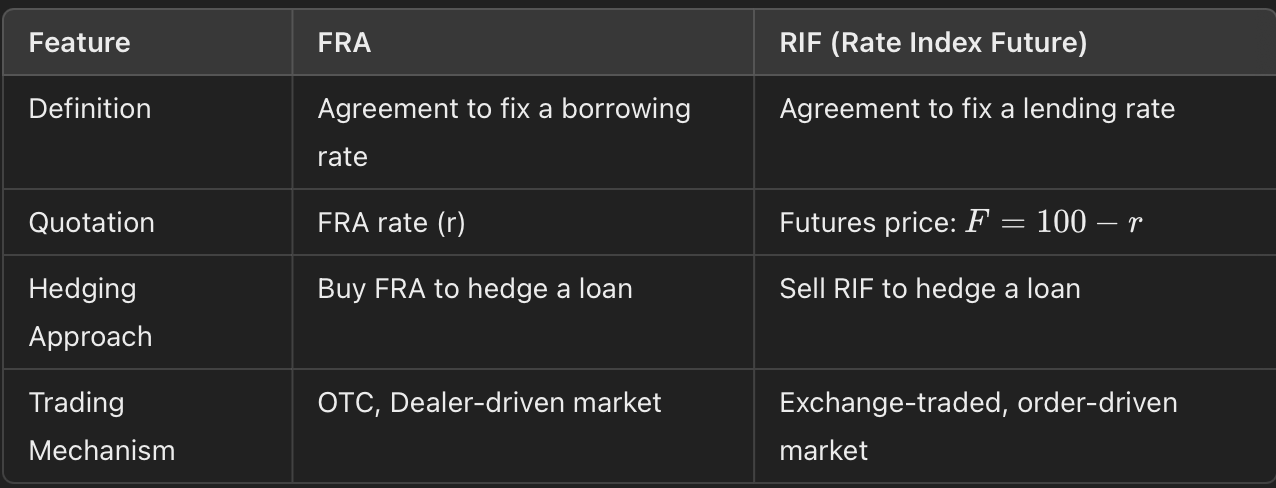
advantages and disadvantages of FRA vs. IRF
FRA [forward rate agreement]
advantages:
easy to use, doesn’t require complex knowledge
customised to firm’s specific needs
no explicit margin requirement
disadvantages:
requires bilateral agreement with a dealer
no secondary market — cannot exit early
lack of pricing transparency
RIF [rate index future]:
advantages:
standardised and exchange traded
liquid secondary market — cannot exit early
transparent pricing
disadvantages:
requires knowledge of future markets
requires broker or bank access
requires margin deposits [initial and variation]
interest rate guarantees
opinions on interest rates
IRGs include caps, floors, and collars
traded OTC with SONIA as the underlying asset
short expiry dates [typically 3 months]
premium paid upfront for protection
borrowing with IRGs
if a firm expects rates to rise, it can purchase an interest rate call option
if rates increase — exercise call option and borrow at a lower pre-agreed rate
if rates decrease - do no exercise and borrow at lower market rate
cost - premium is paid upfront regardless of what happens
cap
a series of call options across different maturities
guarantees a maximum borrowing rate over a loan’s lifetime
advantage - protects against rising rates while allowing firms to benefit if rates fall
floor
a series of put options across different maturities
guarantees a minimum borrowing rate
disadvantage - if rates decrease, the firm still pays more
collar
combination of cap + floor
purpose - reduce hedging costs
the firm sells a floor [limits upside benefits] to pay for a cap [limits downside risk]
guarantees a range for borrowing costs
interest rate options
exchange traded options [e.g. 3 month short sterling options]
based on SONIA:
call option = right to deposit [lend] at a fixed rate
put option = right to borrow at a fixed rate
advantages and disadvantages of interest rate options
advan.
protects against downside risk
allows firms to benefit from favourable interest rate movements
disadvan.
premium paid upfront [cost incurred regardless of market movement]
interest rate swaps [IRS]
plain vanilla interest rate swap
exchange of fixed vs. floating interest payments between 2 parties

party A - wants to pay floating and receive fixed
party B - wants to pay fixed and receive floating
transforming a liability using IRS
a company can use an interest rate swap to convert its debt profile:
example:
company A - currently pays fixed 5.2%
company B - currently pays floating SONIA + 0.8%
swap terms:
company A:
pays SONIA [floating]
receives 5% fixed
new net rate - SONIA + 0.2% [floating liability]
company B:
pays 5% fixed
receives SONIA
new net rate - 5.8% [fixed liability]
both companies get the type of loan structure they prefer
interest rate swaps [IRS] with a bank
swaps are usually arranged through banks
banks earn 3-4 [0.03% - 0.04%] basis points for arranging offsetting transactions
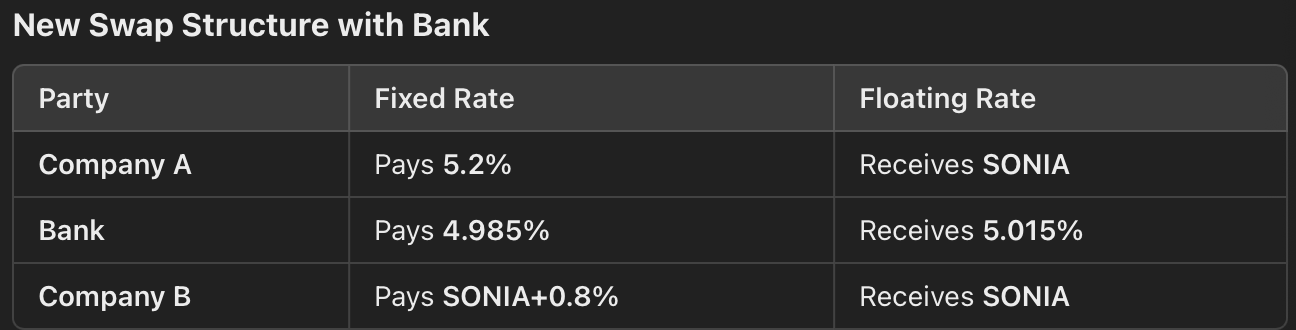
outcome:
company A now pays SONIA +0.215% instead of SONIA +0.2%
company B now pays 5.815% instead of 5.8%
bank earns 3 basis points in total
comparative advantage in swaps
companies should borrow in the market where they have a comparative advantage

key observations:
company A has an advantage in the fixed rate market [lower cost]
company B has an advantage in the floating rate market
total swap gain:
difference in fixed - difference in floating = 1.2% - 0.7% = 0.5%
each company benefits from a 0.25% cost reductions
including a bank in the swap
if a bank is involved, it earns 10 basis points [0.1%], which is shared between both companies
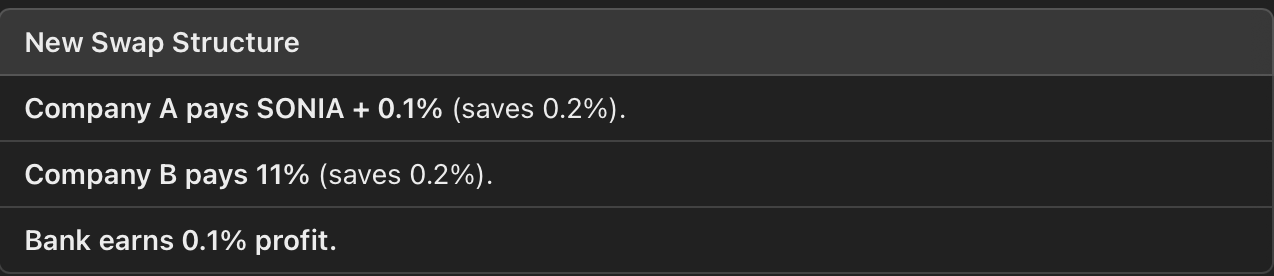
discussion - IRS hedging benefitd
why use an IRS?
hedges interest rate risk effectively
firms get preferred interest structure [fixed vs. floating]
lower borrowing costs due to comparative advantage
good for medium term hedging [5 yrs]
are there disadvantages?
potential counterparty risk
complexity compared to simple loans
bank fees reduce the total savings