calc u2
🟦
1. Tangent Line & Normal Line Formulas
Tangent line equation:
y - y_1 = f’(x_1)(x - x_1)
Normal line equation:
Normal line ⟶ perpendicular to tangent line
\text{slope of normal} = -\frac{1}{f’(x_1)}
y - y_1 = -\frac{1}{f’(x_1)}(x - x_1)
🧠 Remember:
Tangent = same slope as the curve
Normal = opposite reciprocal slope
🟩
2. Derivative Notation (dy/dx)
If y = f(x):
\frac{dy}{dx} = f’(x)
When using implicit differentiation, treat y as a function of x — so when you differentiate anything with y, multiply by dy/dx.
Example:
x^2 + y^2 = 25
Differentiate both sides:
2x + 2y\frac{dy}{dx} = 0
Solve for \frac{dy}{dx}:
\frac{dy}{dx} = -\frac{x}{y}
🟨
3. Logarithm Rules (for log differentiation or simplifying before deriv)
Key properties you need:
\ln(ab) = \ln a + \ln b
\ln\left(\frac{a}{b}\right) = \ln a - \ln b
\ln(a^r) = r \ln a
e^{\ln a} = a
\frac{d}{dx}[\ln x] = \frac{1}{x}
🟧
4. Logarithmic Differentiation (used when powers or products are messy)
If y = x^x, take \ln of both sides:
\ln y = \ln(x^x) = x\ln x
Differentiate both sides:
\frac{1}{y}\frac{dy}{dx} = \ln x + 1
Then multiply by y:
\frac{dy}{dx} = x^x(\ln x + 1)
🟪
5. Derivative Rules (what you’ll actually need on tests)
Power Rule:
\frac{d}{dx}[x^n] = n x^{n-1}
Constant Rule:
\frac{d}{dx}[c] = 0
Sum/Difference Rule:
\frac{d}{dx}[f(x) \pm g(x)] = f’(x) \pm g’(x)
Product Rule:
(fg)’ = f’g + fg’
Quotient Rule:
\left(\frac{f}{g}\right)’ = \frac{f’g - fg’}{g^2}
Chain Rule:
If y = f(g(x)), then
\frac{dy}{dx} = f’(g(x)) \cdot g’(x)
🟥
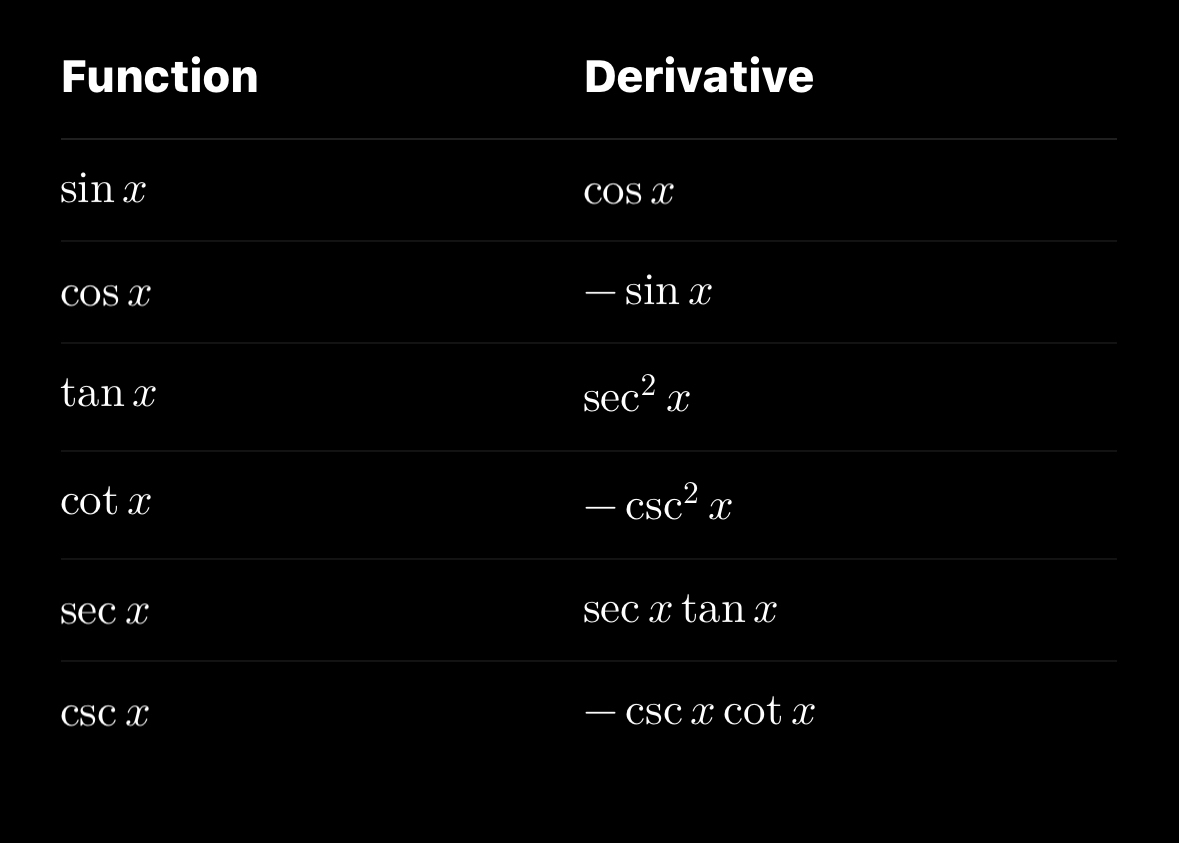
6. Trig Derivatives (must memorize)
🟫
7. How to Remember dy/dx Steps (Implicit/Chain)
✅ Steps:
Differentiate both sides term by term
When you hit y, multiply by \frac{dy}{dx}
Collect all \frac{dy}{dx} terms on one side
Factor it out
Solve for \frac{dy}{dx}
Example:
x^2 + xy + y^2 = 7
Differentiate:
2x + (x\frac{dy}{dx} + y) + 2y\frac{dy}{dx} = 0
Combine:
(x + 2y)\frac{dy}{dx} = - (2x + y)
So,
\frac{dy}{dx} = \frac{-(2x + y)}{x + 2y}