The Unit Circle
Unit Circle Components
Angles are always expressed from the positive -axis, travelling in an anti-clockwise direction.
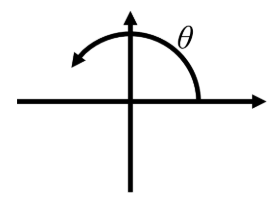
*A negative angle travels from the same position but in a clockwise direction.
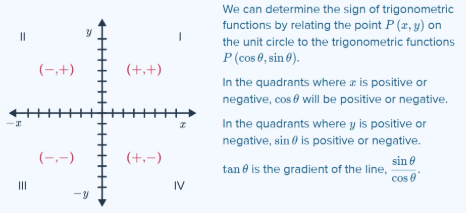
The quadrants are numbered using I, II, III, IV.
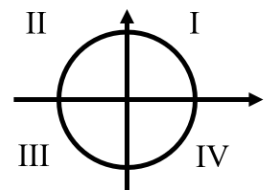
*Angles can be larger than 360°, and really there is no limit. It just begins a new cycle.
The Unit Circle
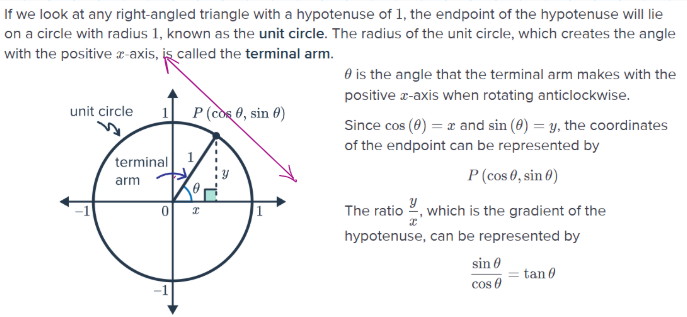
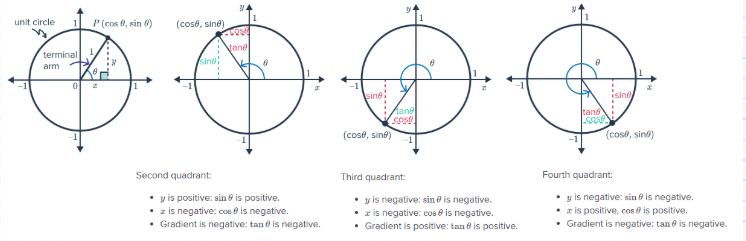
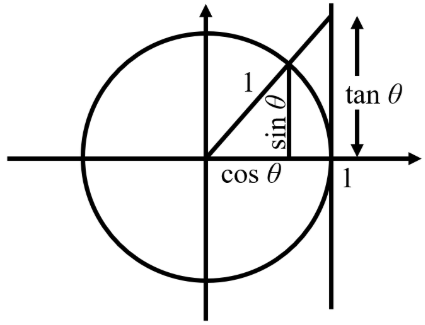
The sine of an angle is the vertical component of a ray.
The cosine of an angle is the horizontal component of a ray.
The tangent of an angle is the length a ray reaches along the tangent x=1.
The trigonometric ratios become:
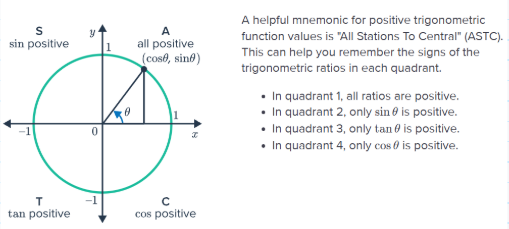
The Other Quadrants